The most expensive plumbing in Silicon Valley does not carry water. It carries customer names spelled four ways, invoices trapped in an old Oracle database, product codes living in SAP, and permissions nobody has reviewed since the regional office moved. Informatica has made a 32-year business out of turning that corporate debris into data a machine can use. In November 2025, Salesforce decided the cleanup crew was worth roughly $8 billion.
The logic looks obvious now that every software company is selling an AI agent. An agent asked to approve a refund cannot reason safely if “Jane Q. Public” in commerce, “J. Public” in support and customer 447192 in finance appear to be three people. A chatbot can produce a fluent answer from bad records. An autonomous system can produce a fast, expensive mistake. Informatica sits between those outcomes.
The deal that failed before it worked
Salesforce first approached Informatica in early 2024. The private merger record shows Informatica's board authorized exclusive talks on the premise of at least $35.75 per share. The market was hot, the stock had climbed, and Salesforce shareholders were in no mood for another enormous purchase after MuleSoft, Tableau and Slack. The companies could not agree on price. Talks stopped.
Then the balance changed. Informatica's stock lost roughly a third of its value. Its cloud business was accelerating, but the total company was not: 2024 revenue rose only 2.8 percent, renewals came in below forecast, and customers moving from maintenance contracts to the cloud retired old recurring revenue along the way. The transformation was working and making the reported numbers awkward at the same time.
Patience, priced per share
Salesforce returned in May 2025 with $25 in cash per share, an equity value of approximately $8 billion net of its existing investment. Informatica accepted. The first thing that failed was not technology or strategy; it was price. What changed their minds was a cheaper target and a more urgent product gap. Agentforce needed context from outside Salesforce, while Informatica owned connectors, lineage and metadata across the rest of the enterprise.
“You have to get your data right to get your AI right.”Marc Benioff, announcing the completed acquisition
What the machine behind the machine does
Informatica began in 1993 with a problem that sounds antique until you meet it in production: moving data from one system into another without mangling it. Its early PowerMart product helped define the extract-transform-load market. PowerCenter became the familiar boxes-and-arrows workbench inside banks, drug companies, manufacturers and government departments. The interface could look staid. The workloads were not. Payroll, orders, risk reports and customer records moved through it.
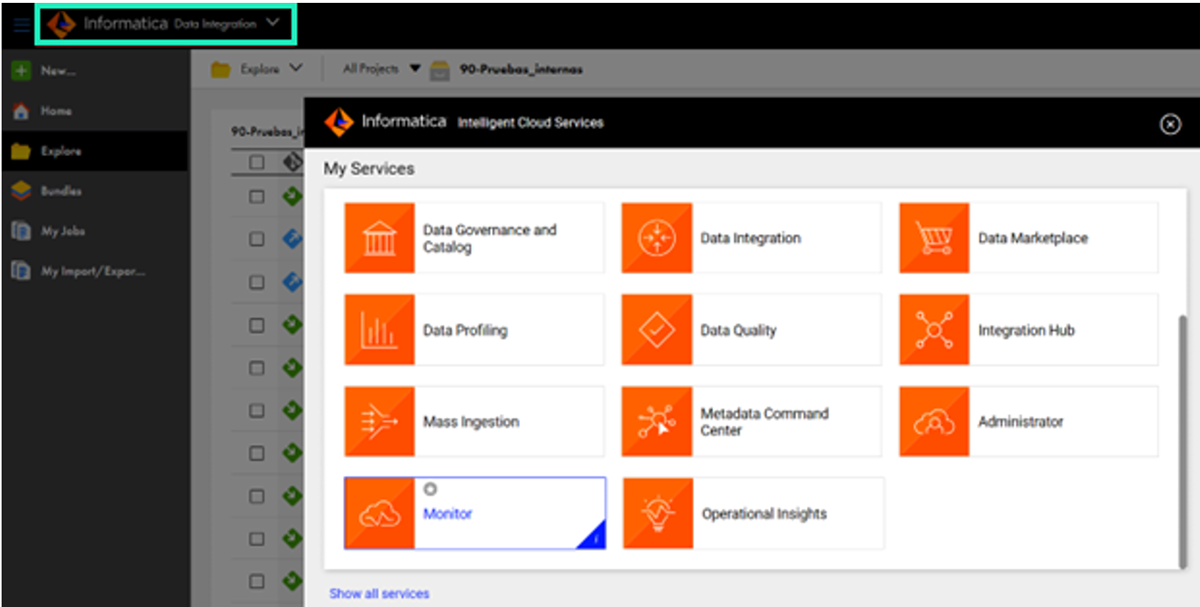
The current product is the Intelligent Data Management Cloud, or IDMC. Calling it one product understates the sprawl. It integrates batch and real-time data, inventories assets in a catalog, traces lineage, applies quality rules, watches pipelines, governs access, masks private fields, synchronizes applications, creates master records and publishes trusted datasets in a marketplace. CLAIRE, its AI layer, uses the metadata generated by those activities to recommend mappings, describe assets and automate repetitive work.
Reach the systems
Databases, apps, files, clouds and old on-premises estates.
Map the meaning
Catalog assets, trace lineage and capture business definitions.
Build trust
Match identities, cleanse records and enforce quality rules.
Serve the work
Send governed context to analytics, apps and AI agents.
That breadth is the difference from a point tool. Collibra and Alation are common catalog-and-governance alternatives. Talend, IBM, Oracle and cloud-native services compete in integration. Reltio and SAP meet Informatica in master data. Microsoft, AWS, Google Cloud, Snowflake and Databricks increasingly bundle adjacent capabilities. Informatica's argument is that one metadata foundation can connect the jobs across vendors and clouds. The obvious counterargument is that buying the whole workshop is expensive when you need one wrench.
A cloud migration with the engine running
Amit Walia, who became chief executive in 2020, pushed Informatica toward a cloud-only, consumption-driven strategy. Customers buy Informatica Processing Units and spend them across IDMC services. This lets an enterprise begin with integration and later use the same pool for quality or governance. It also asks long-time PowerCenter users to leave infrastructure they know, retrain teams and translate years of mappings into a metered cloud service.
The transition extracted a price. Informatica moved PowerCenter 10.4 from general to premium extended support in 2024. It restructured the company, reduced staff and shrank office space. In its 2024 results, management acknowledged weaker-than-expected renewals, lower net-new cloud bookings and more old maintenance revenue disappearing after migrations. Cloud subscription ARR still climbed 34 percent to $827 million, with a 124 percent cloud net retention rate. The old engine was losing fuel while the replacement gained speed.

Who pays for this - and what they get
The buyer is usually a large organization with a messy, mixed estate and consequences for getting data wrong. Informatica says it serves approximately 5,000 customers in nearly 100 countries, including more than 80 of the Fortune 100. Financial services firms use it to identify customers and satisfy controls. Manufacturers reconcile product and supplier records. Healthcare and life-sciences companies govern sensitive information. Retailers try to recognize the same shopper across stores, sites and service desks.
This also explains the business model. The platform is sold as enterprise subscription software, with professional services and older maintenance contracts still contributing revenue. Consumption pricing lets a customer shift processing capacity among integration, quality and governance services, but it can make a bill harder to predict than a simple seat license. The economic case gets better when one metadata layer replaces several point products, or when automation removes recurring manual work. It gets worse when a company buys the broad platform and deploys only one narrow service. Shelfware is still shelfware, even when the shelf is in the cloud.
Citizens Bank is a useful example because the architecture matters more than the testimonial. The bank put Informatica's cloud master-data service on AWS behind an API layer it controlled. That abstraction allowed internal applications to ask for a customer identity without caring how the underlying MDM worked. Citizens reported roughly 85 percent faster data onboarding, near-real-time recognition and 99.95 percent uptime. The copyable move is not “buy Informatica.” It is “hide the vendor behind stable interfaces, and make the trusted record a service.”
Schneider Electric uses cloud MDM on AWS to handle hundreds of millions of records as its asset volume grows around 11 percent annually. RS Group selected Informatica after evaluating MDM vendors because it needed breadth across an estate that included AWS, Azure, Oracle and SAP. These are Informatica-shaped problems: many systems, many countries, long time horizons and enough operational risk to justify central governance.
Copy the discipline, not automatically the stack
It works whenYou have many clouds and legacy systems, regulated data, duplicate identities, multiple technical and business teams, and enough recurring work to benefit from shared metadata and automation.
It does not work whenYour stack is small, your sources are clean, your engineers prefer code-first tools, or the governance program lacks owners. A platform cannot settle definitions nobody agrees to own.
Salesforce bought the context, not the connectors
Salesforce already owned MuleSoft for application integration and Tableau for analytics. The missing piece was a broader system of understanding. A Salesforce object describes the relationships inside Salesforce. Informatica's metadata reaches into SAP, Workday, Oracle, warehouses, lakes and custom systems, recording where a field came from, what transformed it and who may use it. That context can ground Agentforce beyond the CRM boundary.
In 2026, the product direction became explicit. Informatica introduced headless data management, exposing governed IDMC capabilities through APIs and Model Context Protocol. CLAIRE agents can generate quality rules, enrich catalog entries and orchestrate integration work. A developer can invoke those services from tools such as Claude, Cursor or Slack rather than live inside an Informatica screen. The old plumbing is becoming callable.
The strategic risk is neutrality. Walia called Informatica the “Switzerland” of AI-powered data management. That positioning helped it partner deeply with AWS, Microsoft, Google Cloud, Oracle, Snowflake and Databricks. Salesforce says those relationships will continue, and 2026 releases expanded Google Cloud and Databricks integrations. Still, every partner now knows the neutral layer has an owner with its own data cloud, integration suite and agent ambitions.
That is the bet inside the $8 billion price. Salesforce is betting that enterprise AI will not be won by the model with the cleverest demo. It will be won by the system that can tell an agent which Jane Public is real, whether her address is current, who may see her balance and what happened to the number between the source and the screen. Informatica has been answering versions of those questions since 1993. The fashionable interface changes. The mess underneath keeps renewing.