The awkward part of a medical appointment often arrives after it is over. There is a new prescription, a follow-up to arrange, a question that seemed too small to ask until the bus ride home. The clinician has moved on to the next patient. The previous patient has moved into a much less organized institution: everyday life.
Wellframe was built for that interval. Its premise is modest enough to be interesting: health plans already have people who can help. Make those people easier to reach, and give them a clearer view of what happens between visits. The phone becomes a doorway to a care team, with a checklist attached.
- Health plans buy the platform; eligible members use the app for free.
- Members get secure chat, reminders and personalized daily tasks.
- Care teams get dashboards and information for follow-up.
- Customer accounts put staff training at the center of adoption.
A daily checklist with someone behind it
The member-facing experience is deliberately ordinary. Read an article. Answer a question. Remember a medication. Send a message. Track progress. Wellframe turns the diffuse business of managing health into tasks small enough to fit into a day. Its member guide describes direct access to a plan’s care team, which can include nurses, dietitians, social workers and community health workers.
On the other side, staff use a dashboard to follow members and respond. An assessment can supply information before a conversation begins. A message can reveal a problem that a scheduled call would miss. The useful ingredient is the relationship surrounding the task; a reminder has somewhere to lead when the person receiving it needs help.
A small screen.
A real conversation.
Secure messaging connects members to their health-plan care team.
Company-published interface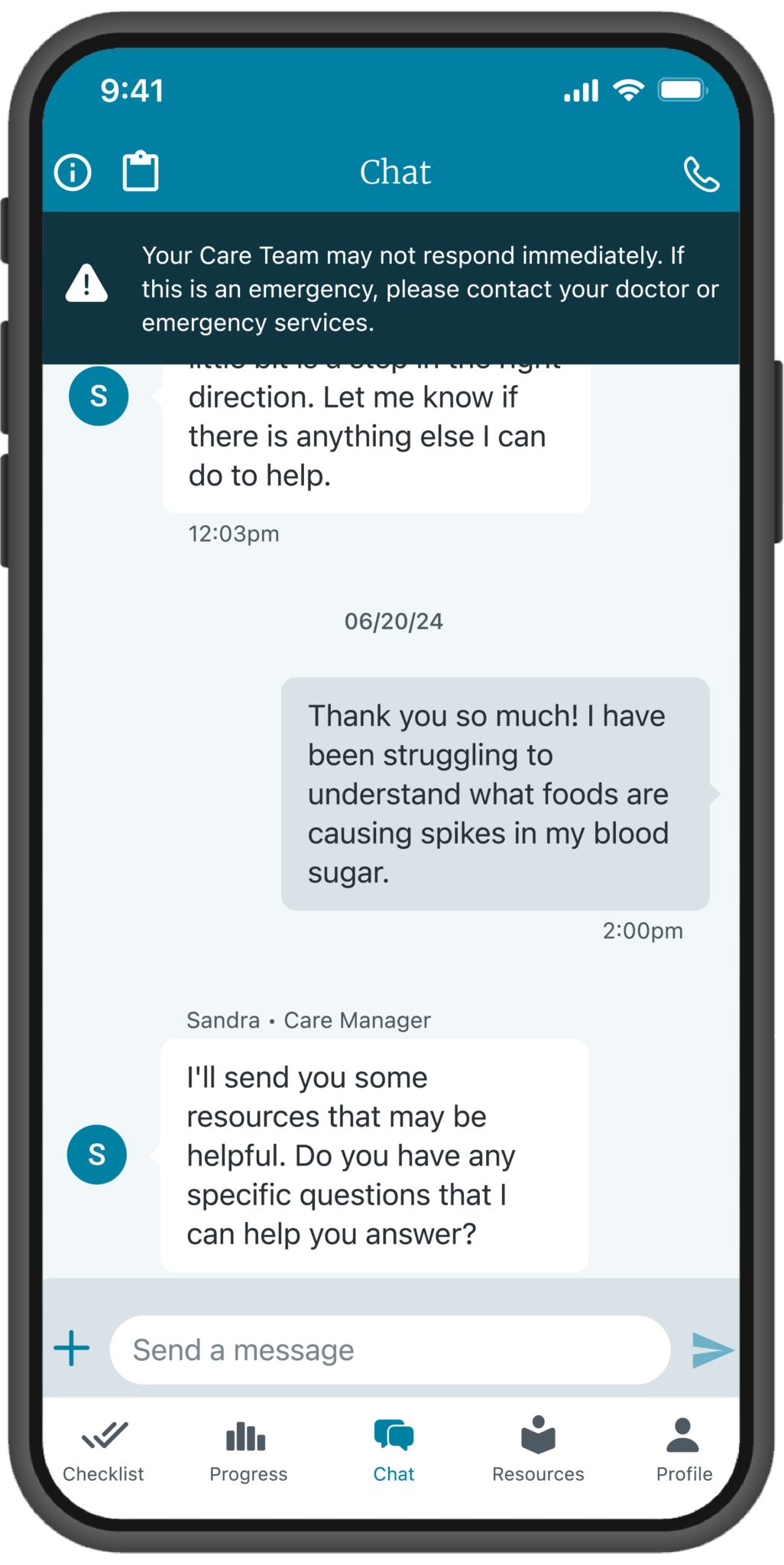
The first obstacle was getting paid
Wellframe started in 2011 with four founders: Jacob Sattelmair, Trishan Panch, Vinnie Ramesh and Archit Bhise. Their backgrounds brought public health, medicine and computing together. In a 2020 interview, Sattelmair said the enterprise began with a mission rather than an ambition to become a business. The founders came to see a for-profit company as a way to accelerate that work.
That decision did not produce instant demand. In a later founder interview, Sattelmair characterized the first three to four years as lacking commercial traction. It is a revealing admission from a software company: recognizing a worthwhile problem and persuading an institution to pay for its solution are separate accomplishments.
By 2019, the customer relationship had acquired an unusual wrinkle. Several clients invested in Wellframe’s $20 million Series C, alongside established venture investors. A health plan was no longer simply ordering software; some were financing the supplier. That alignment helps explain the company’s emphasis on continuing partnership, rather than an app handed over at launch.
The nurses had to change their day
The constraint was not always the member’s enthusiasm. A health plan could buy digital communication and still organize its staff around yesterday’s telephone routines. Wellframe’s case study of one unnamed Blues plan describes three connected jobs: build a digital roadmap, educate staff and create an environment in which people actually adopt the tools.
Named customers supply a more concrete picture. In HealthEdge’s March 2025 account, Blue Cross Blue Shield of Michigan described using early adopters to help colleagues learn new workflows. Training continued, and staff feedback informed adjustments. Nebraska described continuity when a care manager was unavailable, with another staff member able to pick up the conversation.
“We needed another way”Michelle Fullerton, Blue Cross Blue Shield of Michigan, in HealthEdge’s customer account
Michigan reported moving from four or five interventions per case to 20-40. That is a customer-reported experience, with its own circumstances. The broader lesson is practical: putting a chat button on a screen changes expectations. Someone must own the response, and information must reach the systems where that person works.
- 01Member question
- 02Care-team review
- 03Personal guidance
- 04Daily follow-through
A useful number needs a clock
The financial argument is more demanding than the messaging demonstration. A 2021 Journal of Medical Economics paper evaluated digital care management at one U.S. payer using propensity matching and bootstrapping. It reported 9% lower emergency-room utilization, 17% lower inpatient admissions and 29% higher preventive-service utilization.
Observational findings over a three-month evaluation. Results are specific to the studied population.
The researchers estimated $641 in savings per member per month at three months, using that payer’s payment structure. The company’s case study expressed the three-month total as $1,923. Those numbers are estimates tied to a population, a period and a pricing system. Several authors worked for Wellframe. The analysis was observational, rather than a randomized trial; it should inform a buying decision without becoming a guarantee.
A separate cardiac rehabilitation study associated adjunctive mobile technology with greater attendance and program completion. Its patients still attended rehabilitation. The app supported the work already happening around them.
The buyer behind the free app
Wellframe’s business runs through health plans, selling enterprise software and implementation support. The app is free to members through participating organizations, which determine access. Members generally need an access code and insurance information to enroll. That arrangement gives the product a ready-made route to people managing chronic conditions, recovering after hospital care or needing maternity and behavioral health support.
Buckeye Health Plan, for example, offers Wellframe across maternity, chronic care and behavioral health programs. Blue KC’s member guide describes a branded care-management app powered by Wellframe. The technology can sit behind the insurer’s own identity, where the member already has a relationship.

Its alternatives include telephone-based care management, member portals and apps focused on single conditions. Wellframe’s position is ongoing engagement tied to health-plan staff across many care needs. Integration with existing teams is central to its pitch.
HealthEdge completed its acquisition in December 2021. The purchase connected member engagement to a larger health-plan software portfolio. Today’s Care-Wellframe integration links the member experience with GuidingCare workflows. A March 2026 data sheet describes more than 70 care programs, digital assessments and multiple communication channels.
Copy the route to a real person
For another organization, the transferable idea is to connect the question, the responsible person and the next action. Choose staff champions. Train around actual work. Keep information moving. Measure what changes for a defined population. The elegant screen earns its place when those arrangements hold.
For a member, usefulness depends on eligibility, access to the technology and a care team able to respond. A health plan with fragmented records or no capacity to manage incoming questions has more work ahead. Wellframe’s story makes that operational burden visible. The appointment may end, but someone still has to answer the question on the bus ride home.