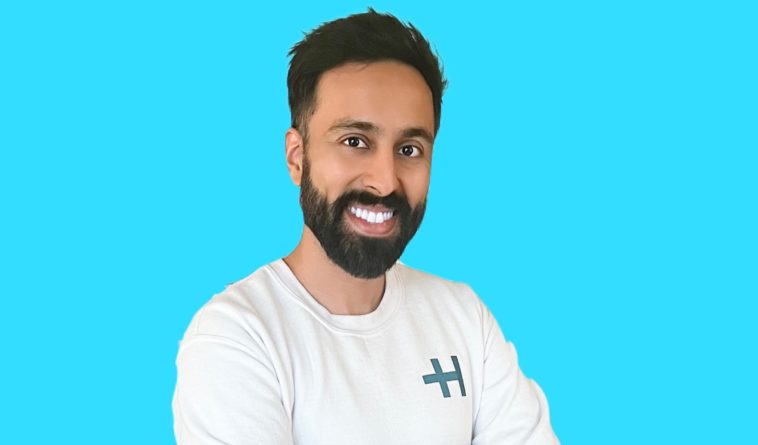
He showed up to Stanford's MBA program in 2010 with the standard plan: meet people, get the credential, figure out the rest. Then HealthTap's founders walked in. He never finished the degree in the conventional sense. He joined as a founding member instead - and spent the next 11 years building what would become one of the largest virtual primary care platforms in the United States.
That is the Sean Mehra move: pivot hard when the opportunity is right, then stay longer than anyone expects. He did it at Yale, where pre-med plans dissolved once he discovered that software could treat more patients in a week than a clinic could see in a year. He did it again after Yale, turning a campus war game into a business, then turning that business into the seed of what is now TSAI City - Yale's official entrepreneurship incubator. And he did it at HealthTap, cycling through Chief Product Officer, Chief Operating Officer, and finally CEO, each role a tighter grip on the machine he helped invent.
"As a driver of our product, strategy, and commercialization efforts since the company's inception, I intimately understand the uniquely powerful suite of technology and operational capabilities we've developed."- Sean Mehra, on his appointment as CEO, June 2021
The Yale-to-Stanford Arc
Mehra graduated from Yale with a B.S. in Biomedical Engineering and Pre-Medicine - with Distinction, the kind of academic detail that trails a person for decades. He planned to be a doctor. Somewhere between Yale and Stanford, a trip to India interrupted that plan. Watching how healthcare was rationed - by geography, by money, by access - he reached the conclusion that a well-designed platform could do more than any individual clinician ever could. Technology as leverage, not as replacement.
At Yale, he had already acted on that instinct. GoCrossCampus, the team-based territory game he co-built with Brad Hargreaves and Jeff Reitman, spread virally across university campuses - hundreds of thousands of students playing simultaneously, millions touched. GXStudios, the company behind it, was one of the first to emerge from the Yale Entrepreneurial Institute, an incubator that Mehra, Hargreaves, and Reitman co-founded. That institute is now TSAI City, the official entrepreneurship hub of Yale University.
Between GXStudios and HealthTap came PayoutHub, a social game-monetization platform he founded and later sold. The pattern was clear: build fast, build for scale, exit if necessary, re-enter at the next level.
"Life is about the journey, not the destination. Money and glory may be side effects, but they often aren't sufficient as primary motivators."- Sean Mehra
Building the Doctor Everyone Deserves
HealthTap launched in 2010 with a simple, radical premise: put a board-certified doctor's answer within reach of anyone with a phone. Mehra came in as Chief Product Officer. Over seven years in that role, the company scaled from private beta to $85 million in financing and eight-figure annual revenue, with over 350 million consumers served. Those numbers were built on one specific insight: roughly 25 percent of Americans have no primary care physician. Not because they don't want one - because the system makes it too expensive, too slow, or too geographically impossible to get one.
Mehra's product philosophy reflected that. HealthTap is not a luxury telemedicine app for the already-insured. It is priced for the cash-pay market, built for the underinsured, and now accepts Medicare across all 50 states. The subscription model the company developed achieves retention measured in years, not months - which is what happens when a virtual clinic actually functions like a primary care relationship instead of an Uber for prescriptions.
"We're in the business of delivering true primary care. What that means simply is you get to choose and then keep one doctor - hopefully for the rest of your life - whom you love."- Sean Mehra
Becoming CEO Mid-Pandemic
The COVID-19 pandemic did something unusual for healthcare technology: it forced consumers to actually use it. Virtual care visits spiked, and platforms that had spent years building infrastructure suddenly found themselves at the center of American medicine. Mehra, by then serving as COO, was appointed CEO and Board Member in June 2021 - a signal not just of internal succession but of strategic re-direction. HealthTap would pivot its focus from urgent care toward something stickier and more clinically meaningful: ongoing virtual primary care.
The shift showed up in the metrics quickly. Monthly active users hit 2 million. Fifteen percent of visits began occurring within HealthTap's virtual primary care clinic - longer relationships, deeper records, more trust. The business that had positioned itself as "a doctor in your pocket" was becoming something closer to an actual medical practice, minus the waiting room.
"The biggest challenge HealthTap has faced is how to sell virtual care to Americans profitably in a world where most are cash pay."- Sean Mehra
Dr.A.I. and the Case for Cautious AI
When large language models became viable consumer technology, most health tech executives either overclaimed or went quiet. Mehra did neither. HealthTap launched Dr.A.I. - an LLM-powered pre-visit patient interview system - with what he described as a deliberately non-controversial scope. The system automates the intake questionnaire patients typically fill out before an appointment, replacing a clipboard with a conversation.
It is not diagnosing. It is not prescribing. But it is generating structured clinical data faster and more consistently than paper forms, and Mehra has pointed to real-world results as the measure. His logic: prove safety in a low-stakes clinical context first, earn trust with physicians, then expand. In an industry full of AI announcements built on demos, HealthTap shipped a system built on data.
"We saw a very safe and useful application of LLM out the gate and quickly launched it and have real-world data to show that it works really well. The use case we took on was non-controversial, clinically, legally and operationally: the pre-visit patient interview."- Sean Mehra on Dr.A.I.
Samsung, Commure, and the Distribution Problem
The final riddle of virtual primary care is not clinical - it is a distribution problem. How do you get patients to choose a virtual doctor before they are already sick? Mehra's answer in 2025 has been partnerships that embed HealthTap where Americans already are. In October 2025, Samsung Health and HealthTap announced a virtual primary care integration, placing HealthTap visits inside an app with 7 million monthly active US users. Sleep data, activity rings, and biometric readings - all the information Samsung Health collects - can now feed directly into a HealthTap consultation.
In April 2025, Commure and HealthTap announced a partnership to bridge the virtual-to-in-person gap. Commure brings EHR integrations and AI-powered care coordination; HealthTap brings the clinician network. The combined offer lets healthcare organizations deploy virtual primary care doctors to their patient populations without building the infrastructure themselves. Mehra's framing was precise: "providers can now think of virtual care beyond just a bolt-on urgent care or triage service."
That sentence is a strategy. Bolt-on urgent care is transactional. Longitudinal primary care is relational. One produces revenue; the other produces retention. Mehra has spent fifteen years positioning HealthTap to own the relational half of the equation, and 2025's partnerships are the distribution pipes to prove it at scale.
The Inventor Behind the Operator
Beneath the CEO biography is something less obvious: Mehra holds multiple honors and inventions spanning health informatics, artificial intelligence, drug delivery, genetic testing, medical devices, and industrial polymers. The biomedical engineering degree was not decorative. His CTO at HealthTap came from Apple's iPhone camera team - a reminder that HealthTap's product decisions reflect an unusual blending of consumer hardware sensibility with clinical rigor.
He advises startups through Stanford's Center for Entrepreneurial Studies and TSAI City at Yale - two institutions with which he has a founder's relationship, not just an alumnus's. That puts him in the room with the next generation of health tech builders at exactly the moment when the infrastructure he spent fifteen years constructing is becoming the obvious base layer to build on.
"Google's health-related searches average 70,000 per minute, so we tailor our marketing strategies to reach our consumers where they are - online."- Sean Mehra