A power station can exist twice. First as a model, where an instructor can stop time, reset the machinery, and ask an operator to try again. Later as an actual plant, where the same decisions carry rather different consequences. GSE Solutions makes its living in the distance between those two versions of reality.
That distance is becoming interesting again. New reactor designs need testing. Existing plants need modern controls. Students need somewhere to learn how a reactor behaves before anyone entrusts them with one. The common requirement is a place where a difficult question can produce useful evidence without becoming a field experiment.
- The work: plant simulators, engineering, training, performance analysis, and compliance support.
- The buyers: utilities, reactor developers, and teaching institutions, including Rolls-Royce SMR, NuScale, and Lancaster University.
- The economics: bespoke projects and software, with long customer relationships and exposure to slipping schedules.
- The next chapter: private ownership, the Iddeal acquisition, and an announced AI collaboration with Nuclearn.
The power station before the power station
In July 2024, Rolls-Royce SMR selected GSE to develop a power-station simulator. The announcement put the contract at $1.5 million. Its purpose was to help develop, verify, and validate the performance and control systems of the proposed factory-built nuclear plant. A simulator was therefore part of the engineering program before there was a commercial station to operate.
David Dodd, then identified as Rolls-Royce SMR’s engineering director, described the work as part of its “digital-first” methodology. The phrase earns its keep here. A dynamic model lets engineers examine how systems respond together, over time. Equipment sizing, control logic, interfaces, and operating procedures become questions to test rather than assumptions to admire.
GSE’s engineering-simulator materials make that distinction explicit: simulation can support design, human-factors work, procedure testing, and operator preparation before commissioning. Its listed first-of-a-kind projects include AP1000, PBMR, NuScale, and mPower. Those names describe assignments and experience; they do not establish that every proposed reactor became a commercial success.
Rolls-Royce SMR simulator contract. A project price, not a price tag for every virtual reactor.
A rewind button, built on physics
The amusing feature is the rewind button. GSE’s JStation instructor software can freeze a simulation, reset initial conditions, backtrack, and introduce equipment malfunctions. An instructor can return a trainee to the point where the situation became confusing. The machinery is simulated; the opportunity to examine a decision is real.
Underneath that convenience sits a collection of engineering tools. JADE, the Java Application & Development Environment, includes JTopMeret for thermal-hydraulic modeling, JControl for control logic, and JElectric for electrical networks. They model the interactions a convincing control-room exercise needs. A handsome screen with an implausible plant behind it would make a poor teacher.

Nor is every customer buying an exact replica. GSE’s Generic Combined Cycle simulator models a gas turbine, a heat-recovery steam generator, and a steam turbine. Ten preconfigured self-paced procedures take learners through operations such as startup. The company offers classroom and cloud delivery, widening access to a model without commissioning a separate custom plant for each student.
That distinction matters commercially. Generic simulation serves learning objectives shared across plants. A plant-specific simulator serves questions about a particular configuration. Buyers need to decide which question they are paying to answer before choosing how much fidelity to purchase.
and controls
and procedures
and judgment
as-built plant
The customer relationship that keeps changing
One GSE utility case study begins with simulators built in 1982. Decades later, the relationship included additional full-scope simulators, instructor training, inspection and testing programs, and balance-of-plant services. GSE also describes updating models and integrating advanced reactor controls to reflect the final as-built design. The customer is unnamed, but the scope is unusually concrete.
Here is the business model hiding inside the chronology. A plant changes. Its training environment must follow. New equipment, revised procedures, and different controls create further engineering work. GSE sells system design and construction, software, training, and consulting; the simulator can become the beginning of a relationship that extends into other plant needs.
Its broader capabilities include design reviews, licensing-impact studies, factory acceptance testing, field support, and post-modification testing. Thermal performance work addresses efficiency and measurement; engineering programs address inspections and regulatory requirements. The company’s stated mission connects these activities to dependable energy and decarbonization. Its practical role is to help the people responsible for a facility make it operate better.
This puts GSE between industrial software and specialist engineering services. CORYS offers competing nuclear training and engineering simulation, so realism alone is no exclusive claim. GSE’s proposition is the combination of its modeling tools, plant knowledge, and services around the model. Whether that combination is useful depends on the assignment, the existing systems, and the customer’s own engineering capacity.
The calendar was harder to simulate
A long technical pedigree does not make a project business immune to waiting. GSE reported $45.041 million in revenue for 2023. In the second quarter of 2024, revenue was $11.7 million, with a net loss of approximately $0.9 million. Workforce revenue fell as major customers reduced staffing needs. Management also described project timing slipping later.
Those disclosures locate the visible pressure in customer demand and schedules. The same quarter produced positive adjusted EBITDA, a separate non-GAAP measure, alongside the net loss. Neither figure should be asked to impersonate the other. A company can improve project execution while still facing the costs of a slow-moving order calendar.
Pelican Energy Partners agreed to buy GSE that August. The original $4.10 cash offer per common share rose to $4.60 in October; the amended announcement also disclosed a third party’s nonbinding expression of interest. Shareholders approved the merger, and its completion was announced on November 1, 2024. GSE became private.
Management had called the transaction beneficial given the industry cycle. Pelican’s announced rationale emphasized investment and growth flexibility under private ownership. The record supports those stated reasons. It does not require an invented boardroom revelation to make the change consequential.
Private ownership, more inspection software
The next substantial addition was decidedly practical. In January 2026, GSE announced the acquisition of Iddeal, bringing enterprise software, on-site support, training, and engineering-program services. The specialty includes ASME inservice inspection and testing programs: the organized, continuing work of checking equipment against defined requirements.
The IDDEAL Software Suite connects requirements, regulations, plant components, and examination programs to scheduling and tracking. Consider what that adds to a simulator company. One product helps teams understand how a plant behaves. Another helps them organize what must be examined, when, and under which rules. GSE is broadening the work it can perform around an operating fleet.
Education provides another route into the market. Lancaster University opened its nuclear operations simulator facility in June 2026 with a £2 million Office for Students grant. The facility uses software from several suppliers, including GSE. That sum funded the university facility; it is not GSE’s contract value. GSE identifies its contribution as a Generic Pressurized Water Reactor simulator.
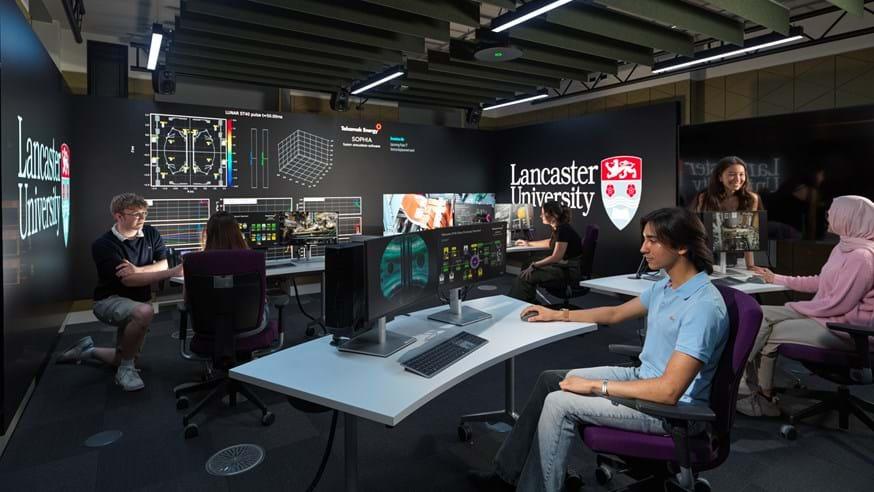
Earlier, GSE supplied technology for three NuScale Energy Exploration Centers, working on a custom interface between the models and the operator. In June 2026, Hadron Energy selected GSE for the training simulator for its proposed Halo micro-modular reactor. Teaching, engineering development, and preparation for future operations are distinct markets, linked by the need to make plant behavior visible.
AI comes to the rehearsal room
In August 2026, GSE and Nuclearn announced a collaboration with two streams. GSE plans to add AI-assisted scenario authoring, performance summaries, adaptive assessments, and plant-specific explanations to its simulation products. Nuclearn plans tools informed by simulator access and data, including scenario exploration and an engineering-modification sandbox.
These are announced capabilities, not proof of measured training improvements. GSE CEO Ravi Khanna emphasized validated training, traceability, repeatability, and alignment with approved procedures. An explanation that sounds persuasive still needs to correspond to the plant. The simulator is valuable precisely because its responses can be examined.
“validated, repeatable, traceable, and aligned with approved plant procedures”
Ravi Khanna · GSE President & CEO · August 2026
Borrow the rehearsal, respect its limits
The transferable lesson is to test handoffs early. Put the control strategy, the procedure, and the person into the same exercise. Examine the response. Revise the design or instruction. Then keep the model current as the real system changes. That sequence is useful far beyond electricity generation.
Its limits follow from the same logic. A generic teaching model cannot settle a question about a specific plant. An outdated configuration can produce reassuring answers to the wrong problem. Simulation needs appropriate scope, maintained assumptions, and qualified review; it does not confer regulatory approval by itself. The value lies in how carefully the rehearsal represents the decision.
GSE’s place in the energy market is therefore quite tangible. It supplies software and expertise to people building, changing, teaching, and operating complex plants. The attraction is a chance to encounter an awkward surprise while there is still time to pause the exercise and do something about it.
Step into the simulator
Explore GSE’s website, its simulation portfolio, and combined-cycle training tools. Follow LinkedIn, X, or Facebook.
Read about the Rolls-Royce SMR project, Nuclearn collaboration, and GSE’s engineering articles.