A North Sea platform is a city squeezed into steel. Pipes cross behind cable trays; yesterday's modification complicates tomorrow's repair; saltwater keeps working while the paperwork sleeps. When somebody spots corrosion, the least interesting part of the job is admiring a photorealistic model. The useful questions are blunt: Where exactly is it? How bad is it? Who owns the next decision? Can a replacement fit first time?
GDi, the Aberdeen business now owned by Oceaneering, has built its proposition around those questions. Its Vision software collects laser scans, dense photography, 3D models, drawings, inspection findings and remedial tasks in one cloud environment. Around that product sits a surprisingly physical business: surveyors capture the plant, accredited inspectors assess its condition, engineers design the remedy, fabrication partners make it and rope-access crews can help install it.
That combination puts GDi in an awkward but valuable gap. It is not simply a software vendor selling licences to people who must untangle implementation themselves. It is not simply an engineering contractor delivering another PDF into another folder. The company is trying to own the continuity between finding a problem and closing the work.
Born when the easy money disappeared
Global Design Innovation was incorporated in August 2016, during the bruising oil-price downturn that forced North Sea suppliers to defend every offshore hour. A regional industry directory describes the young company's starting point as a pioneering approach to engineering repairs and modifications. That origin helps explain the product's temperament. Vision was not conceived as a metaverse for machinery. It grew beside the stubborn business of measuring pipework, defining scope and producing a design somebody could build.
The team that formed around it spans disciplines that software companies often treat as customer personas on a slide: engineering surveyors, inspection specialists, piping and structural designers, project managers, developers and field crews. GDi's public careers language is conventional - expertise, dedication, innovation - but the composition is revealing. A feature is tested against a job, and a job can expose what the software still lacks. The company now advertises 24-hour engineering response where required and uses partially automated modelling tools for tie-ins and repair orders.
This makes GDi a hybrid by design. Software creates repeatability and a shared record; services get the messy first deployment done. The tension is real: services are harder to scale than a pure licence business, while software platforms dislike one-off exceptions. Yet industrial assets are mostly one-off exceptions welded together. GDi's answer is to standardise the route through the mess, not pretend the mess has vanished.
The model is only the map
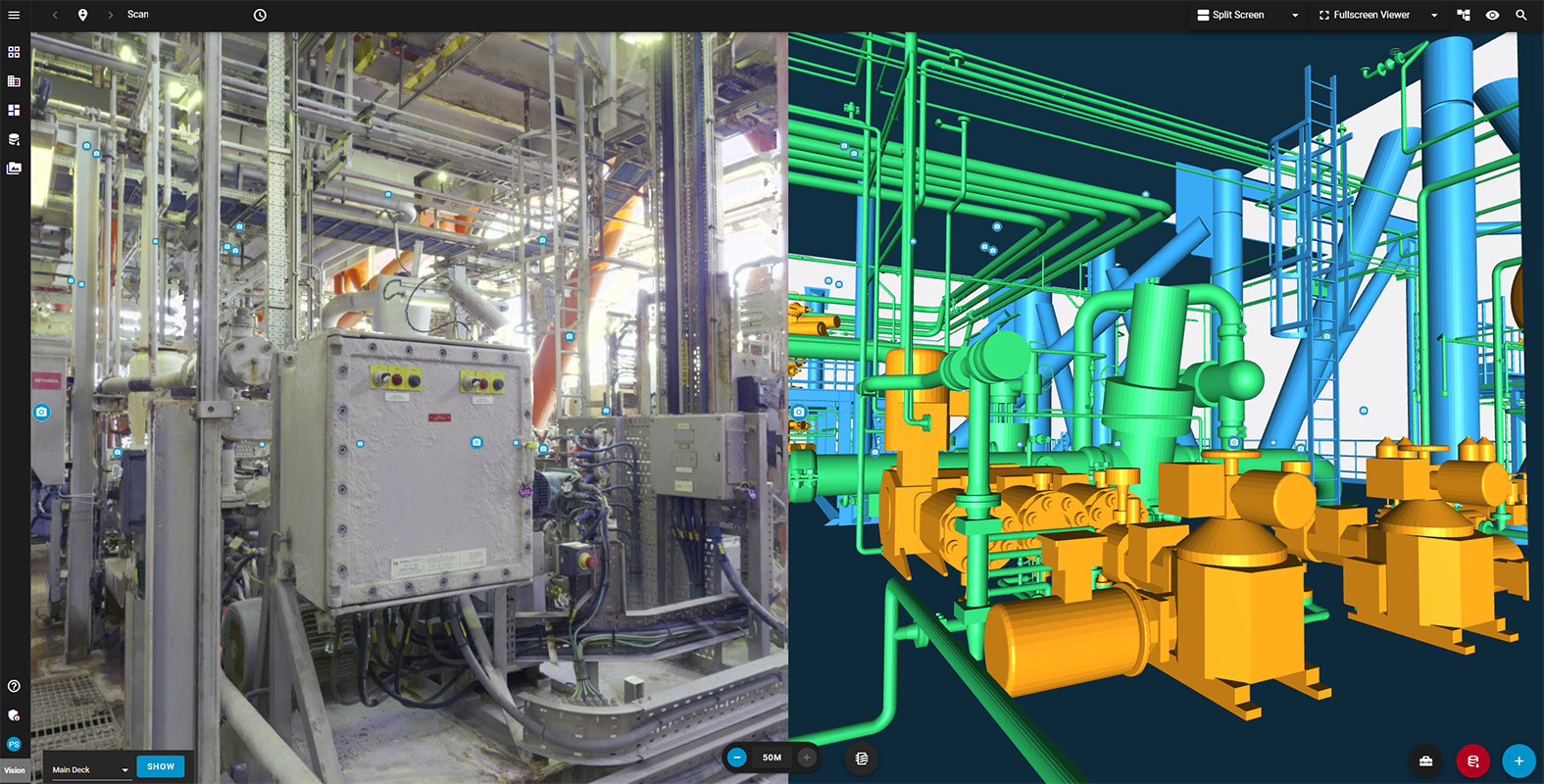
Vision is sold as a single source of truth, a phrase enterprise software has nearly worn smooth. Here it has a concrete meaning. A user can move through a digital representation of a facility, open site photographs and video, locate test points, mark anomalies, compare imagery over time and track remedial work. Integration matters because operators already have maintenance, integrity and planning systems. The twin earns its keep when data can travel in and out without a human retyping coordinates and descriptions.
The 2025 Triton FPSO case is a neat example. Dana Petroleum's integrity team used Xodus's XAMIN platform while the offshore construction team used Vision. The two systems belonged to adjacent parts of the same job but lived in separate lanes. GDi and Xodus built a bidirectional bridge, giving planners geolocated integrity information and sending status back. It reduced manual transfer, the dull clerical seam where errors breed.
GDi's newest product work makes that philosophy visible. An inspection planner can isolate equipment in a 3D view, set the angle, populate test points, arrange annotations and export an inspection-ready isometric image. This is niche software in the best sense: it removes a particular bout of manual drafting from a job that happens repeatedly.
COVID made remote work operational, not optional
The best public proof comes from Serica Energy's Bruce facilities: three platforms joined by two bridges in the northern North Sea. GDi laser-scanned the complex and loaded high-density imagery into Vision. Onshore staff could then inspect corrosion and wear, plan work and design replacement parts without automatically travelling offshore.
Timing sharpened the argument. During COVID-19, offshore bedspace and travel were constrained. Every person who could work from shore spared a flight, a bunk and exposure to a hazardous site. The reported result was up to a 25 percent reduction in inspection and manpower costs, alongside better accuracy and less operator error. It is a project claim, not a universal tariff, but it explains why the buyer cared.
“We are only scratching the surface as to what this technology can offer.”Clara Altobell · Serica Energy
The first thing that failed was not the physical plant. It was the old information chain. Inspection findings sat in checklists, photographs and condition descriptions. Drawings could lag the as-built reality. A designer might need another offshore visit simply to confirm dimensions. GDi's bet was that one rich capture could support many jobs: inspection now, engineering next month, training later, and a visual audit of change over years.
A repair order is the better demo
In a recent example published by the company, an engineering team received a request to redesign a pipe spool. Because point-cloud data already existed, nobody had to return to the site with a tape measure. Using Vision and GDi's Advanced Modeller, the team engineered, approved and issued the redesigned spool to fabrication on the day of the request. From request to delivery on the asset took 48 hours.
That little story reveals GDi's competitive logic better than a gallery of glossy renders. AVEVA, Bentley, Hexagon and Cognite offer broad industrial data and twin platforms. Specialist surveyors can produce excellent point clouds. Inspection vendors know defects; engineering houses know modifications. GDi bundles these disciplines around a working record, so the information does not lose context at every commercial handoff.
The scale gets comic quickly. GDi lists one FPSO dataset with 270 billion points and 324,000 high-dynamic-range images. Hoarding that volume would be digital landfill. The value comes from making it navigable and attaching decisions to places in the model. A point cloud is evidence of geometry; it is not, by itself, an asset-management system.
The certificate behind the pixels
Remote inspection has a trust problem. A convincing image is not automatically an inspection. The method, personnel, traceability and controls matter, particularly when the finding affects safety or production. GDi's UKAS schedule lists it as a Type C inspection body accredited to ISO/IEC 17020:2012 for visual and remote visual inspection within a defined non-destructive-testing scope.
That accreditation is a quieter differentiator than artificial intelligence, but a buyer can use it. GDi applies algorithms to help identify and classify corrosion and coating breakdown, then places the finding inside an inspection and anomaly-management process. Automation speeds the hunt; accountable inspection governs the answer.
The business model follows the workflow. Vision supplies the recurring cloud-software layer. Data capture, inspection, condition assessment and engineering arrive as expert services. Fabrication coordination and construction extend the chain into the physical world. Customers are large operators and service companies in oil and gas, utilities and power generation, with deployments extending beyond Britain to Australia and the Middle East.
Seven months from partner to owner
Oceaneering announced a strategic collaboration with GDi in March 2024. Its Integrity Management and Digital Solutions group would use Vision to streamline inspection and offer more remote support. In October, Oceaneering acquired the company. GDi kept its brand while gaining access to a global network serving offshore energy, defence, aerospace and manufacturing.
That fast courtship suggests the software filled a practical gap in Oceaneering's portfolio. Robots and inspectors can collect oceans of data; engineering teams can recommend work. Vision provides connective tissue, keeping geometry, condition and action in the same view. For GDi, the parent supplies reach and domain depth. For Oceaneering, GDi supplies a software product shaped by people who have had to make repairs fit.
What operators can copy
Begin with a costly decision, not a photorealistic model. Capture an asset once at sufficient quality, give every defect a precise location, connect findings to the systems that assign and close work, and measure avoided visits or shortened cycle time. Keep inspectors and engineers involved while the workflow is designed. The 3D interface is the front door; continuity is the product.
There are conditions. The method is strongest on large, complicated assets where access is expensive or risky and the same captured geometry can be reused. It weakens when the plant changes faster than its record is maintained, when imagery cannot reveal the relevant defect, when integrations remain one-way exports, or when teams have no agreed process for acting on findings. Remote visual work also does not replace every hands-on or subsurface inspection method. Good data does not repeal physics.
GDi's most useful lesson is almost anti-futurist. Industrial transformation rarely arrives as a hologram floating above a control room. It arrives when a planner stops copying a defect between systems; when an engineer trusts an existing measurement; when a crew brings the right spool the first time. The twin matters because the steel does.