At Lewis Press in Malta, a customer’s simple question could set somebody walking. Where was the job? Answering meant checking work in progress around the factory, a trip that could take 20 to 40 minutes. The machines were producing packaging. The information about that packaging required a pedestrian.
That small absurdity gets close to the business of ePS, short for eProductivity Software. Its customers make the cartons, labels, pouches, and corrugated boxes surrounding everyday commerce. ePS sells the systems that help those manufacturers decide what to make, what it costs, and what happens next.
- The job: connect estimates, materials, schedules, and the shop floor.
- The customer: packaging manufacturers with complicated production.
- The catch: automation needs accurate records and people who use them.
The filing cabinet fills up
When Lewis Press entered pharmaceutical printing in 2005, it had fewer than 20 employees. A filing cabinet could accommodate the paperwork. Growth brought more people, more cabinets, and information copied by hand between departments. Prepress cards and operations specifications described related work differently. Even carefully constructed spreadsheets left room for mistakes.
The useful distinction is between a machine problem and a coordination problem. Another press does little for a worker recopying a specification. ePS occupies that second territory: the administrative and operational connections through which a factory either gains time or quietly loses it.

Software that knows a changeover
Enterprise resource planning sounds abstract until a production run needs the right substrate, a particular die, and room on the finishing line. Radius, an ePS ERP product, handles estimates, orders, purchasing, inventory, and costing. PrintFlow 4D schedules production around constraints. Auto-Count 4D collects machine data so the plan can be compared with what actually happened.
In April 2026, ePS formally announced CommandCore, organizing its packaging offering around eight operational pillars. Those cover business planning, manufacturing execution, machine controls, workflows, scheduling, quality, sustainability, and supply coordination. The promise is a connected foundation with adoption in stages. A manufacturer can begin with the problem causing the most pain.
Actual production data feeds the next decision. Schematic, not a product screenshot.
Its competitive argument rests on packaging details: changeovers, roll materials, tooling, waste, and downstream capacity. Industry-specific rivals such as theurer.com C3 also address this territory. Buyers should compare how each system models their actual work. A lengthy feature list cannot tell you whether the scheduler understands your factory.
There is a corporate wrinkle. ePS became independent from EFI under private equity owner STG in an announcement dated January 2022. In October 2025, its Print ePS division merged with CAI Software. The packaging business continued independently. Pace, Avanti, and other commercial print names belong to that former print portfolio; today’s ePS story centers on packaging.
The day the schedule got shorter
Consider a Californian wine-label manufacturer described in an ePS case study. Acquisitions had increased its workload, and the team wanted centralized, automated scheduling. Demonstrations and customer discussions at ePS’s CONNECT event, alongside integration with its existing Radius system, helped it choose PrintFlow.
The manufacturer reported a 70% reduction in scheduling time, from eight hours daily to approximately two and a half. It also reported 50% fewer scheduling-related emails and meeting a target of eliminating at least one changeover per machine each week. These are one customer’s results, published by the vendor.
Daily scheduling time reported by the wine-label customer. The case study describes the reduction as 70%.
The revealing detail is who made it work. An internal Radius administration team governed data accuracy. A master scheduler pursued automation. The transferable lesson is practical: agree on trustworthy inputs, choose measurable targets, and give someone responsibility for changing the routine.
“The game changer for us was the automation capability that PrintFlow offered.”
Master Scheduler / wine-label customer
The price includes changing habits
At Lewis Press, moving from manual records to the Packaging Suite took five months. The work included capturing data and establishing coding conventions without a central database to import. That is a real implementation cost, measured in effort and elapsed time before anyone calculates a return.
ePS earns money through software licenses or subscriptions, maintenance, support, and professional services. Its published agreement separates services such as training and implementation from the software purchase. Unless the purchase documents say otherwise, term licenses and SaaS begin with a three-year term; annual recurring fees are payable in advance. Buyers need a project budget that includes their own people’s time.
Zumbiel Packaging offers another way to think about the payoff. In a follow-up customer account, IT director Barbara Powell describes a new business line generating approximately $2 million in annual sales. Better operational visibility supported diversification. That revenue belongs to Zumbiel, and software was part of the operating change. It is no promise about another factory’s return.
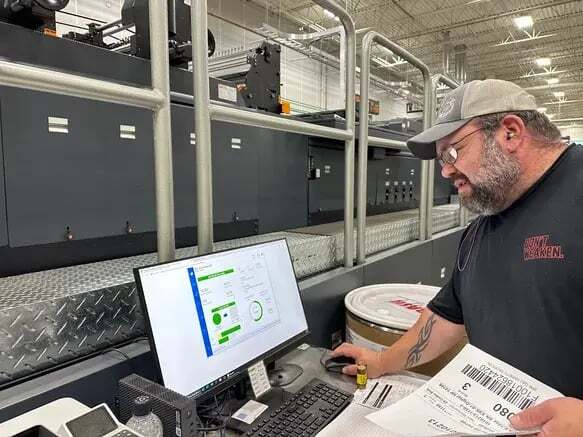
The same accounts suggest where benefits can stall. Inaccurate source data makes the resulting plan unreliable. Keeping scheduling manual leaves automation unused. A plant with those habits needs process work alongside software. Buying the capability is the beginning of the decision.
A job record with a longer memory
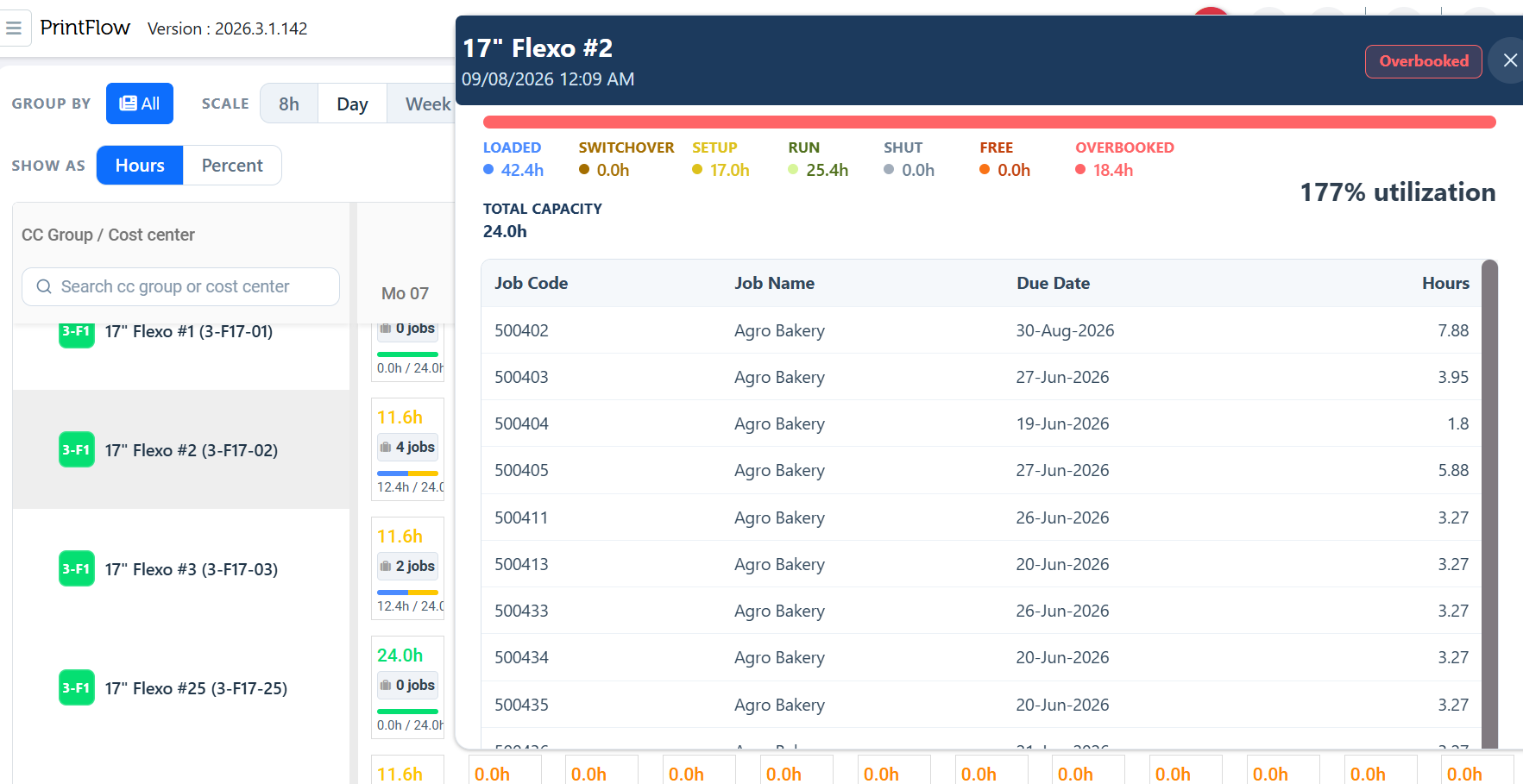
The product is moving toward more immediate decisions. September’s CommandCore 2026.3 release introduced conversational PackAI business intelligence in Radius and capacity views in PrintFlow 4D. A planner can inspect load and available hours; a business user can describe a dashboard in ordinary language. The point is to make production information usable while action still matters.
Another connection extends beyond production. In January 2026, ePS, Esko, and CarbonQuota announced a collaboration linking prepress, ERP, and carbon calculations. The aim is to carry environmental information with the job instead of rebuilding it separately. The logic echoes that walk through Lewis Press: information becomes useful when it reaches the person who needs it without an expedition.