At TPD, a human-resources company, preparing paperwork once resembled a small distribution business. Employees added names and branding in Word, converted files into fillable PDFs, uploaded them to a CRM, then downloaded them to send. Some reached for locally saved forms instead. It was quicker. It also kept old legal language and inconsistent branding alive. The shortcut had become part of the problem. Every new packet carried the risk of an old mistake.
- PandaDoc connects the draft, the quote, the signature, and the payment.
- Its customers include sales teams, HR departments, and growing service businesses.
- The payoff depends on repeatable work and reliable information.
TPD introduced PandaDoc alongside HubSpot. Its published case study reports that new-hire onboarding fell from one hour to 15 minutes, with 188 administrative hours saved each month. Those are the customer’s reported results, published by its software vendor. They describe a particular operation. Still, the sequence is revealing: the work improved when the information stopped making so many trips.
The wrong people were answering
PandaDoc’s founders knew that kind of irritation. Mikita Mikado and Sergey Barysiuk had a software and services business that needed proposals. In 2011 they built Quote Roller to help prepare them. Asked where the idea came from, Mikado gave Mixergy a compact answer: “Internal pain.” A useful origin for business software: the people building it were also stuck doing the job.
The early mistake was subtler than a missing feature. In that interview, Mikado said feedback from passing visitors diluted what the customers who truly depended on Quote Roller needed. Conversations with those committed users changed the ambition. They were already stretching the product into contracts, forms, and payments. A proposal tool could become part of the transaction itself.

The learning was expensive. On the Product Thinking podcast, Mikado recalled burning through the founders’ savings and spending the first three years unsure the business would work. They had initially aimed at web designers like themselves. Broadening their understanding of the customer’s work meant broadening the product. That is a more interesting explanation for PandaDoc than a simple desire to replace paper.
A proposal with somewhere to go
Today, the platform lets a team assemble a document using reusable content, collaborate on it, route approvals, collect electronic signatures, and see when recipients open or complete it. Payment integrations connect the agreement to collection. Developers can build document workflows into other software through an API. The expertise is in joining these steps without asking a person to ferry every detail between them.
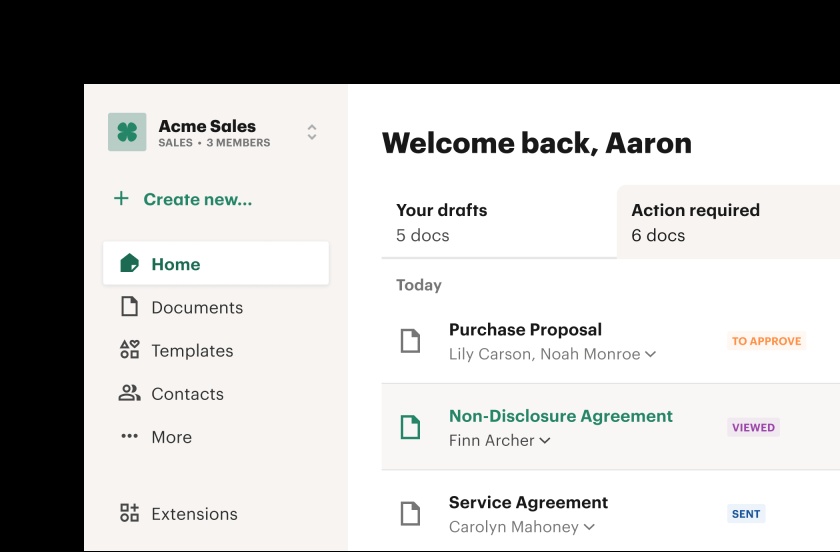
Consider Knocking, a media-commerce business. Its case study describes a schedule that once allowed two months of preparation suddenly requiring ten brands to be accommodated in one week. Through PandaDoc’s HubSpot integration, the team could send documents together, monitor completion, and automate follow-ups. The pressure came from the calendar; the response was to make the request and its status easier to understand.
- 01CRM data
- 02Quote + approval
- 03Sign + pay
- 04Renewal
One connected process. Feature access depends on the plan.
The CRM connections have become a strategic front. PandaDoc launched embedded configure, price, quote software for HubSpot in September 2024, Salesforce in February 2025, and Pipedrive that June. CPQ supplies rules for assembling and pricing an offer. Bringing that work into the CRM reduces the need to rebuild a deal in another window. It also makes PandaDoc relevant before a contract is ready for signing.
That places the company across several markets. Docusign, Adobe Acrobat Sign, and Dropbox Sign are alternatives for signature work; Proposify overlaps in proposals. Buyers also encounter specialist CPQ and contract-management vendors. PandaDoc’s case is the convenience of connecting several jobs. Which alternative wins depends on whether the buyer mostly needs signatures, persuasive proposals, quoting rules, or control of a longer agreement process.
The same work can appear in unexpected departments. At Rakuten Super Logistics, now ShipNetwork, the original problem included sales documents assembled with separate tools and repeated data entry. Its PandaDoc case study describes integrating Microsoft Dynamics for proposals, then using the platform for onboarding and warehouse visitor documents. A document system that enters through sales can find other queues waiting nearby. That expansion makes practical sense when the common need is controlled information, a clear request, and evidence that the recipient has completed it.
Put a price on the handoffs
The business model is recurring software revenue. PandaDoc announced $100 million in annual recurring revenue in August 2024; ARR describes the subscription run rate, rather than an audited annual revenue figure. A September 2021 Series C had valued it at $1 billion. In December 2025, Índico Capital Partners invested €5 million, with AI development and the Lisbon team among the stated priorities.
5 Business seats × $49 × 12 months.
Annual billing; before taxes, add-ons, and usage charges.
At the listed annual-billing rates checked in October 2026, Starter costs $19 per seat monthly and Business $49. Five Business seats therefore cost $2,940 a year before extras. Enterprise pricing is negotiated, and some capabilities require add-ons or usage credits. There is also a free tier. A buyer should price the intended workflow, including integrations and automation, rather than multiply the cheapest headline number.
There is work the subscription cannot remove. Someone must approve the wording, maintain product prices, map CRM fields, and decide who may authorize a discount. My reading: the fit is strongest when similar documents recur often enough to justify that preparation. For occasional signatures, a fuller workflow may add unnecessary setup. Dirty customer data and unsettled approval rules simply give automation bad instructions faster.
There is a useful distinction here for managers: buying access is immediate; earning back the time takes a working process. Start with the packet people send every week. If nobody owns its contents today, assigning that responsibility belongs in the project budget too.
The agreement keeps its calendar
In January 2026, Keith Rabkin became CEO and Mikado moved to Chief Product Officer. September brought another expansion: post-signature contract lifecycle management, including AI extraction, natural-language search, renewal alerts, and a central repository. PandaDoc reported more than 70,000 customer companies at that launch. The contract was now something to keep managing after the celebratory email.
“Product is where my energy, curiosity, and impact are strongest”
Mikita Mikado · January 2026
The useful thing to copy is modest. Pick one recurring agreement. Count the retyping, the attachments, the approvals, and the reminders. Establish which version is approved. Then measure the time again after changing the process. PandaDoc’s history suggests that the opportunity becomes clearer when you follow a customer’s document all the way through. The signature is one stop. The expensive part may be somewhere else.