David King has a useful piece of advice for people giving a business presentation: once somebody has introduced you, resist the temptation to introduce yourself again. Your name is probably on a screen behind you. Begin with something worth listening to. Then, while discussing this very principle in a 2024 podcast conversation, he realised he had opened the interview with his name, his title and his company. He caught the contradiction himself. There is something reassuring about a founder whose advice comes with an immediate demonstration of how easy it is to ignore.
His wider point was practical. A good meeting requires preparation about the other person, their business and the pressures around them. A stack of slides can be assembled from things you already know. Understanding somebody else's problem takes more work. That distinction offers a useful way into King's career: a succession of attempts to make complicated exchanges work better for the people involved.
A business that learned to choose
Before Artificial Labs, there was digital media, software work and an early encounter with insurance. King graduated from Nottingham University Business School in 2005 with a degree in Industrial Economics. His career included digital planning at Carat and a directorship at Sure Insurance Services from 2009. He founded Data Stripes in 2011. Two years later, it joined with Johnny Bridges' ConceptMill to create Artificial. Its early work included digital projects for BMW, Levi's and Betfair. The route into insurance was paved with experience outside it.
Artificial began in 2013, opened a Warsaw office in 2015 and concentrated on insurance from 2016. King and Bridges had both worked with insurers. They recognised the difficulty of getting a new product into the market. Working across several industries had given them plenty of different problems to solve; specialising offered the chance to understand one field more deeply. The choice matters in a founder's story because it involves giving up possibilities. A busy studio can collect clients indefinitely. A product business needs a problem it can keep returning to.
The job King took on was commercial as well as technical. By 2021, King was Artificial's chief commercial officer, answering questions about talent, data, security and expansion. Selling this kind of software means answering questions from people responsible for decisions that have consequences long after the demonstration ends. A pleasing screen is a beginning. People also want to know what happens when their actual business arrives.
Three dates. One deliberate direction.
- 2013King and Bridges form Artificial.
- 2015A Warsaw office joins London.
- 2016The business concentrates on insurance.
The paperwork has a social life
King works in specialty and commercial insurance, where a transaction moves between organisations with their own expertise, systems and ways of recording information. Artificial builds the technology connecting brokers and underwriters. Its current leadership brings King and Bridges together as co-CEOs, alongside specialists in technology, product, markets and customer experience. That breadth reflects the work itself. A contract must make sense to the person drafting it, the person assessing the risk and the systems carrying the information onwards.
Consider the partnership with Lockton announced in December 2023. The broker helped configure and test Artificial's Contract Builder against its requirements. The tool captures structured information and uses it to generate a contract, with familiar drafting and formatting capabilities. Several lines of business had already been rolled out when the partnership was announced. For King, this is a concrete expression of the business he chose to build: the technology has to survive contact with a broker's working day. The document gets its data organised before it begins its travels.
The same argument takes a different form in the work with Placing Platform Limited. Artificial's digital contract capability was embedded in PPL so users could work with structured templates and connect contract information through APIs. The attraction is prosaic and considerable: fewer occasions to enter the same information again. Repetition has an impressive ability to disguise itself as employment. King's commercial proposition depends on making that repetition less necessary, while allowing a contract to keep moving through the placing process.
An editorial illustration of the workflow, not a measured performance chart.
A rulebook with room for judgement
On the underwriting side, the collaboration with Apollo offers another view of the work. Its Smart Follow partnership was announced in 2023, and the first risks went live that November after a proof of concept. Early business included marine hull, aviation, cargo and terrorism. King discussed the project with Apollo's James Slaughter on a podcast and appeared with him at ITC Barcelona. The subject had moved from a proposed approach to something the two businesses were operating together.
When the partnership was renewed in November 2024, King described the importance of turning Apollo's appetite for risk into rules that could support reliable decisions. Appetite, in insurance, means the kinds of risks a carrier wants to accept. Codifying it makes that preference usable in a digital process. The interesting question becomes where a decision can proceed consistently and where a person needs to intervene. That is a more demanding exercise than presenting automation as a magic button. Someone still has to decide what the button is allowed to do.
King also brought an explicitly human angle to his 2022 TINtech presentation. He challenged a simple contest between machines and underwriters, discussing the opportunity for technology to augment people's work. The distinction puts a responsibility on the software maker: understand the judgement already present before proposing how a system should assist it. It also helps explain why Artificial's partnerships occupy so much of his public working life.
The customer who joined the team
One of those relationships produced a particularly clear career connection. In September 2024, Artificial appointed Ed Howkins as chief growth officer, reporting to King. Howkins had spent seven years at Chaucer, including work implementing its NextGen Underwriting business with Artificial. King and Howkins had first collaborated on that project in 2020. A customer relationship had become a working relationship inside the company.
Howkins' brief included strategic partnerships and explaining the company's value across the market. His appointment neatly joins two recurring themes in King's work: knowing the industry and communicating clearly enough for people to use what has been built. A person who has already experienced a product from the client's side brings a useful memory to the sales conversation. They know the questions that remain after everybody has closed the pitch deck.
King's interest in relationships also appeared in his 2020 conversation with Matthew Grant. The discussion covered accelerators, lessons from China, technology choices and when to bring in a CEO. These are the less photogenic parts of a company story: finding people who can teach you something, knowing which capabilities belong together and deciding when another person's experience will help. They make for fewer dramatic founding legends, but rather more useful businesses.
“And of course, be nice to each other.”
David King, on building a team · 2019
What the money buys
Artificial raised an £8 million Series A+ in February 2024, led by Augmentum Fintech with participation from existing investors MS&AD Ventures and FOMCAP IV. It planned further work on underwriting technology, AI tools and Contract Builder. Those details put substance behind the fundraising announcement. King was raising money for products already being developed and adopted with brokers and insurers.
On 3 February 2026, the company announced a $45 million Series B led by CommerzVentures, with Move Capital Fund I and existing investors participating. King described the result in terms of time and capacity: “This round gives us the room to grow with confidence.” The stated plans included team growth and US expansion. Funding gives a software company room to hire and build; its clients still need the resulting systems to work. For an enterprise founder, a larger cheque extends the obligation as well as the opportunity.
The geographical plan soon acquired names. In May, Eric Joost became president leading the US expansion. His background included Aon, Allianz and Willis Towers Watson, as well as CAC Group. His responsibilities covered strategy, client engagement and making sure the platform fitted North American ways of working. A month later, Christopher Lohmann was appointed head of Europe, based in Germany. The initial European focus was Germany and Switzerland, with further markets planned. King's expansion strategy was being entrusted to people with experience of the places Artificial wanted to serve.
Series B financing to support the company’s next stage of growth.
No prize for making the pitch longer
There are lighter clues to how King thinks about performance. He has described himself as competitive and interested in what elite sport can teach a business about teamwork. His Royal Signals gap year put him in a communications regiment. By 2019 he had also completed the Lakeland 50. These details sit comfortably beside his working life without needing to serve as a theory of it. A long course and an enterprise software sale each offer ample opportunity to discover that enthusiasm is not a schedule.
His formal learning continued too: he took Cambridge Judge Business School's Scale Up Programme in 2018. His company was already several years old. There is a pleasing practicality in the timing. Building a business and learning how to build one can happen in parallel.
In September 2026, Artificial was named to CB Insights' Insurtech 50. King framed the opportunity around connecting a fragmented specialty market and helping brokers and underwriters work together differently. Recognition gives a company something to announce. The argument underneath remains consistent with the work on contracts, underwriting rules and partnerships: information has to get between people before those people can make use of it.
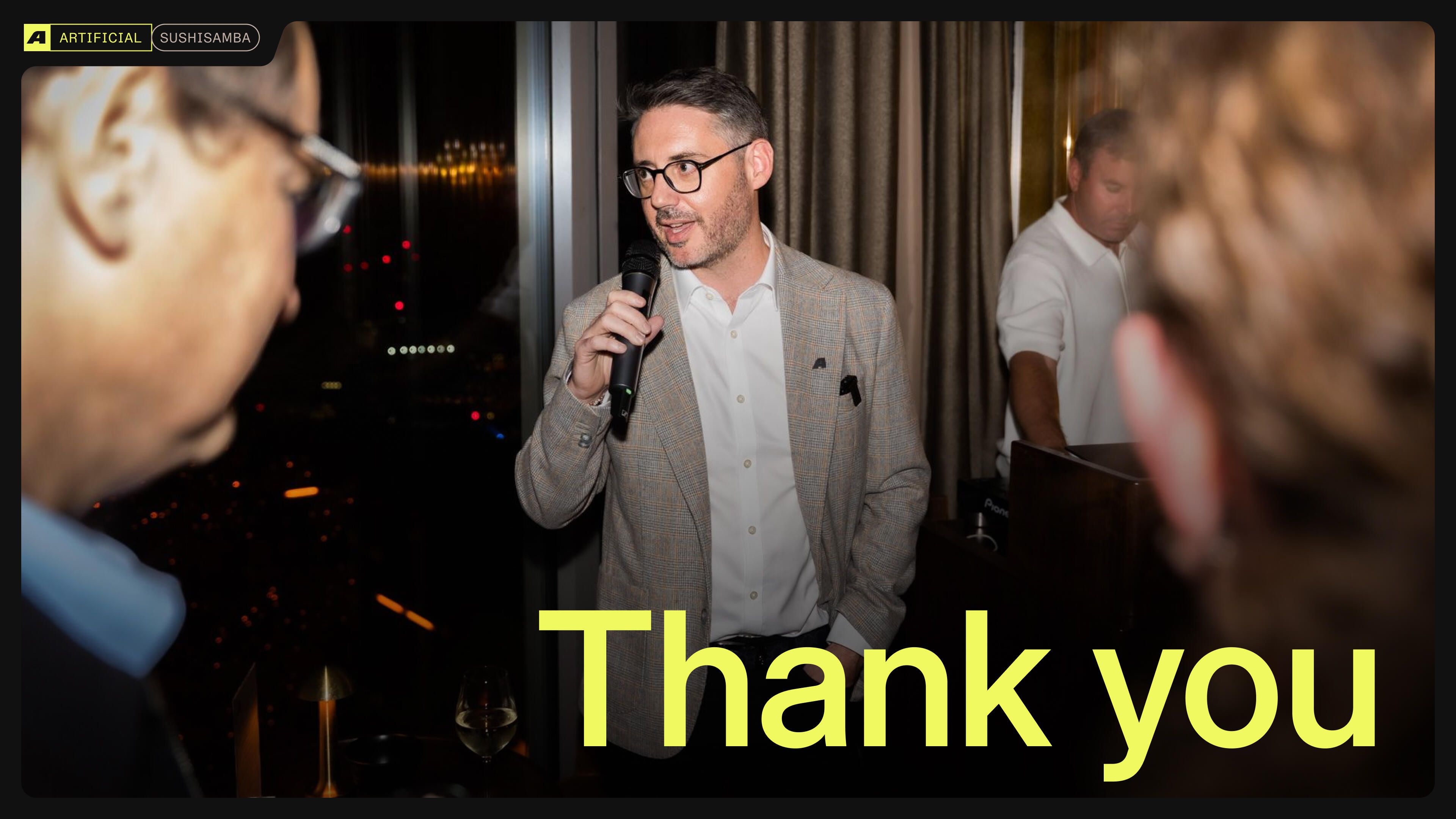
A thank-you above the City
On 14 October 2026, King addressed clients, partners and friends at SUSHISAMBA in Heron Tower. Artificial had gathered 120 guests to celebrate its relationships and introduce a new brand built around The Power Between. The event photographs show him speaking into a microphone, with guests close by. There were cocktails, sushi and party bags. Enterprise software, apparently, can occasionally arrange a decent evening out.
The occasion followed the company's expansion into the US and Germany and an award for its Smart Follow work with Apollo. King thanked the people who had supported Artificial early. The gesture suits a business whose product depends on cooperation: the room contained people who had helped make the work possible. It also brings his story back to the meeting. However sophisticated the technology becomes, somebody must understand the other person's problem, ask a useful question and persuade them to try a different way of working.