The first customers did not wait for a sales pitch. In 1977, as David King and his mother, Gwen, unloaded their bright foam seats from the roof of a car at Sydney’s Paddy’s Markets, people began asking what the strange shapes were and how much they cost. The furniture was casual, colourful and permissive. You could sit on its arms. You could rearrange it. It was conceived for a household in motion, not a formal room wrapped in plastic and opened for guests twice a year.
That market-stall instinct - let people touch the object, watch what they do, then improve it - still explains King Living better than the polished rooms in its international showrooms. The family-owned Australian company now designs, manufactures and sells sofas, dining tables, beds, outdoor furniture, rugs and accessories. But its argument is concentrated in the sofa: the costly object in the middle of a home should be able to change before it needs to be replaced.
King Living reported in June 2026 that it had more than 40 showrooms across eight countries and nearly 2,000 employees. Its fastest-growing regions include North America and Britain. The company plans 60 showrooms by 2028, roughly two-thirds of them outside Australia. That is a large bet that a Sydney vocabulary - restrained forms, engineering hidden beneath upholstery, rooms designed for actual use - can travel.
The business is built around the invisible part
A sofa buyer sees the fabric first. King Living would prefer that buyer think about the skeleton. In 1979, two years after the market debut, the company introduced its first steel-frame sofa and Postureflex seating system. The suspension took inspiration from luxury European cars: flexible steel support designed to distribute weight without the sagging and cracking David King had observed in discarded furniture on Sydney streets.
That frame is now the anchor of the “King Difference,” the company’s compact explanation for a premium price. Steel resists warping. Modular bases accept different configurations. Magnetic joiners hold sections together without turning the sofa into a permanent monument. On many models, tailored covers can come off for cleaning or replacement. A current 25-year warranty on indoor steel frames makes the engineering legible even to someone who never looks below a cushion.
“I wanted to make furniture that wouldn’t end up in landfill a few years later. Furniture you could really live with.”David King, founder
The longevity loop
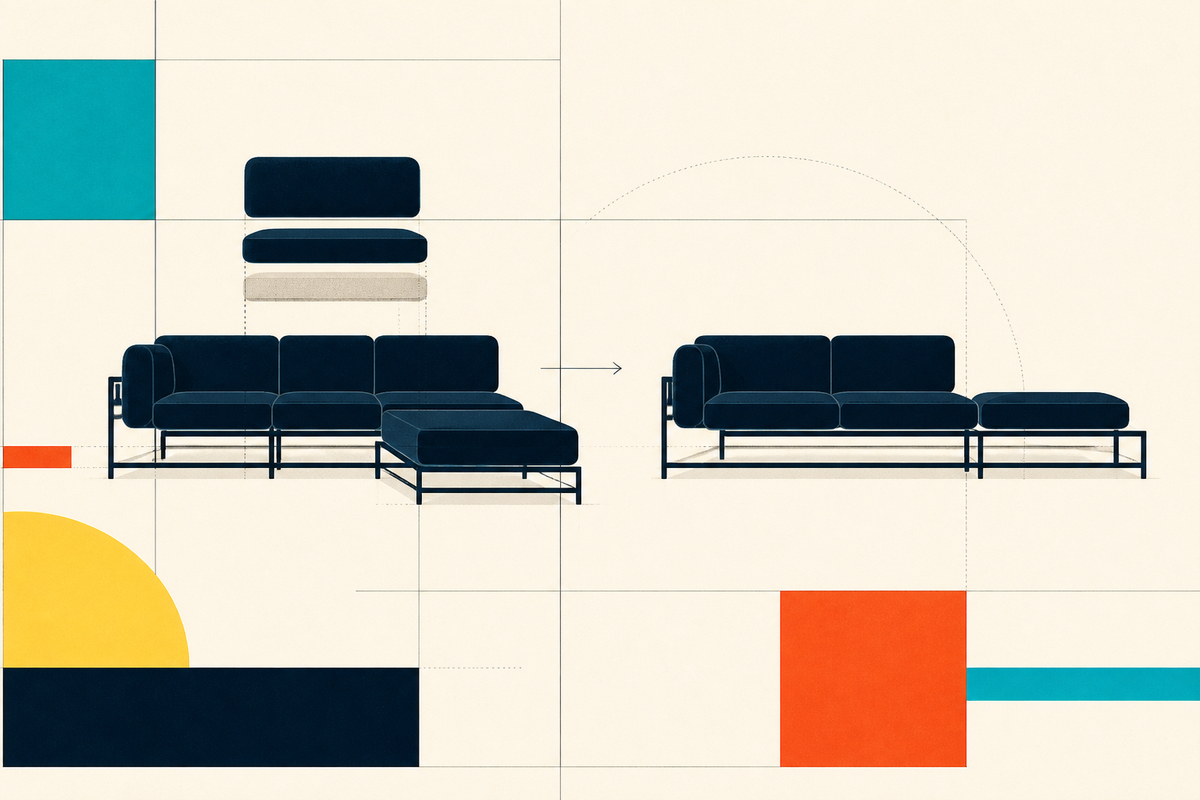
The useful part is not any single feature but the loop they create. A family can add a module after moving to a larger room, separate a sectional when downsizing, replace a damaged cover or send an older piece for recovering. Designers at the company describe seeing sofas bought 20, 30 and even 40 years earlier arrive at King-Care and leave wearing new fabric. Every upholstered piece carries an internal label tied to its original order, making a future match less like furniture archaeology.
A sofa that behaves like a system
The 1998 Delta made the proposition easy to demonstrate. Its movable backs and modular steel base could form a corner sofa, chaise, armless seats or a sleeping surface. The Jasper became a bestseller by combining storage, shelving and adjustable components. Newer products apply the same logic to different moods: the Haven is soft and low; the 1978 High Back adds support to the rounded language of the company’s earliest foam pieces; the Plateau takes movable backs and integrated surfaces outdoors.
Technology appears in small, domestic ways rather than as a glowing dashboard. TouchGlide controls adjust recliners and headrests. Smart Pocket accessories bring a charging point, light or table surface into reach. The important phrase is “into reach.” King Living is not selling a connected-home platform. It is removing the small irritations of a room - the cable across the floor, the side table that no longer fits, the backrest that supports only one posture.
Customers can use the system at several levels. A household can buy one configured sofa online. A showroom consultant can model a sectional for a difficult plan and guide fabric or leather choices. An interior decorator can help coordinate a room. Architects and designers use King Trade for spatial planning, custom solutions and project orders. At the far end, King-Care handles treatment, spare parts, recovering and refurbishment. The sale begins with an object but the higher-value relationship can last through several versions of it.
The direct model is also a listening device
King Living sits in an awkward, useful part of the market. It describes the showroom ambition as “affordable luxury.” The company must look composed beside design-led Australian names such as Jardan and Coco Republic, demonstrate engineering against global specialists such as Natuzzi and BoConcept, and remain understandable to customers comparing a promotional sectional from a high-volume chain. It cannot rely on rarity. Its advantage has to work in a family room.
Vertical integration helps. The company runs an in-house Sydney design studio, manufacturing hubs in Australia, China and Thailand, ecommerce operations and its own showroom network. Without a wholesale layer between the customer and the maker, retail feedback can return to designers and production teams. Founder-led product thinking, fabric development, steel engineering, pattern cutting and service data sit inside the same organisation.
The model also provides more places to earn revenue than a one-time sofa transaction. King Living sells made-to-order seating, whole-home collections, outdoor furniture, accessories and trade projects. It offers delivery, consultations and long-term care. Replacement covers and new modules turn durability from a noble promise into repeat commerce. An online outlet and physical outlet stores give floor stock and imperfect inventory another route to a home rather than a skip.
A measured race for more rooms
A private family company does not publish the operating detail of a listed retailer, and King Living has announced no external funding round or valuation. That makes the physical expansion the clearer signal. In 2024 it opened its first United States showrooms in Orange County and Chicago. Britain grew beyond Tottenham Court Road into Kingston and Westfield London. In 2025 came a large Balgowlah showroom, Portland and Toronto. In 2026, a DIX30 location near Montréal became the 40th global showroom, while a warehouse at Hemel Hempstead gave the British business dedicated logistics infrastructure.
Can Australian restraint travel?
The international challenge is not simply opening doors. Sofas are bulky, local tastes differ and delivery is part of the product whether a designer likes it or not. King Living’s response is a controlled environment. Its global showroom team plans materials, music, scent and product placement, then refreshes displays on an eight-week rhythm. The theatre is quiet, but it is theatre: sit down, move the back, pull the cover, rearrange the modules, understand the price through touch.
Industry recognition has helped translate the message. In 2025, the Cinema Recliner, Haven and 1978 High Back received Red Dot awards; the Plateau Outdoor and 1978 High Back won iF awards. The previous year brought Red Dot recognition for the 1977 indoor and outdoor sofas. These prizes do not guarantee a comfortable Saturday afternoon, but they give a foreign customer shorthand for an Australian brand still establishing familiarity.
The company also works through designers rather than only advertising at them. Singapore studio akiHAUS has specified its pieces since 2016. Australian industrial designer Charles Wilson has collaborated on products and public design discussions. The Creative Spaces series places furniture inside the practices of architects and interior designers. The trade hub at Bondi Junction turns that editorial courtship into a place where professionals can bring clients, plans and fabric questions.
“Our goal is to enhance and simplify our customers’ homes, bringing them comfort and a timeless aesthetic that adapts to their lives.”Chris Cooke, head of design
The 100-year test
King Living’s stated ambition is to become a 100-year company. Chief executive David Woollcott talks about growth that happens in the right locations, rather than growth at all costs. The phrasing suits a business whose central product is supposed to improve through patience. Yet the next phase will test whether its closeness to the customer survives scale, and whether care infrastructure grows as confidently as showrooms do.
There is also a sharper sustainability question ahead. Long life is meaningful, especially in a category defined by heavy materials and difficult disposal, but it is not a complete environmental account. The company says it is deepening measurement of its impact and uses recyclable components, replaceable parts, repair services and outlets. The stronger future case will connect those design choices to transparent evidence about materials, manufacturing, transport and recovery across eight countries.
Still, King Living has identified a problem that nearly every household recognises: rooms change faster than large furniture does. Children arrive. Apartments shrink. A cream cover meets a glass of shiraz. The clever response is not to make the sofa precious. It is to make it forgiving - strong where nobody looks, changeable where everybody does, and supported long after the delivery van leaves.
The foam shapes at Paddy’s Markets were successful because buyers immediately understood what they could do with them. Forty-nine years and 40 showrooms later, King Living is selling the same permission at a much larger scale. Sit on the arm. Move the back. Change the room. Keep the frame.
Keep exploring
See the current collection, follow the design studio and watch the furniture change shape in motion.