Most people meet MillerKnoll one object at a time. An Aeron chair rolls into view behind a podcast host. An Eames lounge chair waits in a hotel lobby like a very handsome old friend. A Saarinen pedestal table turns up in a kitchen, still looking faintly futuristic decades after its debut. The parent company behind those objects, however, is built to think in rooms, buildings and portfolios. Its real proposition is not simply that it can make a good chair. It is that it can help decide what an entire place needs, manufacture the answer and get it through the door.
MillerKnoll took its current shape in 2021, when Herman Miller completed a $1.8 billion acquisition of Knoll. The two names had spent generations as rivals and relatives: competitors in contract furniture, but also branches of the same American modernist family tree. Charles and Ray Eames, Eero Saarinen, Florence Knoll, George Nelson and Alexander Girard moved through a world anchored by Cranbrook Academy of Art, European modernism and an optimistic belief that industry could make daily life more intelligent.
The combination now includes Herman Miller and Knoll alongside Design Within Reach, HAY, Muuto, Maharam, Geiger, NaughtOne, HOLLY HUNT, Knoll Textiles, Edelman, Colebrook Bosson Saunders and Spinneybeck | FilzFelt. That list is not a pile of near-identical labels. It stretches from ergonomic task chairs and monitor arms to Scandinavian accessories, architectural woodwork, high-end residential interiors, leather, felt and textiles. The collection gives MillerKnoll an unusually broad answer to a deceptively simple question: what belongs in this space?
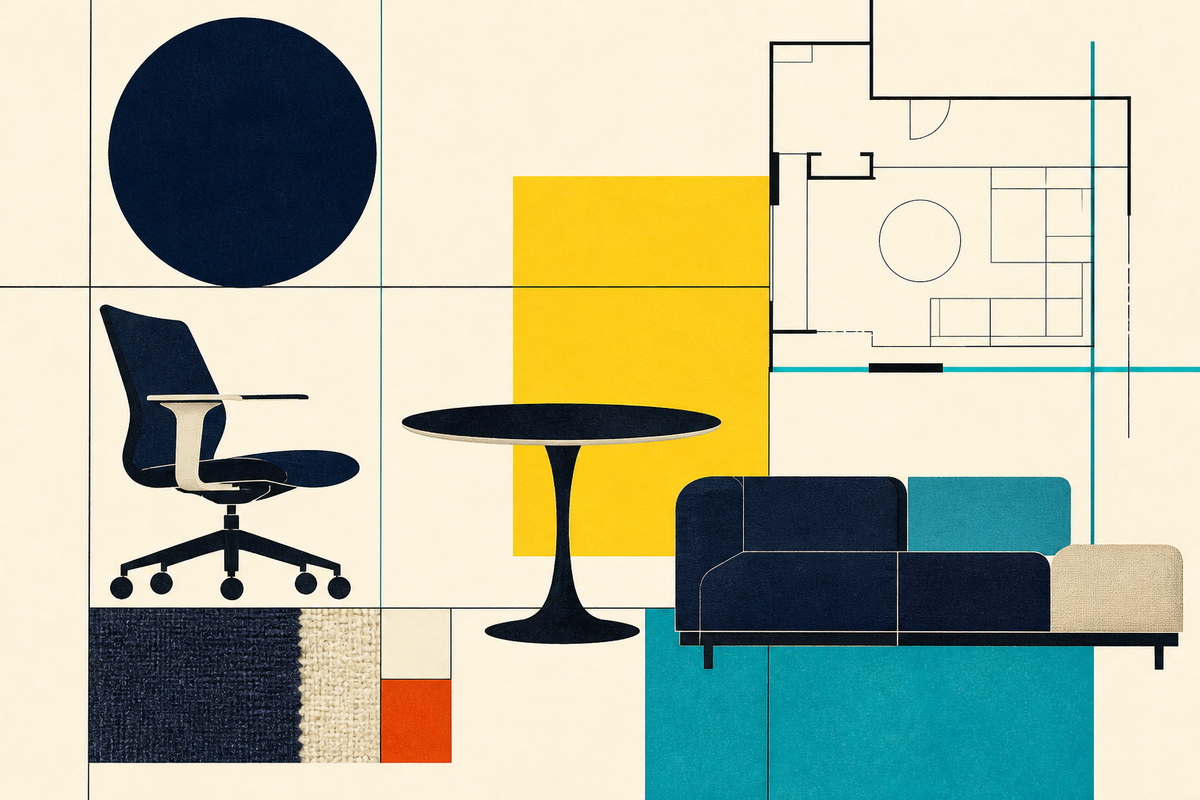
The chair is the handshake
The famous products do important work. They carry stories, designers’ names and visual recognition into a market where many purchases otherwise look interchangeable. A customer may arrive for an Aeron, an Eames molded shell chair or a Barcelona chair. But MillerKnoll’s contract business is prepared to sell the desks, storage, meeting tables, lounge settings, power access, monitor supports, textiles and planning logic around it. The chair is the handshake; the room is the relationship.
That distinction explains where the company sits in the market. It competes with Steelcase, Haworth, HNI, Teknion and Vitra, but it also meets premium home retailers and independent design brands in the consumer aisle. Its customers range from a person fitting out a spare-bedroom office to architects, universities, government agencies and healthcare systems standardizing hundreds of spaces. An independent dealer network adds local specification, installation and service. Stores and ecommerce add direct contact with the person who wants one lamp or one sofa.
In fiscal 2026, MillerKnoll generated $3.842 billion in net sales, up 4.7 percent as reported. North America Contract contributed $2.061 billion. Global Retail supplied $1.107 billion, while International Contract added $674 million. The mix matters: the company may be culturally associated with museum-worthy objects, yet more than half its sales still came from the deeply practical business of furnishing North American organizations.
A portfolio that behaves like a toolkit
MillerKnoll’s brands retain their own voices because distinction is part of what customers buy. Herman Miller leans into problem-solving performance and a long industrial-design legacy. Knoll’s visual grammar joins architecture, furniture and textiles. HAY and Muuto bring accessible contemporary Scandinavian design. Maharam treats textile design with nearly editorial seriousness. Design Within Reach translates the collection for retail, giving customers a place to touch materials and sit before spending.
Performance
Ergonomic seating, systems and work tools led by Herman Miller and Knoll.
Expression
HAY, Muuto and DWR carry modern design into homes and smaller projects.
Material
Maharam, Edelman, Knoll Textiles and Spinneybeck | FilzFelt give surfaces a point of view.
Place
Dealers, researchers and planners connect products into working environments.
What can customers do with that toolkit? A facilities leader can establish an approved menu of products for offices across several cities. A hospital system can standardize materials, dimensions and room types so each new facility does not begin from zero. A university can mix durable classroom pieces with hospitality-minded spaces meant to attract students back to campus. A home buyer can assemble a more comfortable desk and later furnish the living room through related brands.
One recent MillerKnoll healthcare case study makes the unglamorous advantage unusually clear. By agreeing on furniture standards early, a national system reported saving 70 percent of design-coordination time and 11.4 percent against standard Tier 1 pricing. The furniture still had to suit patients, staff and brand standards. But the larger problem was repetition: how to make many decisions once, then deploy them reliably. A beautiful chair cannot solve that alone. A product system, digital specification process and dealer network can.
“The purpose of place has changed.”MillerKnoll workplace research
The office has to earn the commute
Hybrid work threatened the old office-furniture assumption that more employees automatically meant more desks. It also created a more interesting design problem. If focused work can happen at home, an office needs reasons to gather: collaboration that survives a video call, social contact, mentoring, access to tools, privacy when required and a visible sense of belonging.
MillerKnoll’s Global Workplace Assessment surveyed 4,815 desk-based workers across nine countries. Forty-nine percent said their companies had fully in-office policies, 37.4 percent worked under hybrid policies and 13.6 percent were fully remote. Those numbers do not dictate a floor plan. They do show why a single office template no longer works. MillerKnoll’s research operation turns the uncertainty into guidance, and the portfolio turns that guidance into objects that can be specified.
This is one of the company’s sharper differences from a furniture catalog. It publishes articles, assessments, talks and videos on workplace behavior, healthcare and space planning. The research is useful marketing, certainly, but it also changes the sales conversation. Instead of beginning with upholstery colors, a project can begin with what people are expected to do, where they need quiet, and which encounters deserve physical space.
Old objects, current obligations
Furniture makes an appealing sustainability argument because a well-built object can remain in use for decades. Yet manufacturing still consumes wood, metal, foam, plastic, textiles and energy, while office renovations can send rooms full of serviceable products toward landfills. MillerKnoll’s environmental plan therefore works on both production and afterlife.
The company says it reached 100 percent renewable electricity through certificates, power-purchase agreements and on-site generation ahead of its FY2026 deadline. Its near-term targets, validated by the Science Based Targets initiative in 2025, include cutting Scope 1 and 2 greenhouse-gas emissions 50 percent from a fiscal 2022 baseline by fiscal 2030, along with a 25 percent reduction in specified Scope 3 emissions. Product goals cover lower carbon footprints, recycled textile content, responsibly sourced natural materials, fewer single-use plastics and zero landfill at its five largest manufacturing sites.
The RePurpose take-back program attacks the awkward end of the cycle by routing used furniture toward resale, donation or recycling. The target is to divert 10 million pounds from landfill by fiscal 2027. That service is not as photogenic as a new lounge chair. It may be more important to the procurement team calculating a renovation’s waste, cost and public commitments.
Can the collective stay collected?
Scale creates its own friction. A broad portfolio can simplify a customer’s project, but it gives management more factories, stores, price points and brand identities to coordinate. The 2021 Knoll transaction also added debt. At the end of fiscal 2026, MillerKnoll reported a net-debt-to-EBITDA ratio of 2.80. Global Retail grew sales 5.9 percent for the year, but its adjusted operating margin declined, with new-store costs among the pressures. International Contract grew on a reported basis and declined organically. The machine has many moving parts because breadth is both its advantage and its expense.
Leadership is another current variable. Jeff Stutz, a company veteran who joined Herman Miller in 2001 and previously served as chief financial officer and chief operating officer, became interim CEO at the end of June 2026 after Andi Owen retired. The board began a search for a permanent leader. Whoever takes the role inherits a recognizable portfolio, improving reported sales and the less glamorous work of margins, debt, retail maturation and keeping independent brands meaningfully independent.
At Chicago’s 2026 Design Days, the collective filled eight floors and nearly 70,000 square feet with systems, seating, textiles, exhibitions and manufacturing stories. Herman Miller refreshed Aeron with new colors, sustainability changes and broader sizing. Elsewhere were collections from Knoll, new HAY seating, Muuto environments and Maharam collaborations. It was a physical demonstration of the strategy: let each brand speak, but make the building tell one story.
That story begins with famous furniture and ends with infrastructure. MillerKnoll fits between a design studio and an industrial platform, between the dealer who handles a complex installation and the retailer who sells one very expensive chair. Its most durable insight is that people do not experience products as isolated catalog entries. They experience the meeting, the shift, the appointment, the lecture, the quiet hour at home - and only then the chair beneath them.