Kyle Hoff had eight months left on a Chicago lease, three roommates found on Craigslist and no appetite for another disposable table. He had already dragged a cheap bed from Ann Arbor. Buying more temporary furniture meant planning its funeral at the same time as its delivery. Hoff, then working at an architecture firm, chose a smaller nuisance: he would make legs that could clamp onto whatever flat surface happened to be available.
The result was compact, bright and almost comic in its confidence. Four bent-steel legs could turn plywood, an old door or a found slab into a table. When the lease ended, the surface could stay and the useful part could travel in a bag. Hoff carried the prototype with him to Detroit, where he met Alex O'Dell. Together they found the company hiding inside it.
Floyd's origin story is often told through the Kickstarter arithmetic. The founders asked for $18,000 in 2013. Nearly 1,400 backers pledged about $256,000. Yet the more durable result was not the cash. It was proof that a private annoyance was widely shared. People moving between rentals were tired of treating furniture as a bulky subscription to the local dumpster.
A steel-town education
Hoff grew up in Youngstown, Ohio, where making things carried both pride and consequence. His grandparents, aunts, uncles and parents worked in steel mills. His parents met in one. He also watched what industrial retreat did to the city. Manufacturing, for him, arrived as family history before it became a supply-chain diagram.
Architecture sharpened that inheritance. Hoff earned a bachelor's degree in architecture at Miami University, with a minor in entrepreneurship, then completed a Master of Architecture at the University of Michigan in 2012. He moved through Ann Arbor, the Bay Area and Chicago before leaving his firm job for Detroit. A friend was opening PracticeSpace, a shared workspace in Corktown, and Hoff came to design and build it. The city offered a different kind of studio: a place near toolmakers, metalworkers and the deep industrial knowledge of the Great Lakes.
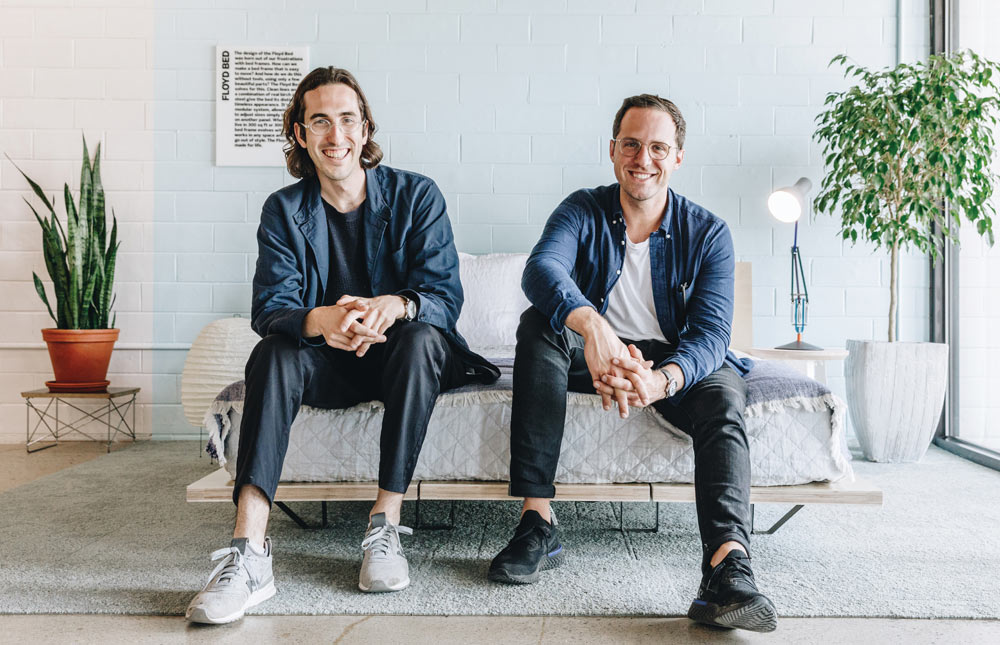
Detroit also put Floyd close to Michigan modernism. The founders could study the orbit of Cranbrook, Knoll, the Eameses and the Saarinens without turning them into remote museum saints. Hoff has described team visits to Cranbrook's archives as a working source of inspiration. The point was not to borrow a silhouette. It was to understand why certain objects continue to earn space decades after their debut.
“We don't want it to be a question when you go to move whether or not you should leave our products behind.”Kyle Hoff
The product is the promise
Floyd expanded slowly at first: the Leg, then a bed, a table, a desk, shelving and seating. Hoff's stated ambition was unusually restrained for a venture-backed consumer brand - make one version of each important object in the home and make it well. A customer should come for the bed or the sofa without navigating a digital warehouse of near-duplicates.
Each category made the original promise harder. Four steel legs are naturally portable. A sofa is a stubborn animal. Floyd's response was to treat adaptability as the engineering brief: pieces should assemble intuitively, separate for a move and accept new components as a room or household changes. Longevity became less about building an immovable monument and more about giving an object permission to change.
The Floyd design loop
The sofa's first prototype made the method visible. The team hacked it together from an old ping-pong table surface and sawed-off side-table legs, then showed the rough idea online. Floyd asked its audience about colors, materials and use. The process invited the sort of criticism that tidy product launches work hard to avoid.
That openness came directly from Kickstarter. Backers supplied money and unsolicited product notes in the same window. Hoff learned to regard customers less as the final stop in a distribution system and more as observant people already living with the problem. Years later, he described Floyd's design inspiration in equally plain terms: people making the products and people using them.
By 2020, that feedback loop had a physical center in Floyd's expanded Eastern Market headquarters. Product, marketing, customer experience, technology and supply chain worked near one another instead of passing decisions down a long corridor of departments. The arrangement suited furniture, where a millimeter in a drawing can become an assembly problem, a damaged shipment or a customer question. Hoff described the office as energized, with many kinds of work happening at once. The room was not decoration around the company. It was another prototype for how the company wanted to think.
The catalog carried evidence of this cross-talk. A bed frame could grow from twin to king through expansion hardware. Shelving could take cabinets or additional bays. Seating could be reconfigured rather than replaced when a room changed. These are quiet features, less photogenic than a new silhouette, but they turn the transaction into the beginning of a relationship. The object is allowed to have a second configuration and the customer is spared a second purchase.
Show the awkward prototype while reality can still improve it. An audience is most valuable before the answer hardens.
A company enters the room
For most of its life, Floyd explained physical objects through a screen. Its website had to communicate proportion, upholstery, joinery, comfort and assembly without letting a customer touch anything. Direct commerce gave the company a close relationship with buyers, but furniture remains stubbornly tactile. A photograph can flatter a chair. It cannot tell your back whether the chair and your back agree.
The business gained reach and endured the swings of the direct-to-consumer market. It raised outside capital, joined Endeavor's global network and put products into more than 50,000 homes. It also experimented with pop-ups and a West Elm partnership. Then, in January 2025, Ohio-based bed manufacturer Rize Home acquired Floyd. The terms stayed private. Hoff's response was notably forward-facing: he felt invigorated to launch products and pursue a larger vision.
Later that year, Floyd opened shop-in-shops with Michigan retailer Gardner White, including a presence at GW HOME in downtown Detroit. By November, the partnership had reached three locations. It was a new test for a company trained to convert web traffic. Customers could now sit on the sofa, inspect fabric and judge the weight of a table before buying.
The pairing also brought Floyd back to a very old retail question: how much explanation should a chair require? Online, copy and diagrams can patiently unpack a system. On a sales floor, the construction, touch and comfort have to make the opening argument. Hoff saw the stores as places to test fabrics and products as well as sell them. A proposed lounge chair, based on the sectional, could meet people before a large production commitment. Physical retail became a listening post with cushions.
The experiment had an agreeably homemade detail. Floyd's team recorded training videos for retail associates on an iPhone in the office. The polished brand returned to the useful roughness of a prototype. Teach the product clearly. Watch what happens on the floor. Improve the next version. Hoff said the company wanted to be methodical about where it went next.
“I'm invigorated to build and launch new products, and go after a larger vision.”Kyle Hoff, after Floyd's acquisition
Keeping the spark in the system
In late 2025, Hoff returned to the University of Michigan for an entrepreneurship panel. He did not offer students a polished march from classroom to exit. He talked about Floyd's failed attempts to design its second product and the learning that followed. Trial and error mattered, but so did returning to the modular strategy when an idea wandered.
He summarized the continuing challenge as trying not to lose the spark that made the company good. It is an architect's version of a founder's problem. Early companies have constraints because they lack money, staff and certainty. Mature companies must choose constraints after resources make them optional.
Floyd's chosen constraint remains visible in that first steel leg. Notice an ordinary frustration. Reduce the object to what must travel. Build the rest as a system. Let the customer keep it long enough for wear, moving vans and changing rooms to become part of its biography.
The idea is also present in Hoff's own home, a 1954 modernist house in Ann Arbor designed by William Muschenheim. The rooms mix older work by Michigan-linked designers with Floyd prototypes and current pieces. History is used, not roped off. A sectional must survive everyday family life. Shelving divides a room. A lamp earns its corner. Even good taste has chores.
Hoff's story resists the usual furniture fantasy, where permanence means an untouched chair in perfect light. His version is more demanding. A lasting object must tolerate the moving truck, the spill, the new apartment and the add-on bought years later. Floyd began because one architect did not want to purchase a table for eight months. Its future depends on making furniture useful for the years after that.