An apple can be perfectly edible and commercially homeless. In 2018, at an orchard outside Philadelphia, Abhi Ramesh saw thousands of them with no respectable future. Some were misshapen. Some bore a spot. Some had simply landed on the ground. The farmer explained the undignified itinerary: try a farmers market, perhaps feed the pigs, compost the remainder. Ramesh had gone apple-picking with the woman he would later marry. He returned with a business problem.
He already knew that grocery stores sorted produce with a precision that nature had neglected to observe. A curious article about grading standards had introduced him to an elaborate taxonomy of size, shape and color. At the orchard, the abstraction became a cold room full of inventory. The farmer called the sidelined fruit “misfit apples.” The phrase had charm, pity and, crucially, an available domain name.
Ramesh began calling farms around Pennsylvania at six in the morning, the hour when growers were reachable and founders were either admirably committed or behaving suspiciously. He asked whether they had produce grocery stores would not take. They did. He bought apples, onions, potatoes, beets, carrots and squash. Farmers often had no price because there was scarcely a market. His apartment filled with vegetables. He ate what he could and left the rest for neighbors.
The squash meets the peach
The demand test was delightfully plain. Ramesh built a Shopify page with two products: a small seasonal box for $22 and a large one for $35. He put his personal card behind Facebook ads featuring twisted carrots and odd squash. “Ugly fruit in need of a home,” the copy said. At first he spent perhaps $50 or $100 a day. When customers arrived for five or ten dollars each, he increased the budget. Soon $1,500 in daily ads could bring roughly 100 sign-ups.
A friend from Penn, Edward Lando, sent the first $150,000 before there was much corporate apparatus to receive it. Ramesh leased a small North Philadelphia warehouse, bought two industrial refrigerators, rented a U-Haul three times a week and drove two and a half hours to farms. He packed the first boxes himself. Craigslist supplied drivers, their own cars supplied the fleet, and a basic routing program supplied printed directions.
Then commerce introduced physics. A box placed gently on a local doorstep behaved differently in the roaring digestive tract of a national parcel network. A butternut squash would bounce against a peach; the peach, lacking a legal department, lost. About one order in fifteen generated a complaint. Ramesh tested insulated bags, fruit containers, wrapping and cardboard dividers. The noble cause of food rescue came down to a mundane question: how do you stop lunch from beating up dessert?
“This is a low-cost, low-margin, highly perishable industry that involves very sophisticated operations and logistics.”Abhi Ramesh
That sentence is the hinge in his story. Misfits Market looked like a clever consumer brand built around crooked carrots. Underneath, it was becoming an operating system for temperature, shelf life, density, routes and time. The website could persuade a shopper in seconds. The box had to survive the continent.
Practice in beginning again
Ramesh was accustomed to ideas that refused to become companies. He moved from India to the United States at seven and grew up mainly around Atlanta, the son of two software engineers who treated education as the family ladder. At 15, he wanted a go-kart. His parents agreed on the condition that he pay for it. A perfect SAT score gave him the means: he started tutoring.
At the University of Pennsylvania, he made the tutoring operation more systematic. Altair Prep catalogued thousands of exam questions and assembled individual study plans. Ramesh took a year away from college to try turning it into software, only to learn that anxious parents preferred a brilliant tutor they could see. He used the remaining leave to teach himself to code, slept on couches in Los Angeles and built other experiments, including an early menswear subscription service.
After graduating in 2015 with economics and international studies degrees, he joined Apollo Global Management. Nine months of analyzing technology businesses confirmed that he wanted to be presenting the deck, not underwriting it. He left to co-found Horizons School of Technology, a 12-week coding program. Horizons was profitable, yet awkward to scale. The founders accepted several hundred thousand dollars, reconsidered, and returned the money two months later. It was a rare startup achievement: recognizing that cash could be the wrong answer.
These were not wasted starts. Tutoring taught him to personalize. Coding let him build. Finance taught him to read unit economics. Horizons taught him that a decent business and a venture-scale business are different animals. By the time the apples appeared, he knew how to test both supply and demand before mistaking enthusiasm for evidence.
When demand became the emergency
By late 2018, Misfits Market had several thousand recurring customers and a couple of million dollars in annualized revenue. Greenoaks invested $2 million. The simple arbitrage was attractive: buy sound food at a discount, pass part of that advantage to customers, and preserve enough margin to operate. The hard part was making the arithmetic survive reality.
Reality arrived at speed in March 2020. Between March and April, the customer base nearly doubled. Grocery demand cannot be answered by adding a server. It requires inventory, cartons, refrigerated space, labor and delivery capacity. Misfits stopped acquiring customers and opened a waitlist. Its headcount grew from about 175 at the beginning of the pandemic to nearly 1,000 in six months. Ramesh joined daily warehouse meetings at 6 a.m., 3 p.m. and midnight.
The acceleration helped produce $85 million in Series B funding in 2020 and $425 million across two rounds in 2021. The later financing valued the company at $2 billion. Capital went into facilities, including a 300,000-square-foot refrigerated and frozen site in Salt Lake City. What began as a North Philadelphia room with two refrigerators was acquiring industrial scale.
A grocery company discovers its machinery
The modern Misfits Market is no longer a mystery box of unusual produce. It carries a full grocery assortment. In 2024, the selection grew by half; the Odds & Ends private label passed 100 products; and the company introduced a paid membership. It says it rescued 28.5 million pounds of food that year, more than 500,000 pounds in an average week.
The proportions tell an even more interesting story. By 2026, Misfits reported $500 million in annual sales. Only about $50 million came from the imperfect produce on which it was founded. Another $50 million came from Odds & Ends. Most revenue came from ordinary groceries. The misfit apple had opened the door, but a weekly grocery habit required milk, pantry staples, meat, frozen food and whatever else dinner demanded.
Acquisitions expanded the apparatus. Misfits bought Imperfect Foods in 2022, gaining a fleet of roughly 400 vans and the ability to make most combined deliveries itself. In 2025 it acquired The Rounds, a household-restocking service built around reusable packaging, adding more than 250 products and new relationships with apartment operators.
The next act runs in the opposite direction. Instead of using its network only to sell groceries, Misfits now sells the network. Fulfilled by Misfits handles perishable orders for brands including Cometeer, Little Spoon and Spot & Tango, and powers a fresh assortment for Gopuff. In 2025, the unit generated $45 million and was the company's fastest-growing segment.
“If we can build the best perishable food infrastructure in the country, we can monetize it in a lot of different ways.”Abhi Ramesh
Inside a Baltimore warehouse kept at zero degrees, algorithms now determine packing order using size, weight, temperature, purchase frequency and even the weather at a box's destination. Ambient, chilled and frozen goods can travel in one customized order. The tiny problem that once pitted a squash against a peach has become a science.
Orchard visit, farm calls, two box sizes and the first Philadelphia deliveries.
$425 million raised across two rounds; reported valuation reaches $2 billion.
Imperfect Foods acquisition adds a national in-house delivery fleet.
The Rounds acquisition extends the model into reusable household restocking.
$500 million in annual sales, with fulfillment growing fastest.
The useful life of a misfit
Ramesh still objects to calling Misfits an “ugly food company.” The distinction matters. Ugliness is a campaign. Inefficiency is an industry. Food gets stranded for cosmetic reasons, but also because a label is misprinted, a forecast was wrong, a crop arrived too large, a date is approaching or a distribution system lacks a route. The larger opportunity is to catch those failures before they become a landfill's supper.
His stated ambition is correspondingly broad: build the country's best infrastructure for perishable goods, use it to make groceries more affordable, and let other companies run on it. There is grandeur in the aim and very little glamour in its execution. Refrigeration, packing sequence and delivery density do not make a stirring founder poster. They do, however, get the food there intact.
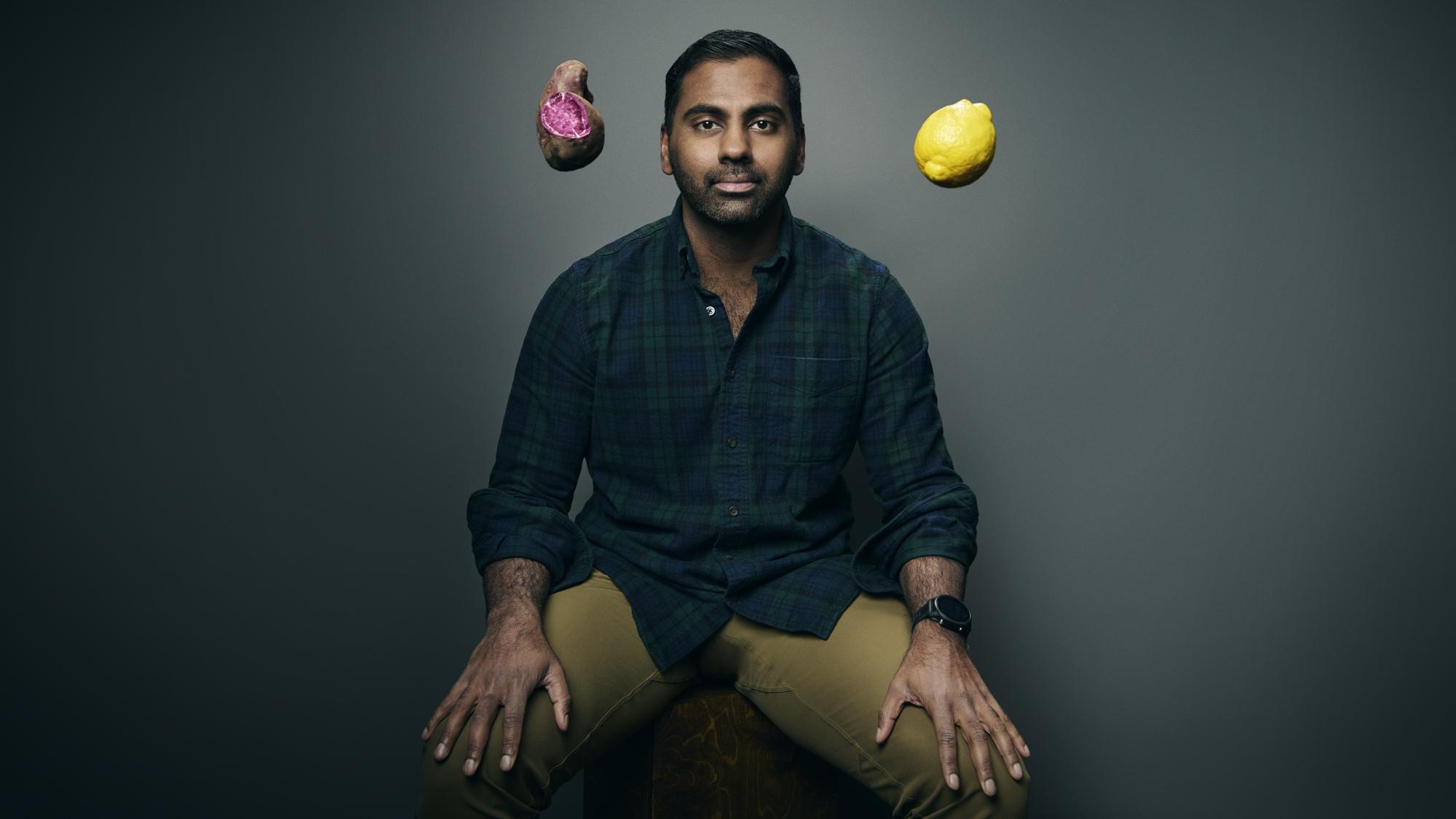
Away from the warehouse, Ramesh has described himself as a poor cook and an enthusiastic consumer of ice cream. He receives his own Misfits box. Romanesco, whose fractal geometry looks almost counterfeit, is a favorite. Asked which misfit vegetable resembled him, he chose a six-pound sweet potato because it suggested a certain talent for lazing around. This may be the only known evidence that he occasionally stops moving.
The orchard insight remains appealing because it is so easy to hold: good apple, no buyer. Everything since has been an attempt to repair the sentence between those two facts. A website found the customer. A box protected the peach. A warehouse kept the order cold. A fleet drew the map. Eight years later, the second life of an apple looks less like rescue and more like a road.