A New Yorker ordering a peach online has to make a small leap of faith. There is no squeeze, no sniff, no quick turn under the fluorescent light. FreshDirect, one of the first companies to make perishable groceries feel like ecommerce, built its business around closing that sensory gap. The answer was not simply a better website. It was a roomful of food people, a centralized warehouse, carefully divided temperatures and refrigerated trucks that move through one of America's least forgiving delivery environments.
Founded in 1999 by Jason Ackerman and Joe Fedele, FreshDirect made its first delivery in 2002. The proposition sounded simple: order produce, meat, seafood, milk, pantry goods and prepared meals from home. Underneath, it was closer to a food manufacturer crossed with a logistics company. Unlike a marketplace that sends a shopper into someone else's supermarket, FreshDirect buys inventory, receives it at a central operation, prepares many products, packs each order and manages the cold chain to the doorstep.
That distinction is still the most useful way to understand the company. Instacart offers breadth across many retailers. Amazon brings scale and a broader membership system. DoorDash and Uber Eats have trained customers to expect immediacy. FreshDirect's historical wager is narrower: if one operator controls more of the journey, it can make a more credible promise about the food itself.
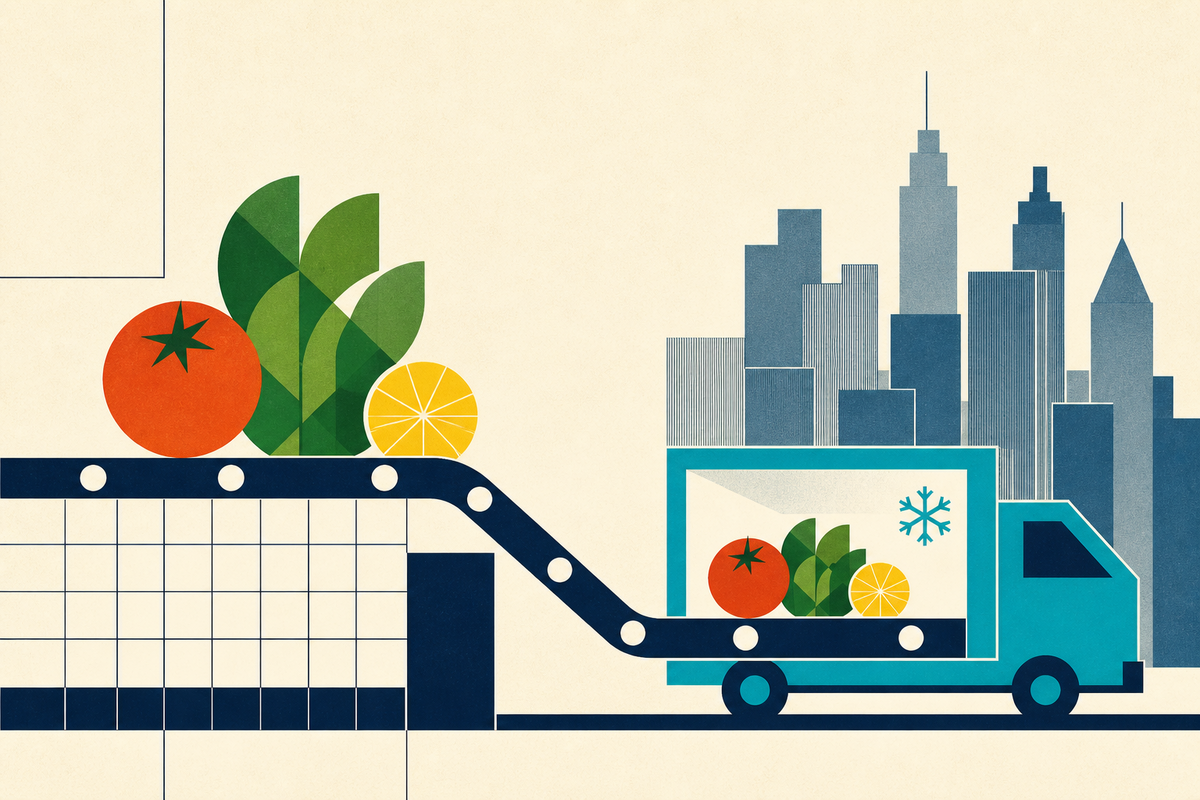
A grocery interface needs judgment, not just inventory
FreshDirect's most revealing feature is a rating system for produce and seafood. The company says its experts taste more than 800 fresh products daily, marking what is especially good at that moment. This is merchandising as translation. A conventional grocer lets shoppers perform quality control themselves. A digital grocer has to perform it before the photograph reaches the screen.
The same idea shapes sourcing. FreshDirect says 90 percent of its produce comes directly from farms. It highlights seasonal goods, local makers and relationships with farmers, fishermen and artisans. A shorter route can improve transparency and shelf life, while centralized buying can make unusual products visible to a large urban audience. Its RIPE incubator extended that role: six emerging brands selected from more than 90 applicants received category-manager mentorship and access to tri-state customers.
“We believe in making great food easy to get.”FreshDirect food philosophy
The phrase is modest, but the operation behind it is not. Fresh food refuses to behave like a book or a charging cable. Bananas ripen. Fish warms. A missing package of paper towels is annoying; a warm carton of milk is a safety issue. FreshDirect's facility must keep ambient, chilled and frozen items in their appropriate worlds, then recombine them into one household order.
One basket, four operating disciplines
A weekly shop, a shortcut to dinner and an office pantry
The consumer product spans the ordinary and the curated. A customer can buy cereal, cleaning products and eggs alongside local oysters, peak-season fruit, butchered meat, wine and a chef-prepared entrée. There are meal bundles for people who want to cook with fewer decisions, ready-to-eat foods for people who do not, plus catering, gifts and seasonal collections. The website and mobile apps support scheduled delivery; express options and the 2025 Uber Eats partnership add more immediate orders.
FreshDirect Business, operating since 2006, adapts the system for offices. It stocks refrigerators and pantries, delivers coffee and paper goods, and supplies meeting platters or individual meals. Corporate customers get recurring orders and dedicated support. That is a less glamorous but durable use case: the office manager who would rather make one large order than coordinate snacks, milk, lunch and supplies across several vendors.
Revenue comes mainly from retail product margins, augmented by delivery charges, corporate fees and DeliveryPass. The current menu lists a $12.99 monthly membership, $79 for six months and $129 for a year. The subscription waives eligible delivery fees, lets members reserve timeslots and encourages a habit: once delivery is prepaid, the next basket is easier to justify. Regular home orders generally have a $35 minimum in the core service area, with fees varying by location.
The moat is also a very expensive building
Vertical integration gives FreshDirect more authority over substitutions, preparation and handling. It also makes the company responsible for nearly every operational failure. A marketplace can spread fulfillment across thousands of stores and independent shoppers. FreshDirect carries fixed costs: inventory, food labor, automation, energy, maintenance, drivers and temperature-controlled vehicles. Demand must arrive in the right density, and delivery windows must be routed tightly enough that a truck is not spending its day hauling air.
That makes New York both attractive and punishing. Dense neighborhoods can put many customers within a short radius. The same streets bring congestion, loading restrictions, elevators, doormen, walk-ups and narrow delivery windows. FreshDirect is not merely competing on grocery prices. It is trying to make all those hidden minutes disappear inside a fee or subscription.
Ownership changes underline the pressure in online grocery. Ahold Delhaize and Centerbridge took majority ownership in 2020. Getir acquired FreshDirect in December 2023 as the rapid-delivery sector consolidated. FreshDirect remains private; a reported $100 million UBS loan in June 2026 was described as funding technology and AI investment. The company's last widely reported valuation was about $600 million in 2016, when a $189 million growth round backed geographic expansion and new facilities.
04 / Opening the loopThe next experiments look less purely direct
In March 2025, FreshDirect put its catalog on Uber Eats in New York City, the first time it had offered on-demand delivery through a third-party app. Orders could arrive in about an hour, and Uber supplied discovery, payment context and a familiar tracking interface. It was a practical concession to how grocery habits had changed: customers still plan a weekly basket, but they also remember the missing lemons at 5:40 p.m.
Two months later, the online pioneer opened FreshDirect on Main in Southampton, its first physical store. The temporary shop sold seasonal favorites, local produce, cheese and FreshDirect staples, with a coffee counter and events. The experiment inverted the original promise. Instead of bringing the aisle to the customer, it invited customers into a small, edited version of the aisle.
Neither move necessarily abandons the centralized model. Both can be read as new doors into the same inventory and sourcing system. Uber Eats can capture urgent demand. A store can make the brand tangible, showcase producers and create local theater. The strategic question is whether those doors add enough volume and relevance without muddying the quality guarantee.
The most interesting thing FreshDirect sells is confidence in the peach you cannot squeeze.05 / The wider ledger
Freshness, waste and the claim to a better food system
FreshDirect frames its mission as building a better food system, and its impact report puts numbers behind that language. It says customer orders have generated $2 billion in local sales since 2002, supported 682 local farms and 824 local small businesses, and reached 3,675 family-owned farms nationally. Eighty-nine percent of employees live in New York City, with the largest share in the Bronx.
Food waste is where grocery ideals meet a messy bin. FreshDirect reports donating 24 million pounds of food to City Harvest over the years. Edible surplus can find a second route through prepared food - imperfect bananas, for example, become banana bread. Material that cannot be donated or reused goes to Divert; in 2023, the partnership converted 667 tons of food waste into eco-fuel. FreshDirect also says all shell eggs it sells are cage-free and that it has introduced paper packaging for raspberries and mangoes.
These are meaningful operating choices, though they do not erase the environmental cost of warehouses, packaging and last-mile vehicles. The honest appeal of FreshDirect is not purity. It is visibility. A centralized system can measure what it buys, wastes and moves. That makes improvement legible, and failure harder to assign to somebody else.
FreshDirect now sits in a peculiar market position: older than the app-delivery boom, more operationally involved than most marketplaces and smaller in reach than national supermarket platforms. Its expertise is the conversion of food knowledge into repeatable fulfillment. For households, that means a weekly shop without carrying bags up the stairs. For offices, it means a stocked pantry without five invoices. For local producers, it can mean one digital shelf with access to dense urban demand.
The company helped teach New Yorkers that a refrigerator could be filled from a screen. Its harder task is proving that the system behind the screen still deserves their trust. That work happens item by item: the strawberry at the right ripeness, the fish kept cold, the delivery window met. Online grocery may look like software at checkout. FreshDirect's story is a reminder that the product is everything that happens before the doorbell rings.