The first Stater Bros. store was not born from a grand theory of retail. It was bought during the long shadow of the Depression by Cleo and Leo Stater, twin brothers who scraped together a $600 down payment in 1936. The shop stood in Yucaipa, east of Los Angeles, and the proposition was plain: good groceries, fair prices, neighbors serving neighbors.
Nine decades later, the vocabulary has changed. Grocers discuss loyalty systems, last-mile delivery, digital circulars, programmatic audio and retail media networks. The weekly shop, however, remains stubbornly physical. A tomato bruises. A butcher's recommendation matters. A missing dinner ingredient cannot be patched in the next software release.
That tension explains Stater Bros. better than a history lesson does. The privately held company now reports 172 supermarkets and roughly 18,000 employees, almost entirely concentrated in Southern California. It is large enough to operate a serious supply chain and small enough for customers to regard it as a regional institution. Its real product is groceries. Its strategic product is familiarity.
A company made for one map
Most chains describe growth as outward motion. Stater Bros. has generally grown by filling in its home terrain. The Inland Empire remains its center of gravity, with stores extending through Los Angeles, Orange, San Diego, Riverside, San Bernardino and Kern county communities. This density gives the business a practical advantage: marketing travels across adjacent neighborhoods, distribution routes stay regional, and the brand appears often enough to become part of the scenery.
The stores are conventional full-service supermarkets, which is less an insult than a useful definition. They cover produce, meat, seafood, dairy, frozen and packaged goods, plus bakeries, service delis, floral departments and private-label products. Party trays and custom cakes turn a grocery trip into event preparation. Sushi counters, fresh-cut fruit, prepared dinners and newer burrito or tamale offerings answer a more modern question: what if the customer needs tonight's meal, not ingredients for an aspirational Sunday?
The customer is not a narrow demographic. It is the household buying a week of staples, the commuter collecting a curbside order, the parent ordering a birthday cake, the host who has remembered the party tray late, and the shopper who wants a human being to cut a particular piece of meat. The company solves the unglamorous recurring problem of feeding people within a budget, close to home, with enough choice to avoid another stop.
Fresh food is the merchandise. Familiarity is the retention system.
The service counter is still software
Stater Bros. executives are unusually direct about the competitive equation. In a 2025 employee newsletter, then-CEO Pete Van Helden cited a survey showing that 79 percent of the chain's most loyal customers also bought food at Walmart as often as they shopped Stater Bros. The company, he wrote, could work to lower prices but could not match Walmart. Customer service was the advantage it had to press.
That is a more credible position than pretending every dimension of the offer is unbeatable. Grocery loyalty is porous. Shoppers split baskets among warehouse clubs, discount stores, specialty markets and delivery apps. A regional chain earns its place by being convenient and by making the human parts of a visit noticeably better.
This is where training becomes part of the product. Stater Bros. runs a meat apprenticeship program and promotes education pathways that include retail management, technical training and tuition support. The company's public culture emphasizes teamwork, respect, open communication and challenging routines that no longer add value. Such language can sound generic on a careers page. At a service counter, it has a test: can the person behind it answer the question?
The invisible supermarket
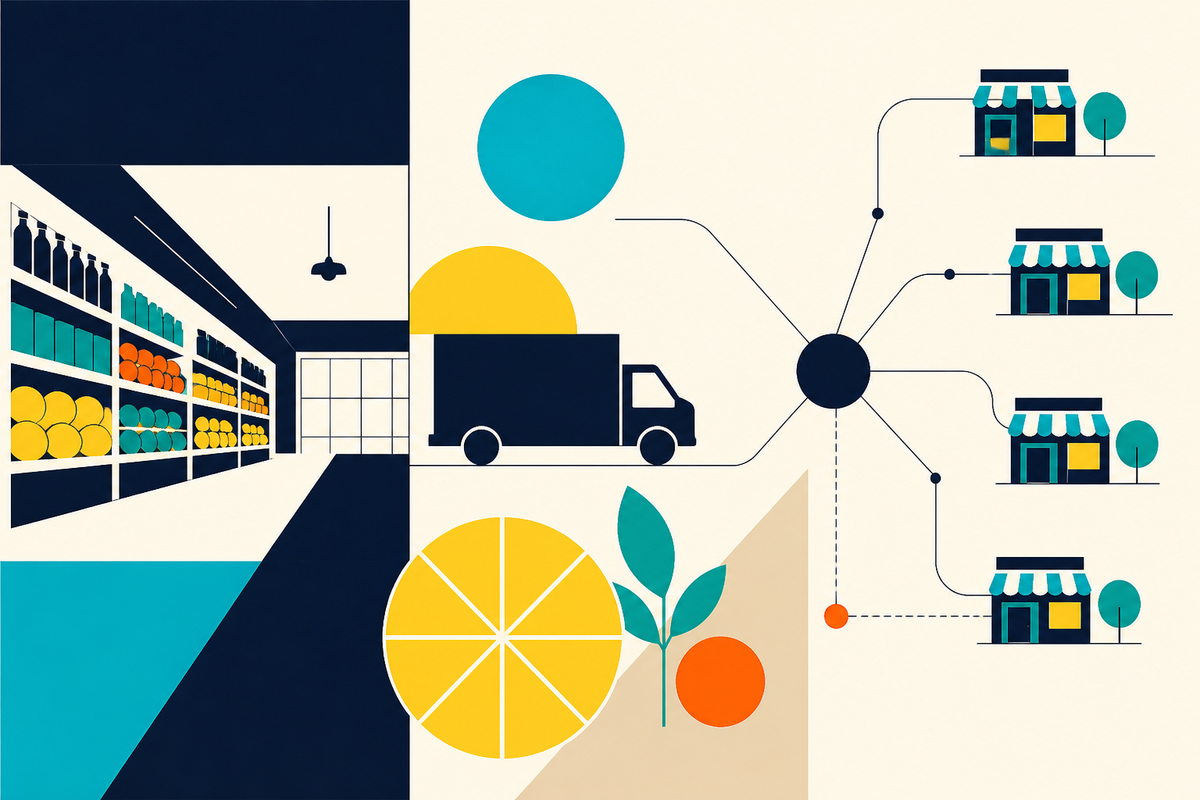
Customers see polished apples; operators see dwell time, shrink, temperature, replenishment and miles. Stater Bros.' distribution center operates around the clock, receiving inventory, moving it through storage and dispatching it to stores. A dense regional network makes that system legible. Each new location adds volume without requiring the company to pretend it understands an entirely new part of the country.
The business model is straightforward and unforgiving. Stater Bros. buys products, moves them, merchandises them and earns a retail margin when customers check out. Private-label items can improve value and economics. Prepared food and catering expand the occasions the store can serve. Weekly ads, digital deals and coupons stimulate trips. Online ordering, pickup and delivery extend the shelf to the phone.
Because the company is private, its economics are less visible than those of Kroger or Albertsons. Supplied company data puts annual revenue near $5.5 billion; Forbes estimated $4.7 billion for its 2025 list. The difference is a useful warning against false precision. What is observable is the scale: hundreds of stores would be a different business, and a dozen would be a different business. Stater Bros. occupies the regional middle, where central capabilities can coexist with a local face.
A second checkout lane for attention
In 2026, the company began turning store traffic into a new product. A partnership with In-Store Marketplace, Mood Media and Vibenomics introduced programmatic audio advertising across 165 locations, with digital screens planned later in the year. For packaged-goods brands, the appeal is obvious: reach shoppers near the moment a decision is made. One partner described the network as touching roughly 2.5 million weekly visitors.
The delicate part is not installing hardware. It is keeping an ad network from making a familiar store feel like an airport concourse. Stater Bros. has framed the rollout as a service to shoppers, communities and vendors, and says success will include shopper receptivity. That qualification matters. The company is monetizing attention generated by trust; too much interruption would spend the asset it hopes to sell.
of the chain's most loyal customers also shopped Walmart for food just as often, according to a 2025 internal company newsletter. Loyalty in grocery is a share of the basket, not a wedding vow.
The receipt has a local address
Community involvement is not separate from the market position. Stater Bros. Charities, launched in 2008, directs money from customers, employees and vendor partners into hunger relief, children's programs, education, health, veterans' causes and other local needs. By 2021 it said it had invested more than $36 million. Its Harvesting Hope campaign reported more than $9.1 million raised through 2023, helping provide over 45 million meals.
The mechanics are beautifully ordinary: donation cards at checkout, coins, supplier support and recurring relationships with regional food banks. ABC7's Feed SoCal campaign adds broadcast reach; Feeding America affiliates provide local distribution. The store is both collection point and community bulletin board. A five-dollar ask makes more sense when the beneficiary is down the freeway.
Military support also runs through the company's history. Cleo and Leo Stater were World War II veterans, as was the late longtime leader Jack Brown. Partnerships with the USO and other service organizations turn that history into food, logistics and grants rather than nostalgia alone.
What survives the remodel
Stater Bros. is now led day to day by CEO and president Greg McNiff, a grocery veteran who took the role in September 2025. Pete Van Helden moved to executive chairman and retained leadership of the charity. Rebecca Calvin became executive vice president and chief marketing officer, adding supply-chain oversight, while Bertha Luna took expanded responsibility for store operations.
The arrangement hints at the work ahead. Marketing cannot promise freshness if supply chain cannot deliver it. Store operations cannot produce warm service without sensible labor planning. Digital tools cannot merely exist; they have to find the tomato when a customer types “tomato.” Store remodeling cannot be cosmetic; it needs to match the way people now assemble meals.
Recent remodels point in that direction: more prepared food, sushi, boba, fresh-cut produce and culturally specific grab-and-go options alongside the expected bakery and floral counters. The company is also adding stores, including a new Menifee project announced in 2026. Growth is still happening on the same map, only with a broader definition of what belongs in the weekly shop.
The useful lesson is not “stay small.” It is “know where scale actually helps.”
For entrepreneurs, Stater Bros. offers a playbook worth stealing. Choose a geography where repetition compounds. Centralize the invisible work. Keep the human moments visible. Let community investment strengthen actual relationships, not merely campaign copy. Modernize where convenience demands it, and be honest about the dimensions where a giant will always win.
The company turns 90 with no immunity from grocery's pressures: thin margins, price-sensitive households, costly labor, aggressive competitors and digital expectations shaped by companies much larger than itself. Its advantage is less dramatic. In much of Southern California, Stater Bros. does not need to introduce itself. The store is already on the route home.