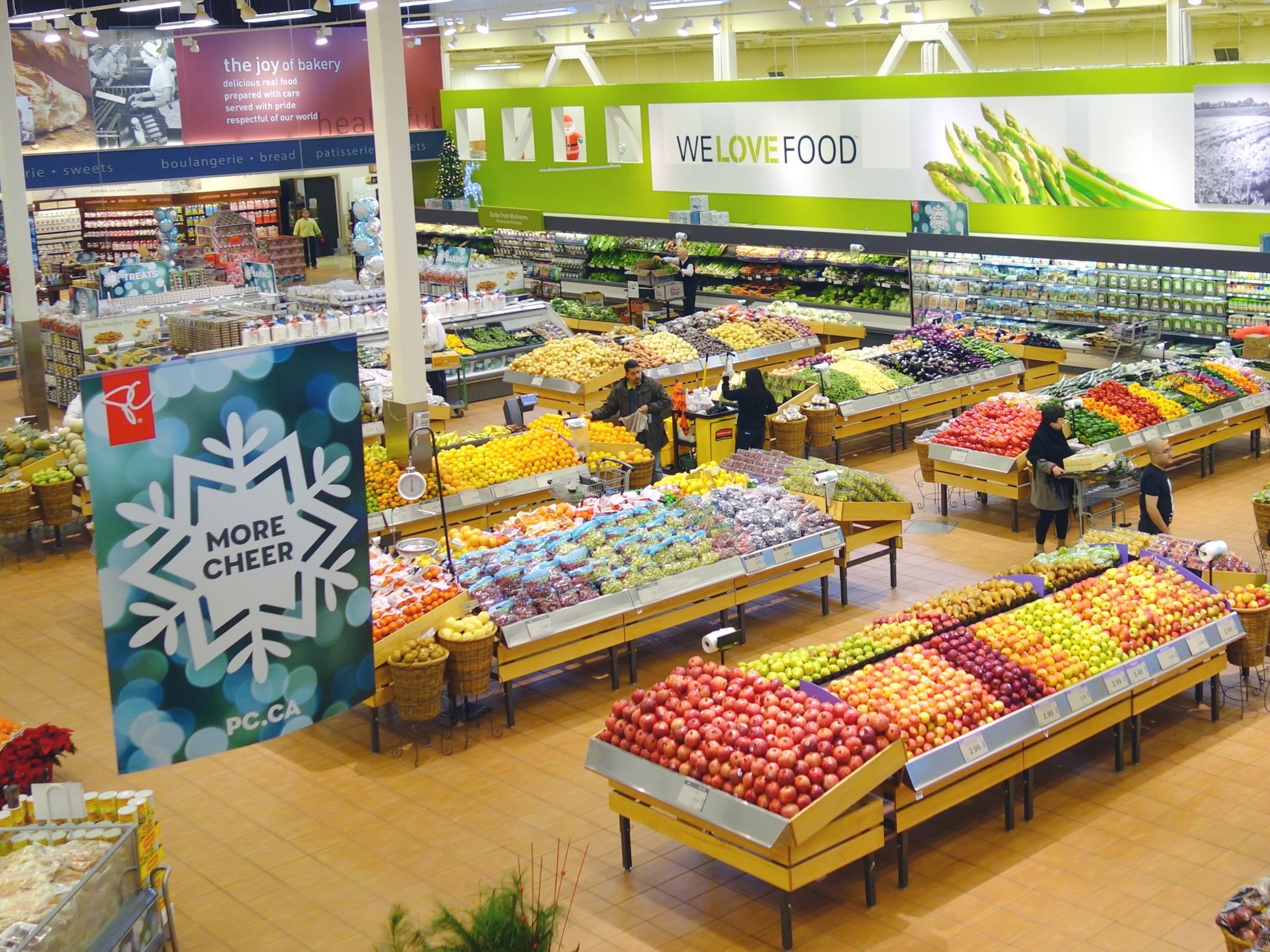
The first Loblaw store made one audacious product decision: it got the grocer out of the shopper's way. In June 1919, Theodore Pringle Loblaw and John Milton Cork opened a Toronto "groceteria" where customers walked past accessible shelves, chose their own tins and packets, and paid cash at the end. No clerk fetching flour. No tab. No delivery wagon bundled into the price. The store was a user interface disguised as a room, and the savings were the sales pitch.
A century later, Loblaw Companies Limited is still in the friction business. It sells food through Loblaws, No Frills, Real Canadian Superstore, Maxi, Provigo, Fortinos, Zehrs and T&T. It sells prescriptions, cosmetics and convenient things you forgot at Shoppers Drug Mart and Pharmaprix. It sells clothing through Joe Fresh, grocery pickup through PC Express and the small dopamine hit of points through PC Optimum. Its healthcare interests include Pharmacy Care Clinics, MediSystem and Lifemark. The names change by region, income, errand and mood. Underneath is one large machine.
The portfolio is the product
Calling Loblaw a supermarket company is accurate in the way calling a Swiss Army knife a blade is accurate. Food retail supplied C$45.2 billion of its 2025 continuing-operations revenue. Drug retail supplied C$18.7 billion, split between pharmacy and healthcare services and the "front store" of beauty, snacks and household essentials. The company reported C$2.67 billion in net earnings available to common shareholders. More than 200,000 people work across Loblaw, its franchisees and associate-owned operations.
The customer proposition is coverage. A price-sensitive family can shop at No Frills or Maxi. A customer seeking a broad conventional assortment can use Loblaws, Zehrs or Fortinos. T&T specializes in Asian food. Shoppers adds medication, beauty and late-hour convenience. PC Express makes the basket digital. PC Optimum remembers the relationship across many of those visits. Loblaw says more than 18 million people actively use the program, while 90 percent of Canadians live within 10 kilometres of one of its locations.
That is the differentiation. Walmart and Costco have scale. Empire's Sobeys and Metro have formidable Canadian networks. Independent grocers can have local intimacy. Loblaw's particular trick is stacking a segmented banner portfolio, famous control brands, pharmacy traffic, a national rewards program and large-scale supply-chain infrastructure. Each layer makes the next one more useful. The app is better with nearby stores; the stores learn more with loyalty participation; the private labels give offers something exclusive to promote.
Yellow paint, premium cookies
The best-known Loblaw products are lessons in opposing directions. No Name debuted in 1978 with 16 generic products wearing black type on yellow packaging. It stripped away the visual theatre of packaged goods and made frugality recognizable from the other end of the aisle. President's Choice, launched in the 1980s, did the reverse. It gave private label a point of view, an editorial voice and products designed to compete on taste rather than merely price. The Decadent Chocolate Chip Cookie became an icon. Together, the brands let Loblaw occupy both "less expensive" and "worth seeking out."
As a 200-store chain, we didn't look very good. As a 100-store chain, we looked very good indeed.W. Galen Weston, recalling the 1970s turnaround
That line matters because Loblaw's history is not a tidy upward chart. By the early 1970s, price wars had cut its Ontario share in half. The chain carried too many aging, unprofitable locations and faced C$80 million of debt coming due. W. Galen Weston became chief executive in 1972, closed weak stores and recruited operators including Dave Nichol and Richard Currie. The first thing to fail was growth without unit discipline. The response was subtraction before expansion - fewer stores, renovated formats, improved products and clearer reasons to visit.
What it cost to become an errand system
The biggest modern step was the 2014 purchase of Shoppers Drug Mart for C$12.3 billion, paid with roughly C$6.6 billion in cash and 119.5 million Loblaw shares. It was not a cheap way to add another storefront. It added prescription files, pharmacy relationships, beauty expertise and frequent convenience visits. Loblaw expected C$300 million in annualized synergies by the third full year. The bet shifted the company from a grocery portfolio toward a household-needs portfolio.
The investment never stopped at the acquisition. Loblaw recorded C$2.06 billion in capital investments during 2025 and expects about C$2.4 billion in gross capital expenditures in 2026 for stores and distribution centres, excluding the effect of the PC Financial sale. Technology and analytics power customer and patient engagement; automation adds capacity to distribution. With Gatik, Loblaw moved groceries on a fully driverless commercial route in Canada in 2022, then announced a five-year Greater Toronto Area expansion in 2025 using cold-chain-ready autonomous trucks.
This works because grocery logistics contain repetitive, high-frequency routes between known facilities. It is a useful warning against copying the shiny object instead of the operating condition. Autonomous middle-mile delivery is not the same problem as navigating an unpredictable driveway with someone's melting ice cream. Dense routes, stable volumes, regulatory permission and disciplined loading operations come first.
The loyalty card is also a trust contract
Scale produces leverage, and leverage attracts scrutiny. Loblaw acknowledged its participation in an industry-wide arrangement involving packaged-bread pricing and offered customers C$25 gift cards. In 2024, as grocery bills remained painful, a consumer boycott made Loblaw the national face of food-price anger. The company argued that supplier costs and inflation mattered; many shoppers saw rising earnings and market concentration. Both realities can coexist. The retailer can run on thin percentage margins and still make billions because the denominator is enormous.
This is where the model is most fragile. PC Optimum is valuable because members exchange attention and purchasing data for relevant rewards. A grocer is trusted because it handles necessities. A pharmacy is trusted with health. Combine those roles and an ordinary disappointment can travel across the whole portfolio. The first self-serve store asked customers to trust marked prices. The modern company asks them to trust personalized offers, health services, retail media and the explanation on a grocery receipt.
The 2026 sale of PC Financial to EQB shows where Loblaw drew a new boundary. EQB paid cash and shares, and Loblaw became a significant shareholder. Yet Loblaw retained PC Optimum, while EQB became its exclusive financial-services partner. The regulated banking machinery moved; the loyalty relationship stayed. That is the clearest signal of what management considers core.
What changed their mind
Loblaw repeatedly changes direction when an operating fact becomes impossible to ignore. In the 1970s, bad stores overwhelmed the value of having more stores. The answer was closure. When premium private-label coffee outsold every other grocery item on its shelf, the company learned that store brands could win on desire, not only discount. When pharmacy visits and grocery visits looked complementary, it paid billions for Shoppers. When banking required a different owner to compete at digital scale, it sold PC Financial while protecting the points layer.
- Give each format one job. Discount, discovery, specialty and convenience should not mumble the same promise.
- Make value visible. No Name's yellow is a memory device before it is packaging.
- Improve the product before the story. The 1970s reset treated weak goods and weak stores as operating problems, not advertising problems.
- Reward a natural frequency. Loyalty works because groceries and prescriptions already bring people back.
- Automate a bounded bottleneck. Known middle-mile routes are a better first target than chaotic last-mile promises.
Where the playbook breaks
A founder cannot reproduce Loblaw by downloading a points plug-in and choosing a loud Pantone. The system depends on frequency, procurement scale, store density, exclusive products and the capital to modernize distribution. Loyalty offers are expensive noise when customers visit twice a year. Private label is a liability without dependable quality control. Multiple formats create confusion if shared infrastructure does not produce real savings. Automation disappoints when routes, regulation or volume keep changing.
It can work when...
Customers return often, the business owns distinctive products, locations are dense, and better data creates visible value for the shopper.
It tends to fail when...
Expansion hides weak unit economics, rewards feel manipulative, brand promises blur together, or scale is used as a substitute for trust.
Loblaw's expertise sits at the intersection of merchandising, brand development, pharmacy operations, customer analytics and physical logistics. Its market position is correspondingly awkward and powerful: essential enough to be routine, large enough to be political. The company can help a household consolidate errands, find lower-priced private labels, collect rewards, order groceries and access pharmacy care. It can also remind that convenience is never neutral when one system becomes the default route through so much of daily life.
The enduring lesson is smaller than the empire. In 1919, Loblaw and Cork watched a shopper wait for a clerk and redesigned the room. Every strong move since has followed that observational habit: find the friction, change the format, make the benefit legible. The caution is equally old. A business can remove friction so successfully that customers start asking what the smoothness costs them.