Scott Hickle’s mother had a problem with her phone. A geriatrician, she had given patients her number, only to receive rather more photographs of their stool than she wanted. When Hickle and fellow engineer Tim Blumberg asked whether human waste contained useful medical information, she had an immediate answer. Their peculiar idea already had customers doing the work by hand.
- A clip-on sensor records bathroom patterns without a wearable or sample kit.
- The current price is $399, followed by $6 a month per member.
- Food and symptom notes give the automatic readings context.
- Today’s product tracks wellness. Cancer screening remains a future ambition.
Throne Science’s opportunity sits inside that exchange. People were willing to collect intimate evidence. Their doctor understood its relevance. The collection method was awkward, and the resulting photographs were hardly an orderly history. A toilet camera sounds like a joke until you consider the system it proposes to replace.
01 The diary nobody wants to keep
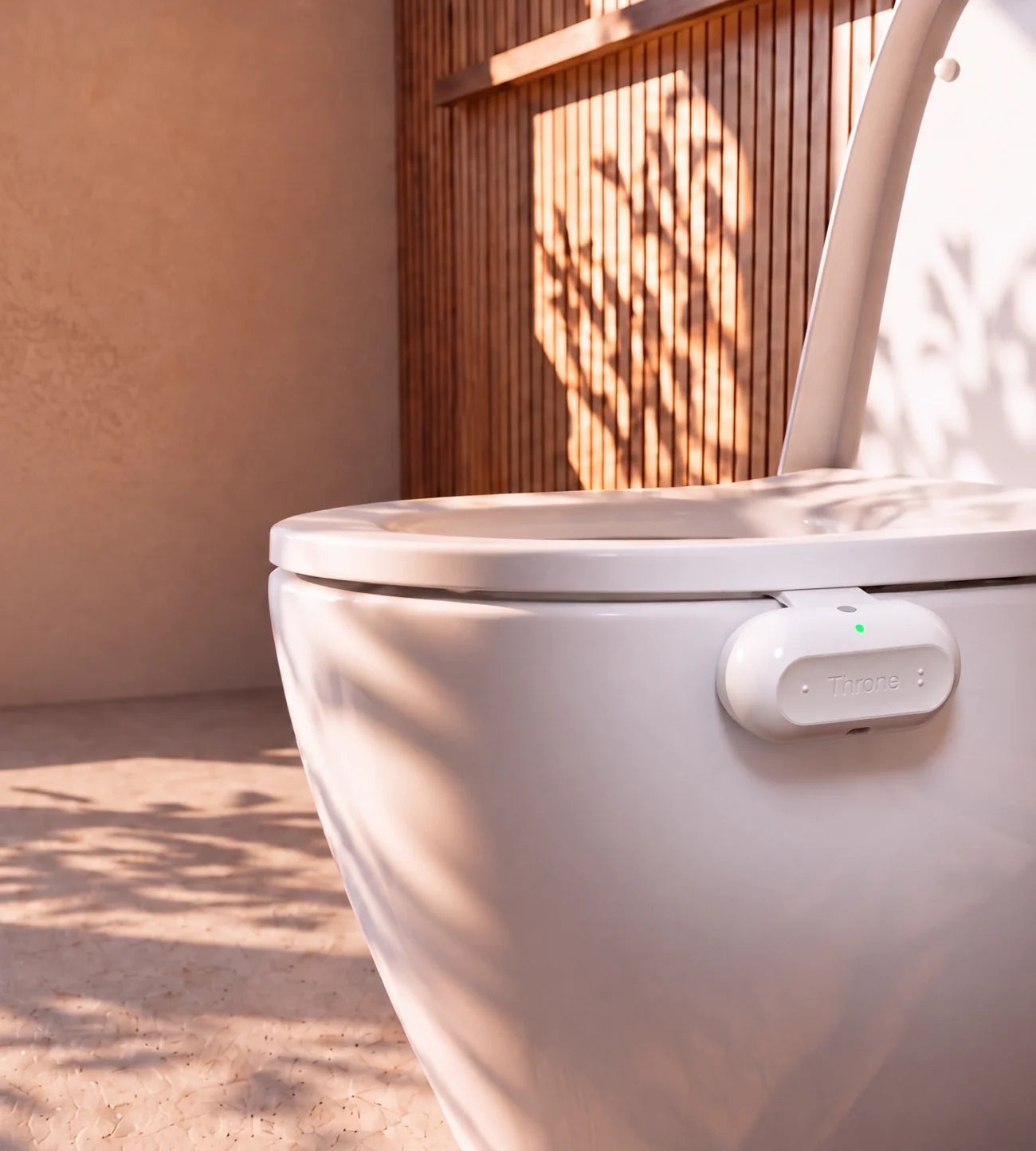
Throne One clips onto an existing toilet. Optical and acoustic sensors feed software that records stool characteristics, hydration-related signals and urinary patterns. The accompanying app turns those observations into a history. The company’s proposition is wonderfully domestic: let the bathroom do some bookkeeping while its occupant gets on with the day.
Its customers include people curious about food and hydration, people watching ongoing digestive symptoms, and wearable devotees whose wrists already report sleep and exercise. A step counter can tell you that you went for a walk. It cannot tell you what happened in the bathroom afterward. Throne adds a different observation point.
The distinction matters when comparing it with stool tests. A microbiome test examines a sample; Throne watches visible patterns over repeated visits. Those are different questions. The notebook remains another competitor: inexpensive, flexible and entirely dependent on someone remembering to fill it in.
02 A wearable veteran, a very personal question
John Capodilupo brings an unusually relevant history. He co-founded WHOOP, the fitness-tracking company, and was diagnosed with ulcerative colitis in 2016. In an interview with the Crohn’s & Colitis Foundation, he described being hospitalized for nearly a month and losing 60 pounds. Tracking was no longer merely an interesting engineering problem.
As he tried treatments, the question became painfully straightforward: would this particular one work for him? Population evidence could not answer that individual question in advance. His experience helps explain Throne’s emphasis on repeated observations of the same person. A reassuring fortnight can look different inside a longer record.
“Is this really going to work for me?”
John Capodilupo, on treatment uncertainty
Hickle and Blumberg founded the company in 2023; Capodilupo joined as chief product officer in 2025 and is now described as a co-founder. Blumberg’s background includes self-driving-car simulations and encrypted databases. The combination is apt: a messy visual problem, sensitive information, and a consumer who would prefer everything simply worked.

03 What the camera cannot tell you
Throne’s science overview describes its use of the seven-category Bristol Stool Scale to classify stool form. Its hydration analysis estimates urine concentration from an optical signal. Acoustic analysis estimates urinary flow during standing sessions. These measurements have limits: stool appearance cannot diagnose an inflammatory disease, and urine color is not a complete assessment of hydration.
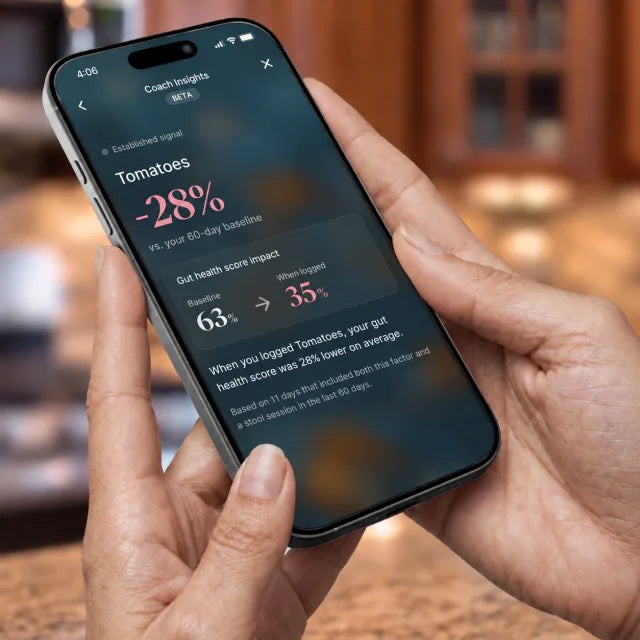
The Gut Health Coach, introduced in beta in July 2026, tackles the next problem: interpretation. Users add journal context about food, stress or symptoms. The software looks across those entries and readings. Automatic capture removes one chore, but the camera still cannot see yesterday’s dinner or the argument before it.
For the reader, the transferable method is simple: keep a baseline, note what changed, and compare ordinary days with uncomfortable ones. Throne’s own demonstration uses coffee creamer as a possible connection to loose-stool days. It presents that connection as something to investigate. A recurring association does not establish its cause.
04 Privacy has a guest problem
A camera beside a toilet needs a convincing answer about when it switches on. Throne recognizes members through a paired phone’s Bluetooth or an assigned physical button. The camera points into the bowl. The company says its data is encrypted and that it never sells personal information.
There is a revealing qualification in the FAQ: a member’s phone left in the bathroom can trigger a session while someone else uses it. Recognition by phone proximity is not recognition of a body. Guests need to know the device is there, and members need to understand that edge case.
The first failure a new owner may encounter is considerably less dramatic. Throne identifies the protective sticker left on the lens as its most common setup hiccup. Dark or patterned toilets can affect accuracy; missed visits leave holes in the record. A clever model still needs a clear lens and representative observations.
05 The subscription follows the person
The $399 device supports up to six members, each paying for a private account. The current offer includes three months for the first two paired members, then charges $6 monthly per person. One member’s first twelve months therefore total $453 before tax, assuming that introductory offer and unchanged monthly pricing.
$399 device + monthly memberships. Three included months apply to the first two members. Assumes current pricing.
After an earlier January target, Throne reports launching to consumers in March 2026. July brought a $10 million Series A led by Will Ventures. Its longer ambition is an early-warning system for cancer, but that capability remains under development. Today’s purchase buys a wellness record. Whether that record earns its subscription depends on how often its owner can turn a pattern into a useful question.