Consider the small ceremony of a health check. Find the equipment. Put it on. Get the reading. Remember where it went. Binah.ai has built a business around shortening that ceremony to something people already know: looking at a phone. Sit still in decent light, face the camera, and wait 35-60 seconds. The familiar selfie acquires an unfamiliar job.
- The product: health-check software businesses put inside their own apps.
- The trick: extract an optical pulse signal from facial video.
- The distinction: camera spot checks; Polar sensors for continuous monitoring.
- The boundary: wellness use, with several blood-test indicators still under research.
That sounds like a story about a camera. It is also a story about the inconvenience of collecting data. An insurer can offer a digital service; a wellness company can offer advice. Both still need someone to supply useful information. Binah.ai occupies that awkward interval between having a customer and knowing how that customer is doing.
The phone has been here all along
The underlying technique is remote photoplethysmography, or rPPG. Changes in blood volume alter the light reflected from skin. Binah.ai uses computer vision and signal processing to extract that faint optical signal from a facial video, then applies algorithms to produce health indicators. Heart rate, breathing rate, heart-rate variability and blood pressure are among its advertised outputs. The face supplies the signal; software does the interpretation.
The company’s founders were David Maman, Michael Markzon and Konstantin Gedalin. Established in 2016, Binah.ai brought together AI and mathematical expertise. Investor Arc Ventures records an intriguing earlier chapter: the company pivoted from endpoint security into health monitoring. Its 2019 materials still described applications across several industries. Today, the business has a much clearer subject: health data collected through ordinary devices.
The customer owns the app
Binah.ai sells to businesses. Its central product is a software development kit, a package developers integrate into their own applications. The customer keeps the interface and the relationship. Binah supplies the measurement capability. There is also Binah Check, an evaluation app for organizations, and Binah Connect, a ready-to-use application for sensor-based continuous monitoring.
Momentum Metropolitan offers a concrete example. It integrated Binah’s SDK into Kimi Screening, adding remote vital-signs checks to an existing application. In Binah’s customer account, Momentum executive Carol Atkinson described the technology as adding a valuable new source of health data to our operation
. The important word is source. An insurer gained another input without asking customers to establish an entirely new relationship.
Other customers give the same technology different surroundings. Together by Renee incorporates checks into a healthcare assistant for older Americans and caregivers. CareOS puts measurements in smart mirrors. Sapiens, the insurance software provider, announced a partnership in February 2024 to connect the capability to insurance workflows. Distribution takes the shape of the service already around it.
The commercial terms follow that logic. Binah’s May 2025 datasheet offers per-measurement or per-device pricing. An occasional screening service and a frequently used wellness app can therefore buy differently. License rates are negotiated rather than displayed as a public shopping-cart price. In June 2020, the company raised a $13.5 million Series B led by Maverick Ventures Israel, funding development and commercial expansion.
Businesses served worldwide across insurance, healthcare and wellness.
Processing happens on the user’s device. Binah says the SDK does not retain videos or give the company access to measured health data. Measurement can run offline; sharing results is a separate step. This architecture removes a required cloud-analysis round trip. The business deploying the software still decides where results go, how consent works and what happens next.
A person can face a camera for a spot check. Repeating that action throughout the day is another proposition.
THE FREQUENCY QUESTION
The wearable arrives, politely
In September 2023, Binah announced a partnership with Polar Electro. A company selling camera checks had invited a wearable into the picture. Maman explained the decision with a practical phrase: Following high demand from the market for continuous monitoring
. Customers wanted a different rhythm of measurement.
A person can face a camera for a spot check. Repeating that action throughout the day is another proposition. Polar’s Verity Sense sensor, worn on the arm, sends raw PPG signals by Bluetooth to Binah’s software. The launch described intervals configurable from three to 120 minutes. Binah Connect can send the results to the organization’s cloud. Continuous monitoring acquires equipment, but loses the repeated selfie ritual.
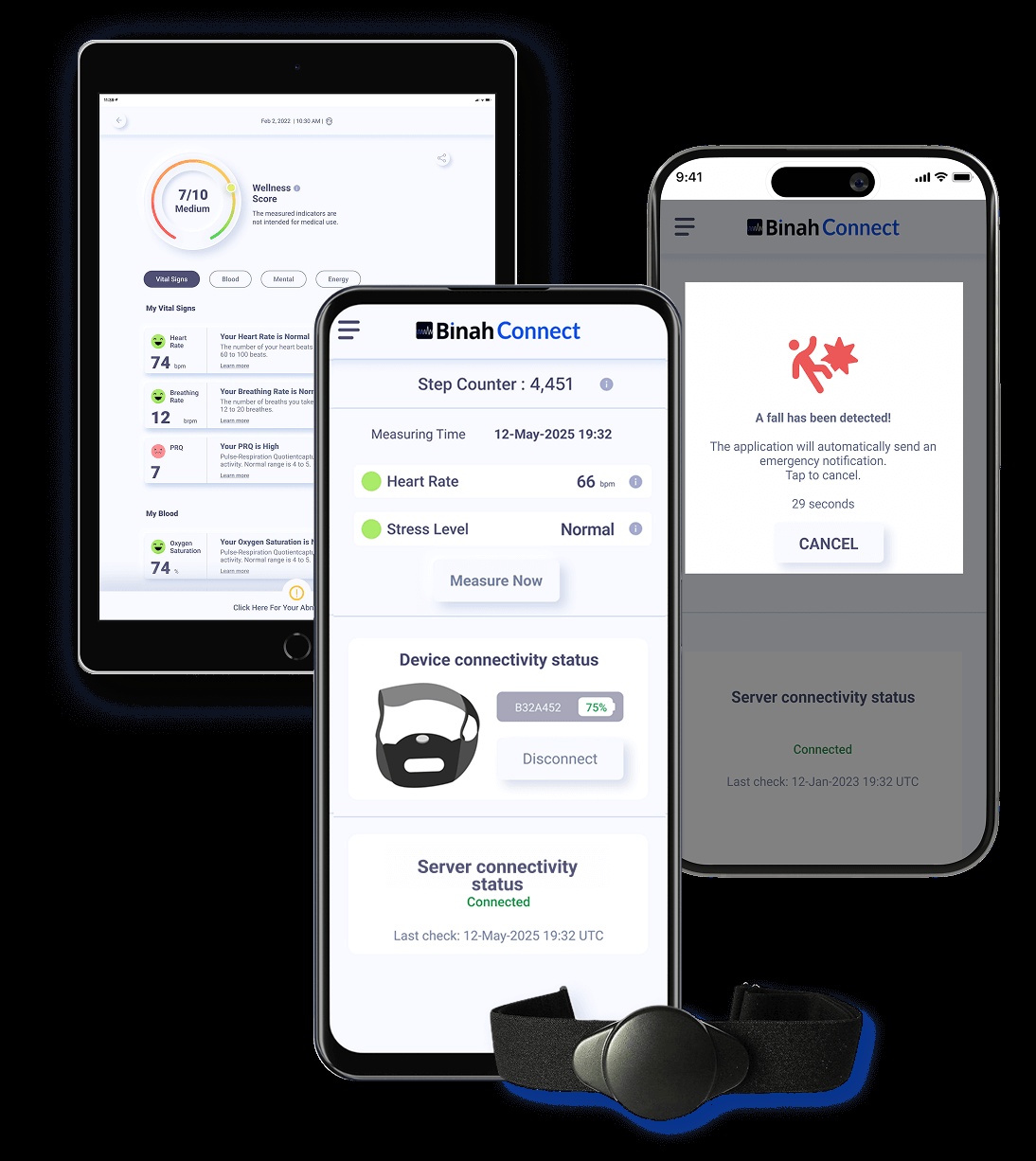
This is a useful distinction for buyers: the input depends on the job. Camera checks reduce dedicated hardware for occasional measurements. The Polar offering accommodates recurring checks and sensor-based fall detection. Both feed the same broader ambition, but they ask different things of the user.
Read the asterisk before the result
Binah’s September 2025 SDK release added cardiac workload, pulse pressure and mean arterial pressure. Its more arresting promise is bloodless blood testing. Current materials mark hemoglobin and HbA1c capabilities as under research. A risk flag, an estimated indicator and a laboratory test have different meanings. A compelling interface cannot make them interchangeable.
The company’s January 2026 announcement describes its own product as intended for general wellness. It also reports CE MDR Class I certification for Comestai’s Binah-powered app, web platform and SDK. That certification belongs to the specified partner solutions; the announcement says third-party custom apps need certification. Product boundaries matter as much as feature boundaries.
Nor is Binah alone. NuraLogix’s Anura and Shen AI also offer camera-based health software. On-device processing appears in Shen’s offering too. Binah’s position rests on its combination of indicators, enterprise integrations and camera-plus-Polar delivery. Buyers have to compare the particular measurement, evidence and intended use, rather than award the contract to the longest feature list.
The clever part is the habit
The portable lesson is about adoption. Put a new capability where people already go. Let a business test it before integration. Make the measurement fit its frequency. Binah’s research guidance supplies the unglamorous conditions: remain still, avoid talking, use good lighting and measure at rest on a supported device. Convenience has requirements.

The interesting wager is that useful health information can become easier to collect without demanding a new daily ceremony. Success depends on whether the check produces an appropriate result, whether someone repeats it, and whether the receiving service acts sensibly. The camera opens the door. The service on the other side has to deserve the visit.