The first thing to disappear was the vendor. A Colorado internal medicine practice had a remote monitoring program, patients using devices, and the ordinary expectation that tomorrow’s readings would arrive. Then its supplier shut down without notice. The practice needed somebody to take over. A polished demonstration could wait; the patients could not.
- Vivo Care combines monitoring software, connected devices, and optional nursing services.
- Practices can manage care themselves or use its U.S.-licensed clinical team.
- A vendor rescue shows why logistics and follow-up matter as much as the dashboard.
Vivo Care’s account of the rescue, published in January 2026, reports 74 patients onboarded within 30 days. Device logistics and clinical intake ran together. Cellular devices replaced Bluetooth failure points affecting older patients. Within 90 days, the company reports a 30 percent reduction in high and critical vital readings. That is a practice-level case report, rather than a controlled trial. Still, it provides an unusually concrete view of the work.
A reading needs a destination
Remote patient monitoring sounds like a problem of distance. A person takes a measurement at home; a clinician sees it elsewhere. But distance is only one obstacle. Someone must enroll the patient, get a suitable device into the house, explain its use, review what comes back, and decide when the practice needs to intervene. Every handoff creates an opportunity for a reading to become merely a number.
Vivo Care packages those handoffs. Its software displays vital signs, highlights readings against configured thresholds, and gives teams population views alongside individual records. Calls and texts sit inside the platform. Care plans and treatment goals can be personalized. These are useful features because they organize attention: which patient has a new reading, which requires review, and which has stopped participating?
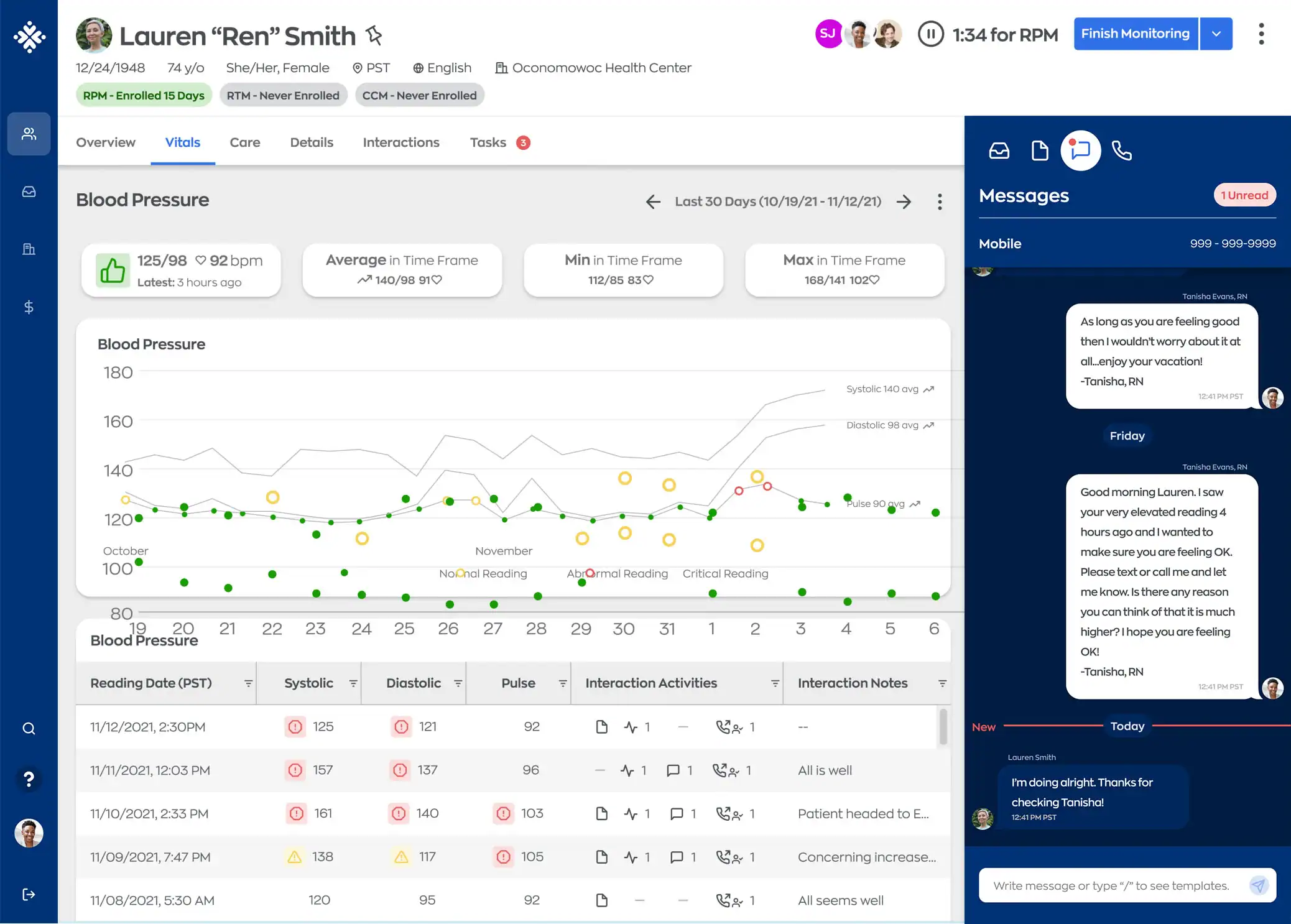
The buyer is the healthcare organization. Vivo Care targets physician practices, hospitals, health systems, federally qualified health centers, accountable care organizations, and groups working under value-based care arrangements. Its market includes teams managing hypertension, diabetes, kidney disease, and other chronic conditions. Patients use the program through their care relationship; this is a business sold to providers.
The nurse behind the notification
A practice can use Vivo Care’s technology with its own staff. Alternatively, it can bring in managed clinical services. That choice matters. A clinic with a functioning care team may need better tools. A clinic already struggling to return calls may need the people who will use them.
The managed service covers patient identification, insurance eligibility verification, device shipping, onboarding, monitoring, and care coordination. Monthly business reviews add an operational check on the program. The clinical team is U.S.-based and state-licensed. In practical terms, Vivo Care offers a way to add remote-care capacity without making the practice recruit an equivalent team itself.
“We act as an extension of the practice.”Kat Baker, RN · Director of Clinical Operations
Chronic care management adds a different kind of work. A blood-pressure chart cannot explain every obstacle to following a treatment plan. Vivo Care’s CCM offering supports care plans that record goals, barriers, symptoms, medications, and allergies, alongside engagement and documentation. Monitoring supplies measurements. Care management helps organize the conversation around them.
- 01Measure
Patient at home - 02Review
Configured thresholds - 03Contact
Clinical conversation - 04Coordinate
Partner practice
The home gets a vote
The Colorado case makes a tempting argument for cellular devices: fewer troublesome connections for patients to manage. Yet homes are not interchangeable. In August 2025, Vivo Care announced a Tenovi partnership adding six device brands and eight device types. The announcement included Bluetooth options for people facing cellular connectivity challenges, including rural residents.
That detail is more revealing than a blanket promise of simplicity. A device strategy has to accommodate the place where the device will live. The practical lesson is to choose connectivity around the patient’s circumstances. Otherwise, the patient becomes an unpaid technical support department, and the clinician receives a beautifully organized absence of data.
Two clocks, one rollout
Vivo Care encountered a similar problem in communication. Its existing secure-link workflow made providers navigate into patient charts to retrieve messages. The company adopted Virtru for encrypted email. The vendor’s account describes a phased rollout lasting about six weeks, including tests with ten trusted clinic partners. Once prepared, the nursing team was operational within 24 hours.
Those two clocks deserve to stay together. The quick activation followed preparation; it did not abolish it. The transferable move was testing with recipients, then resolving the small problems that recipients actually encountered. Software can be easy for its administrator and tiresome for everyone receiving its messages.
The business of the next step
Vivo Care officially launched in August 2025 under CEO Ryan Clark, bringing an existing software history and clinical operation. Public company directories connect that history to Optimize Health, which announced more than $18 million in Series B financing in October 2023. That earlier financing is useful background; it is not a fresh funding round for the new brand.

The business combines software and service contracts with device support. For buyers, the budget calculation extends beyond a platform fee: internal staffing, enrollment, documentation, and reimbursement workflows determine whether the program is sustainable. Against standalone software or a wholly internal operation, Vivo Care’s proposition is the ability to buy several pieces of execution together. That is a purchasing distinction, not proof that it beats every rival.
A May 2026 partnership with Onpoint Healthcare Partners takes the same logic into enrollment. AI-enabled panel management identifies eligible patients during the visit, allowing the provider to discuss participation before they leave. The companies report a 40 percent increase in consent rates. The finding suggests that the timing and messenger of an invitation can matter as much as its wording.
These programs depend on patients participating, connections working, and clinicians following through. Vivo Care’s terms also exclude emergency and urgent treatment. The useful question for a prospective customer is therefore specific: who owns each step when a reading arrives, fails to arrive, or calls for attention? The Colorado rescue supplies one answer. Continuity requires somebody to keep doing the ordinary work tomorrow.