The first Farmer's Fridge was not a vending machine. It was an ordinary refrigerator in Luke Saunders's apartment, bought at Best Buy and filled with salads. The distinction is useful. A vending machine suggests hardware, a sturdy cabinet with a payment terminal. A refrigerator full of homemade lunch suggests an experiment, possibly a peculiar one, and certainly the sort a landlord might remember. Saunders was trying to learn whether freshness and convenience could occupy the same square foot.
The question had followed him for miles. After college, Saunders sold metal-finishing services across Michigan, Ohio, Indiana and Kentucky, driving roughly 1,000 miles a week. The road offered fuel, coffee and a parade of shelf-stable snacks. A fresh meal was usually somewhere else, open at the wrong hour or too slow for the next appointment. He did not have restaurant experience. He had the more irritating credential of being the customer every day.
The idea that emerged was almost childishly legible: prepare proper meals, put them in a small automated shop and keep that shop open around the clock. People told him this sounded like a vending machine. Saunders resisted the term because vending meant chips and soda, the very problem he wanted to escape. Language eventually surrendered to physics. If a refrigerated box displayed food, accepted money and dispensed the purchase without staff, the box had joined the vending family, however much kale it contained.
The worst food court in Chicago
The first public fridge appeared in 2013 in a downtown Chicago food court. Saunders has described it with affectionate severity as the worst food court in the city. It was also the only place willing to take the idea. The machine stood between McDonald's, Dunkin' and Subway, three businesses that required no explanation. His did. A jar full of lunch behind glass asked customers to believe that an unattended machine could be as careful as a kitchen.
So Saunders decorated the doubt away. He rented a scissor lift and painted the wall. He added reclaimed wood, live plants and a patch of AstroTurf, an indoor picnic assembled beside familiar fast food. Most importantly, he stood there for nearly a month and talked to customers. The supposedly automated restaurant came with a founder serving as a very human instruction manual.
“The first-ever fridge was actually in my apartment. I went to Best Buy and bought a refrigerator and filled it full of salads.”Luke Saunders, recalling the first test
There were about three dozen prototypes before the format settled. The work around the machine was no more glamorous. Saunders fetched small produce orders himself, once waiting in his Subaru at two in the morning to be loaded. He helped prepare the dishes and stocked the fridge. Lettuce was cut by hand. Dressings were made from scratch. The first customers returned, which is the only applause a lunch counter can bank.
The cheerful box and the difficult business
The original customer problem was simple. The company required complexity. Fresh food expires, and every location develops its own appetite. An airport terminal, a hospital corridor and a college campus do not want the same lunch at the same hour. Buy too much produce and waste climbs. Buy too little and the machine becomes a handsome empty cupboard.
Farmer's Fridge responded by owning more of the chain. Meals are prepared centrally. Demand-planning software helps forecast ingredients and labor. Refrigerated trucks carry food from Chicago toward regional warehouses, and local drivers finish the routes. Connected machines report sales and inventory. The touch screen is what the customer sees; the clock, forecast and route density are what make the transaction possible.
One salad, four coordinated systems
Saunders has offered the plainest description: “We're really a fresh food logistics business.” It lacks the sparkle of “food tech,” but it explains more. By 2022, he said the network could send food from Chicago to San Diego in 48 hours or less. The company built warehouses, employed its own local drivers and used temperature-controlled vehicles because freshness is an agreement with time, and time is notoriously unmoved by branding.
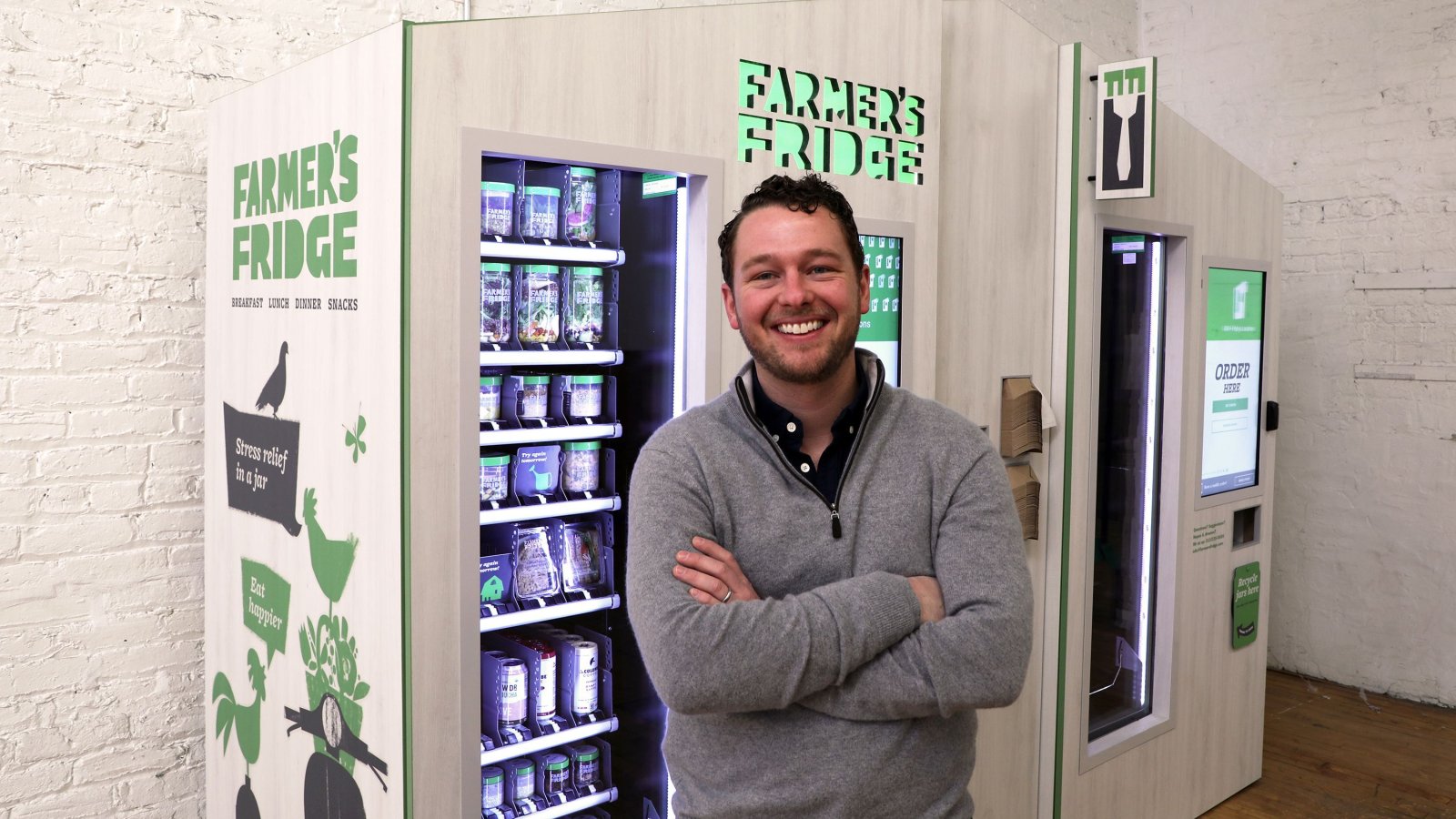
His preparation for this odd hybrid began at Washington University in St. Louis. Saunders studied international studies, taking courses across economics, anthropology and English, and became interested in agriculture and different food systems. Through the university's student entrepreneurship program, he ran Bear Bikes. A bicycle-rental business is not a salad company, but both are merciless teachers of total responsibility. The customer does not care which department lost the lock or forgot the fork.
That appetite for the whole picture also shaped how Saunders described the workplace he wanted. Prospective hires were shown not only the office but the kitchen, with its speed, noise and uncertainty. He spoke about honesty, direct feedback and giving people enough authority to fail. These are agreeable sentiments in a quiet conference room; they become more expensive when a missed decision can strand tomorrow's lunch on the wrong side of the country. Still, the operating logic is sound. A company inventing its own category cannot issue instructions for every situation in advance. People have to notice the exception, name it plainly and act before the lettuce acquires opinions of its own.
When the customers disappeared
By early 2020, Farmer's Fridge had grown around offices, universities, airports and hospitals - places organized by foot traffic. Then offices emptied, campuses closed and travel stopped. In one account, three quarters of more than 400 fridges abruptly had nobody nearby to buy from them. Saunders wrote that sales vanished and revenue nosedived. Investors advised cutting losses. He made retaining the workforce his priority.
The company's awkward abundance became its escape route. It still had a kitchen, refrigerated distribution, drivers and software. Farmer's Fridge redirected those assets toward homes and toward hospitals where people were still very much at work. Saunders said the company was supplying food to roughly 30,000 healthcare workers a week in May 2020. It also moved quickly into home delivery, then expanded retail and business-to-business channels.
This was less a theatrical reinvention than a revealing change of address. The kiosk had been the storefront, but production and distribution were the capability. When customers could no longer reach the machines, the system learned to reach customers by other routes. The episode made visible what Saunders already understood: a channel can vanish while an operating skill remains.
“For people to be effective, you have to empower them to fail; and they will fail.”Luke Saunders on building a candid operating culture
Access, measured in locations
Saunders's stated ambition has remained remarkably consistent: make fresh food easier to get. The interesting word is easier. It moves the problem away from lectures about individual discipline and toward placement, price and availability. A decent lunch cannot be chosen where no decent lunch is sold.
He has said that 15 to 20 percent of Farmer's Fridge locations sit in traditional food deserts, and that serving places with few alternatives can carry both business and public value. The company has also put machines in hospitals, airports, schools and universities - buildings where a meal often has to fit between shifts, gates or classes. Convenience is not frivolous there. It is the product.
The recognitions arrived along the way: Forbes named Saunders to its 30 Under 30 list for Food & Drink in 2016; Crain's Chicago Business put him on its 40 Under 40 list in 2018; Fast Company included him among its 100 Most Creative People in Business in 2019. Washington University now reports more than 2,000 Farmer's Fridge locations and more than 13 million meals served from the machines.
In 2025, Saunders was still explaining the system on podcasts and stages, discussing customer data, hospital expansion and the tradeoffs of vertical integration. The menu kept shifting too. A steak salad prompted a tidy observation from him about rising demand for protein. Even a national network must still answer the oldest lunch-counter question: what do people feel like eating today?
The achievement is not that a salad emerged from a machine. Machines dispense stranger things. It is that Saunders treated distrust, spoilage, forecasting and distribution as parts of the same design. The plants and AstroTurf at the first food court were early versions of this instinct. If the customer hesitated, the environment had to change. If the food expired, the forecast had to change. If the building emptied, the route had to change.
The jar remains pleasingly uncomplicated. Open lid, add dressing, shake. Behind it sits a decade of midnight deliveries, software, cold rooms, candid mistakes and small daily bets on appetite. Saunders wanted to make fresh food as easy to find as a candy bar. The comparison sounded whimsical in an apartment full of salad. In thousands of locations, it now looks like an operating plan.