A supermarket is a clock disguised as a building. The bananas are moving toward brown. The rotisserie chickens have a dinner rush to meet. A promotion is pulling sparkling water forward faster than the shelf can be filled. Online shoppers and people pushing carts are reaching into the same inventory, while a delivery from a beverage vendor follows a different route from the warehouse truck. Every item has a place, a price and a deadline.
Upshop sells software for that clock. The Austin-based company connects forecasts, orders, fresh-food production, inventory, waste, compliance and digital fulfillment. Its ambition is larger than making another dashboard for headquarters. The useful moment comes later, when a store associate sees a short list of work: prep this item, check that date, receive this delivery, print that label, correct this count. The forecast matters only if the aisle changes.
Grocery's problem is not a shortage of software
A large grocer may have separate systems for point of sale, recipes, scales, direct-store delivery, ordering, task management, e-commerce and food safety. Those systems can each be competent and still produce a confused store. A promotion sits in one database. The production plan lives elsewhere. A bakery employee relies on a paper recipe. An online order claims the last unit that a shelf count says does not exist. Tribal knowledge fills the gaps until the experienced department manager takes a day off.
Upshop's answer is a shared operational layer called Upshop 360. Fresh 360 handles ingredient ordering, production plans, recipes, labels and scales. Inventory 360 covers replenishment, counts and receiving. Waste 360 tracks expiration dates and markdowns. Commerce 360 coordinates digital orders. Compliance 360 manages traceability, labels, temperatures and audits. Commissary 360, introduced in 2026, extends production planning to centralized kitchens serving multiple locations.
The platform's newest action layer, Cockpit, collects signals across those modules and prioritizes work for store and field teams. This is a significant product choice. Enterprise software has spent years getting better at displaying information. Store operations demand a stronger opinion: of the hundred things that look unusual, which three deserve attention before lunch?
“Ordering is not a standalone task - it's a storewide decision engine.”Mike Sanders, Upshop CEO
The peculiar mathematics of fresh
Forecasting canned soup is forgiving. Forecasting cut fruit is not. Fresh food has variable weights, ingredients shared across recipes, short shelf lives and production steps that consume labor. Demand bends with weather, holidays, local tastes, promotions and time of day. A forecast can be statistically accurate and operationally useless if it arrives after the prep window or asks a team to make an awkward quantity.
Upshop's domain expertise shows up in those unglamorous details. Its ingredient ordering can translate finished-item forecasts into the amount of each input a kitchen needs. Production plans specify what to make, where and by when. Digital recipes keep portions and allergens consistent. Hardware-agnostic scale and label integrations try to prevent a modern cloud workflow from breaking at the oldest machine on the counter.
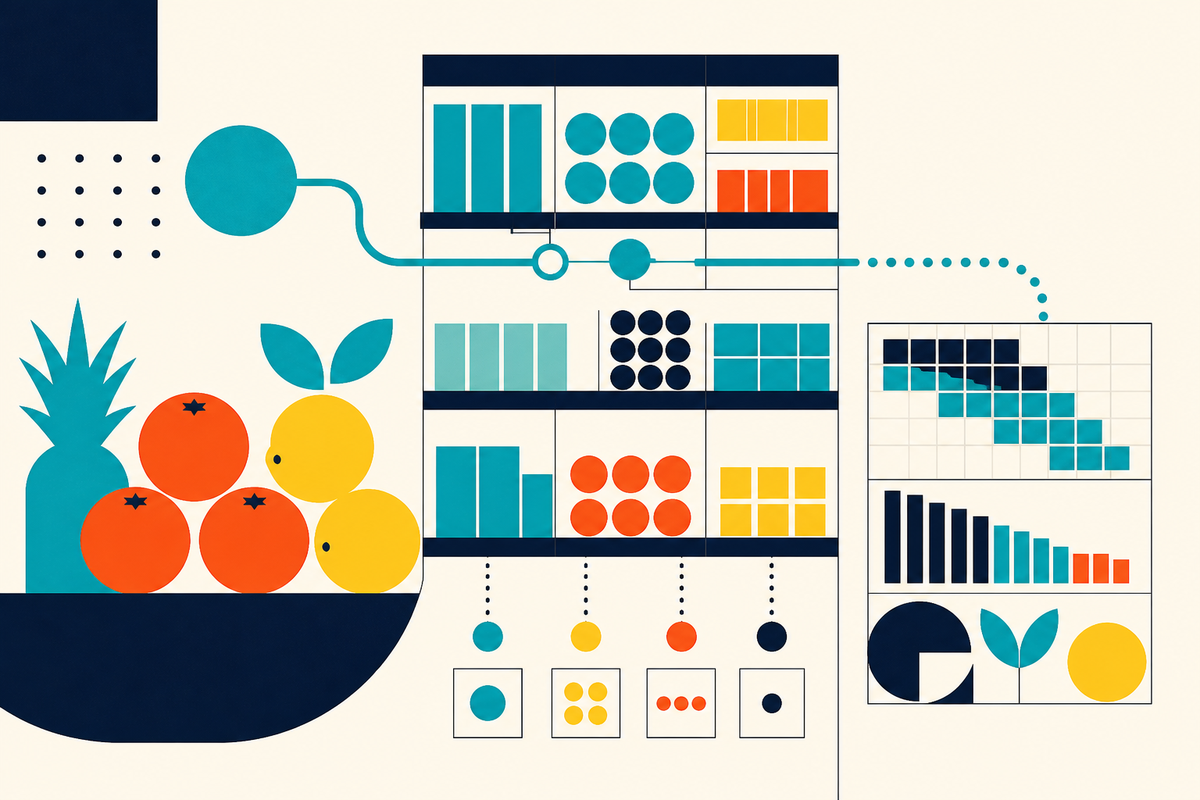
The results in Upshop's customer studies are the clearest account of what buyers expect. The Fresh Market reports 95 percent forecasting accuracy and a 3 to 5 percent sales increase. Albertsons says a financial inventory process that took days can now be completed in hours across more than 2,200 stores. Foodstuffs North Island reports a 90 percent reduction in food waste in key departments and more than an hour of labor saved per store each day after digitizing expiration checks. These are customer-reported outcomes, not universal guarantees, but they reveal the buying logic: small improvements repeated across hundreds of stores become material.
A roll-up becomes a platform
Upshop did not spring fully formed from the current AI cycle. Its lineage begins in 1989 with Applied Data Corporation, a grocery-software specialist. The modern suite was assembled through product development and acquisitions, including ShopperKit for e-commerce fulfillment, Pinpoint for expiration management and Itasca Retail for inventory intelligence. In July 2024, Upshop merged with Invafresh, a fresh-operations company founded in 1988.
That combination changed the scale of the business. In early 2024, Upshop described more than 150 retail customers and 30,000 stores. By June 2026, after the merger, it reported more than 450 retailers and 55,000 stores. Level Equity is the principal financial backer; Tailwind Capital retained a stake through the Invafresh deal, and Prairie Capital remained a minority investor after Level's 2024 investment. Deal values were not disclosed.
The company has also changed leaders. Mike Sanders became chief executive in 2025, succeeding Shamus Hines, who led the acquisition-heavy chapter. The task now is integration: make the assembled modules feel like one product, migrate customers to a shared cloud architecture and turn a larger data footprint into recommendations that remain local enough for an individual store.
| Old patchwork | Upshop's platform pitch |
|---|---|
| Department forecasts | One demand signal across fresh, center store, DSD and commerce |
| Reports after the fact | Prioritized tasks in the flow of store work |
| Paper dates and recipes | Mobile expiry checks, digital recipes and labels |
| Point integrations | Open API plus shared platform data |
Who pays, who uses it and what they are buying
Upshop is a business-to-business enterprise SaaS company. It does not publish prices. Contracts are likely shaped by the number of stores, selected modules, integrations and implementation needs. The economic buyer may sit in operations, technology, merchandising, finance or e-commerce; the daily user may be a bakery associate holding a tablet, a receiver scanning a vendor shipment or a field manager looking across fifty stores.
Named customers span Albertsons, The Fresh Market, Cardenas Markets, Wegmans, Gelson's, Festival Foods, One Stop and international SPAR operators. Grocery remains the center, but Upshop is pushing into convenience and pet retail. The convenience offer is particularly logical: hot food and grab-and-go bring fresh-style forecasting into stores where labor is thin and the product mix is widening.
Partners fill gaps around the platform. Toast is working with Upshop on scale and label integration. ReposiTrak is part of a food-traceability offer tied to FSMA 204. Inmar Intelligence connects marketing and e-commerce execution. Scandit, Zebra Technologies, Shipt and SPS Commerce appeared among partners at the company's 2026 Altitude conference. The pattern is pragmatic: Upshop wants to orchestrate the store, not manufacture every scanner, commerce service or compliance network it touches.
The competitive line is breadth versus depth
Upshop competes with specialists and suites. Afresh and Shelf Engine focus sharply on fresh forecasting and replenishment. RELEX Solutions, SymphonyAI and Retail Insight cover broad planning and retail operations. Blue Yonder, Oracle and SAP arrive through larger enterprise estates. Many chains also maintain custom systems built around their own practices.
Upshop's distinction is not that nobody else can forecast demand. It is the attempt to connect grocery-specific forecasting with the messy work around it: weighted ingredients, production batches, direct-store deliveries, expiry checks, markdowns, recipes, labels, online substitutions and the task queue for the person on shift. Breadth is useful if the seams disappear. It is expensive clutter if they do not.
Trust is the deeper test. An automated order that overreacts to one odd weekend can poison confidence for months. A task list that cries wolf becomes another screen to ignore. Upshop has to make recommendations explainable enough for experienced operators, simple enough for new associates and adaptable enough for stores whose customers buy differently six miles apart.
The store associate is the last API. If the recommendation cannot survive contact with the shift, the model has not finished its job.
Where Upshop fits now
The company sits at the intersection of retail operations software, supply-chain planning, workforce execution and food-waste technology. Its sustainability case is inseparable from its margin case: a yogurt sold before expiry is revenue rather than shrink, and it also stays out of the waste stream. The same forecast can improve availability and reduce overproduction. That alignment makes waste prevention easier to fund than a stand-alone environmental initiative.
In 2025, Upshop launched Total Store Ordering and the Upshop 360 brand. In 2026, Cockpit, Commissary 360 and the Elevate migration program followed. The release sequence tells a coherent story. First unify the modules. Then unify the order. Then translate the combined signals into actions. Finally, help older customers move onto the architecture that can support it.
The opportunity is substantial because grocery margins are narrow and operational errors repeat daily. The risk is equally plain: a platform this broad must integrate with old hardware, retailer ERPs, local processes and workers who have little time for training. Upshop will be judged less by the intelligence of a demo than by whether Tuesday's order is right, Wednesday's label is accurate and Thursday's strawberries sell before Friday makes the decision for everyone.