The Startup That Put a Number on Your Steak
For a century, beef and lamb have been graded by a person squinting at a carcass. MEQ Solutions built the hardware and AI to give the industry a number it can trust - and got the USDA to sign off.
Walk the floor of a large meat processor and you will find, somewhere near the chain, a person whose job is to look at a carcass and decide what it is worth. They are skilled. They are also human, tired by mid-shift, and impossible to clone. For roughly a hundred years, this is how the red-meat industry has answered its most valuable question - how good is this meat? - and the answer has been a trained guess.
MEQ Solutions decided the guess was the problem. The Melbourne company builds hardware and artificial intelligence that measure red-meat quality objectively: intramuscular fat in lamb, marbling in beef, yield, ribeye area, the traits that decide price and eating experience. Instead of a person's judgment, a device gives a number. In December 2025 the company raised US$15 million (A$23 million) in a Series A led by the US software investor Insight Partners, capital aimed at a market worth more than a trillion dollars a year that still runs, in large part, on the human eye.
Turning a judgment call into a measurement
The core idea is deceptively simple. Grading meat has always been subjective - two graders, or the same grader on two different days, can disagree. That variance ripples through the whole supply chain: producers are not consistently rewarded for raising better animals, processors cannot fully back their premium brands with data, and the shopper plays a quiet lottery at the meat counter. MEQ's pitch is to install a consistent, trustworthy number at the point where value is decided, and let that number travel.
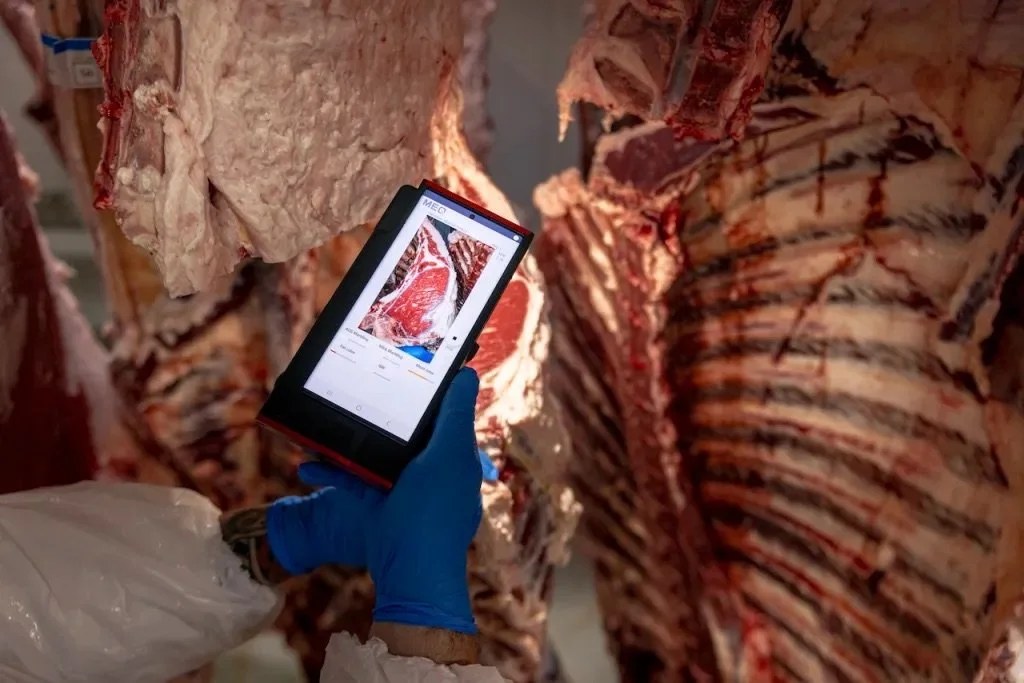
To do it, the company built a family of tools rather than a single gadget. The MEQ Probe is a handheld device that reads a hot, uncut carcass - meaning quality is scored before the meat is even chilled - estimating intramuscular fat in lamb and marbling in beef at the speed the chain moves. The MEQ Camera pairs a smartphone with a clip-on 3D depth sensor, using high-resolution video to grade marbling, ribeye area and yield. MEQ Live pushes measurement earlier still, onto the standing animal. And MEQ Insights is the software layer that turns all those readings into decisions.
Why an eyeball was never going to scale
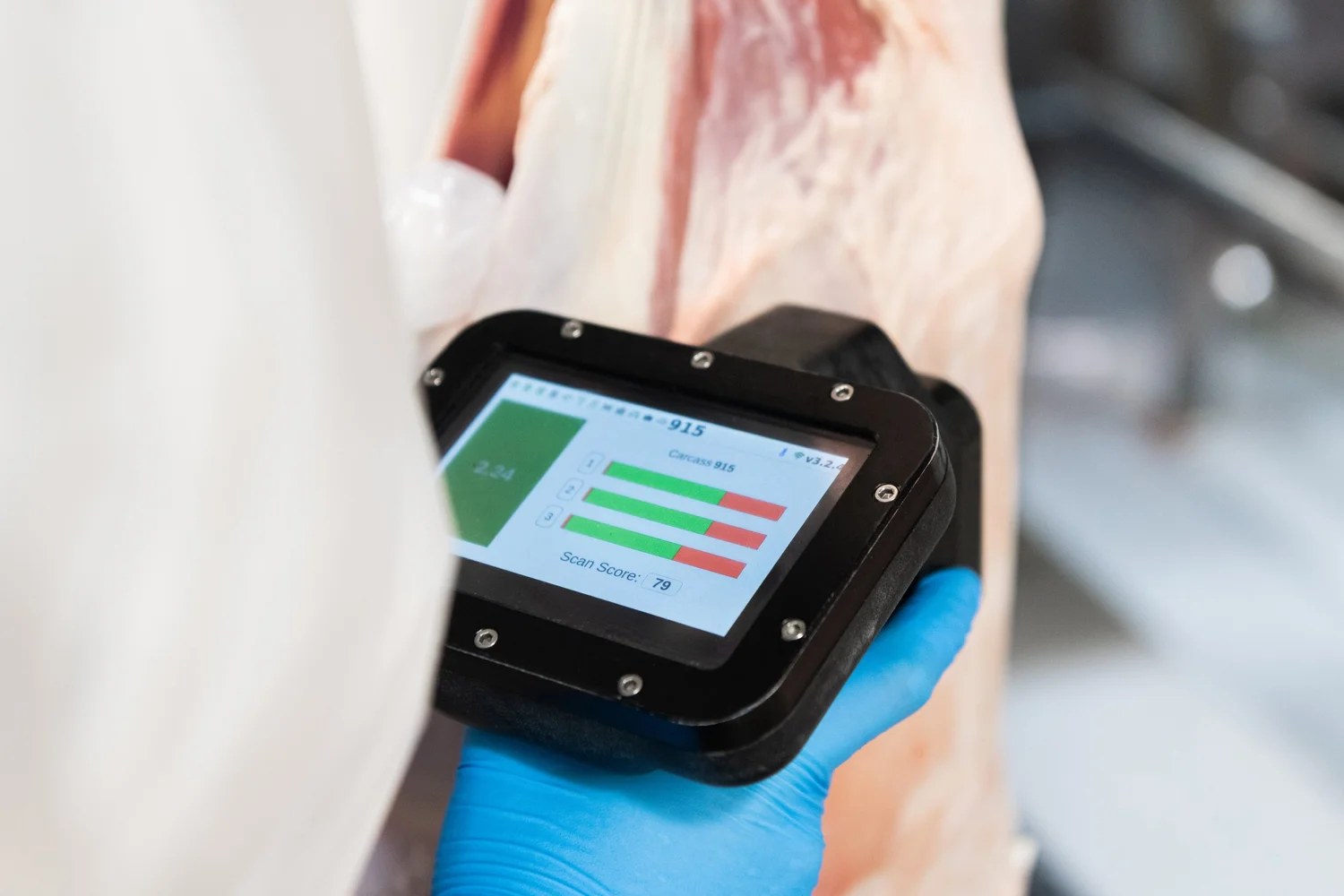
Visual grading has three problems that no amount of training fully fixes: it is inconsistent between people, it is slow to standardise across plants and countries, and it produces no data you can build on. A grader's call lives and dies in the moment. MEQ's instruments produce a record - a scan score, a marble grade, a yield figure - that can be logged, compared, and fed back to the farm. That feedback loop is the quiet prize. If a producer can see, carcass by carcass, how their animals actually performed, they can change how they raise the next ones.
Subjective grading vs. objective measurement
Illustrative comparison of what each method delivers - not a certified accuracy benchmark.
"I never ever thought it was credible that livestock would be replaced."
Remo Carbone, Co-Founder & CEOThat quote is the whole thesis in a sentence. While a wave of food-tech money in the late 2010s chased plant-based and cell-cultured alternatives - betting, in effect, against the cow - MEQ bet the animal was staying and the real opportunity was measuring it better. It was an unfashionable position that turned out to be the durable one.
The founders and the pivotFrom a New York trading desk to the abattoir floor
MEQ was founded in 2016 in Adelaide by Remo Carbone and Andrew Grant, who met through science and technology-commercialisation programs at the University of Adelaide and the University of Texas. Carbone had spent time in institutional financial markets in New York before turning to red meat - an unusual resume for an industry many technologists found culturally distant and geographically remote. He assembled a team that was equally unusual: physicists, meat scientists and engineers pointed at a problem the tech world had largely ignored.
The path to the product was not straight. The founders originally set out to build a probe operated by a human. Along the way they built a 3D camera simply to generate the imagery needed to train their AI models - and eventually realised the camera itself, not the probe, was the more valuable product. It is a classic hardware pivot: the tool built to serve the plan became the plan.
Getting a regulator to say yes
Hardware startups can demo forever; the hard part is getting someone official to stake their name on the reading. MEQ cleared that bar twice. In 2022 it received what it describes as the world's first accreditation for hot-carcass marbling measurement in beef, and it remains the only technology accredited to measure both intramuscular fat in lamb and marbling in beef. Then, in 2025, the bigger one: the USDA certified the MEQ Camera for official beef grading - the first video-based system it had approved, and the first new grading instrument of any kind approved in over 15 years. The certification followed a trial in which more than 10,000 carcasses were analysed between mid-2024 and mid-2025.
"MEQ Solutions is well-positioned to be a category-defining company transforming how value is measured and shared in one of the world's largest industries."
Connor Guess, Vice President, Insight PartnersWho is buying, and how MEQ makes money
MEQ sells to the businesses that turn animals into product: meat processors, premium brands and producers. Its named customers span the map - JBS Australia, Kilcoy Global Foods, Greenhams, Gundagai Meat Processors and Harmony Agriculture & Food in Australia, Alliance Group in New Zealand, and Sustainable Beef in Nebraska. The model is B2B hardware plus software: deploy the measurement devices into a plant, then monetise the data they generate through the MEQ Insights platform. The company reports more than 10 million scans and over 60 deployments to date, commercially live across Australia, New Zealand, the United States and Brazil.
A capital-efficient climb
MEQ has raised in deliberate steps rather than one giant leap. An early A$500,000 in 2018 funded industry trials of the probe. A A$6 million round in 2023 supported the move to a Melbourne base with prototyping and manufacturing space. The 2025 Series A - US$15 million, led by Insight Partners - is the accelerant, earmarked to strengthen operations, grow the team and deepen work with partners across four countries. For a company that builds physical devices, the capital efficiency is notable; hardware usually burns faster than this.
Funding raised, by round
Series A led by Insight Partners. Bars scaled to A$ round size.
The measurement layer under a $1 trillion trade
Objective carcass grading is not brand new - camera and instrument systems from established players have measured cold carcasses for years, and Meat Standards Australia built a respected visual grading framework. What makes MEQ different is range: an integrated hardware-and-AI system that reaches from the live animal to the hot carcass to the cold carcass, tied together by one data platform, and now carrying a USDA video certification no competitor holds. Rather than replacing one grading step, MEQ is trying to become the connective measurement layer - what one write-up called the "truth infrastructure" - beneath the entire trade.
The lesson for everyone else
There is a portable idea here for founders in any unglamorous, physical industry. Find a decision that is being made by human judgment at scale, prove it is inconsistent, and replace the judgment with a measurement people can bank on. The hard, slow parts - building hardware, running multi-year trials, earning a regulator's certification - are exactly what makes the result difficult to copy. MEQ's moat is not a clever app; it is 10 million scans, a USDA stamp, and the trust that comes with them. The caveat is equally clear: this only works where the underlying trait can genuinely be measured, where an authority will validate the reading, and where customers feel the pain of getting it wrong. Red meat happened to check all three boxes.