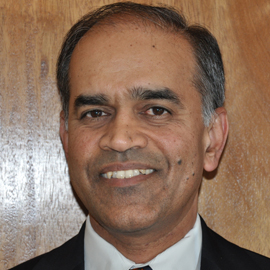
The inventor who chose warehouses
Somewhere between patenting Diamond-like Carbon coatings for hard drives in 1992 and watching Amazon write a check from its billion-dollar industrial fund thirty years later, Dr. Srinivasan "KG" Ganapathi figured out something about deep technology: the more unglamorous the problem, the bigger the opportunity.
Warehouses are not glamorous. They are loud, fluorescent-lit, staffed by people with scanners who spend their shifts walking the same aisles counting boxes that may or may not be where the system says they are. The global supply chain runs on inventory data that is, at best, an educated guess. Ganapathi saw this clearly - and decided to fix it.
In 2017, he founded Vimaan Robotics in Silicon Valley, co-founding it with Marc Mignard. For nearly four years, the company operated entirely under the radar. No press releases. No startup conference panels. Just cameras, sensors, computer vision algorithms, and a lot of time spent on warehouse floors studying how goods actually move.
That patience - unusual in a Valley culture that celebrates speed above all else - turned out to be Vimaan's competitive advantage. When the company emerged from stealth in January 2022 with $25 million in Seed and Series A funding from New Enterprise Associates, Wing VC, and Neotribe Ventures, it didn't just have a product demo. It had production deployments. Fortune 10 customers. Real data from real warehouses.
"The process of collecting inventory data is a major bottleneck within warehouse management. Vimaan has worked hand in hand with our blue-chip customers to design solutions that strike at the heart of data tracking challenges."- SK Ganapathi, Founder & CEO, Vimaan
Started with drones. Ended with everything.
The original Vimaan concept was simpler: use aerial robots - drones - to scan high-bay warehouse shelves that human workers couldn't easily reach. Tall warehouses, tight aisles, inventory stacked stories high. A drone with a camera and a barcode reader seemed like a neat solution.
Then Ganapathi actually started talking to customers.
Cycle counting - the task drones were meant to accelerate - turned out to be a fraction of the real problem. Inventory inaccuracy was everywhere: at the receiving dock, during put-away, through picking, packing, and shipping. Ganapathi directed his engineering team to embed themselves in customer facilities, studying workflows firsthand. Twenty-four months of that fieldwork later, Vimaan had evolved from a drone company into a full end-to-end computer vision platform.
As he put it himself: "What started as a hardware systems play has stretched into an end-to-end solution." That understated sentence describes an entire strategic pivot - one that few deep tech founders execute cleanly without losing their original investors or their team.
Thirty years of invention before the warehouse
To understand why Vimaan works, you need to understand how Ganapathi thinks about technology - which requires going back to 1990, when he completed his PhD in Metallurgical Engineering at Ohio State University. He was 25, freshly credentialed, and promptly headed to UC San Diego's Centre for Magnetic Recording Research. The hard drive era was booming.
From there: Applied Magnetics Corporation in Santa Barbara in 1992, developing Diamond-like Carbon coatings that protected magnetic recording disks. Then Read-Rite Corporation in Silicon Valley in 1994, where he commercialized the "Tripad" recording head - a component that went into millions of disk drives. Then DAS Devices in 1997, where he joined the founding team and served as interim CEO.
The pattern that emerged was clear: Ganapathi is a physicist who becomes a businessman, every time. He does not build products in search of markets. He finds specific material or sensing challenges - things that require deep technical knowledge to even frame correctly - and patents his way through them.
Fidelica Microsystems, which he founded in 2000, applied MEMS technology to fingerprint sensing - a radical departure from capacitive methods that eventually landed it inside Lenovo's portfolio. Verreon Inc., which he co-founded and led as CEO, focused on thermal imaging for displays before being acquired by Qualcomm for integration into its display division.
Two companies built. Two acquired. Then, at an age when most people consider slowing down, he founded Vimaan - with the ambition to reinvent an industry he had no prior experience in.
"Amazon reached out to me, which made me more convinced we're doing the right thing."- SK Ganapathi on Amazon's Industrial Innovation Fund investment
When Amazon called, Ganapathi wasn't surprised
In April 2022, Vimaan became the first computer vision company to receive investment from Amazon's $1 billion Industrial Innovation Fund - a program Amazon launched to back technologies improving safety, worker productivity, and customer experience inside warehouses and fulfillment centers.
The framing of his response was notable. Not "we're thrilled to have Amazon's endorsement." Not the standard founder-excitement boilerplate. Instead: confirmation. Amazon's reaching out meant the problem was real, the product was working, and the direction was correct.
That orientation - using external validation as a signal rather than a celebration - is consistent with how Ganapathi has operated throughout his career. He did not emerge from stealth until after two years of customer deployments. He does not describe Vimaan's technology in terms of what it could do; he describes it in terms of what it does, for specific customers, in production environments.
His customer list, while not fully public, includes Fortune 10 companies, major brand owners, and some of the largest third-party logistics operators in the country. They are not running pilots. They are running Vimaan across live operations.
Patents
Companies
Invention
Six products. One warehouse.
Where most startups build a point solution and call it a platform, Vimaan built the platform first - then filled it with purpose-built products covering every major touchpoint inside a warehouse.
Gartner placed Vimaan in its Hype Cycle for Mobile Robots and Drones, 2024 and its Hype Cycle for Supply Chain Execution Technologies, 2024 - both in the "Autonomous Data Collection and Inspection" category. That back-to-back recognition across two different research threads is unusual for a company still in the Series A stage.
IIT to Ohio. Palo Alto to the loading dock.
Ganapathi left IIM Ahmedabad - one of India's most competitive business schools - after just one year to pursue graduate school in America. He arrived at Ohio State in 1986, earned his master's in 1988 and his PhD in 1990. Both in Metallurgical Engineering. Both, it turned out, foundational to everything that followed.
The materials science background gave him a physicist's intuition about surfaces, coatings, and sensors. The business school year gave him just enough management vocabulary to know what he didn't know - and to hire people who did. The combination shows up in how he talks about Vimaan: precision about the technology, directness about the business problem, and a clear-eyed accounting of what customers actually need versus what engineers like to build.
He serves on the Founding Advisory Board of UC Berkeley's Management, Entrepreneurship and Technology (MET) program - a role that puts him in front of the next generation of engineer-founders navigating the same questions he's answered three times over. He is married to Nita and based in Palo Alto. He is a patron member of the Odisha Society of the Americans, reflecting ties to eastern India alongside his technical roots in Chennai.
Ohio State's College of Engineering recognized him with its Distinguished Alumni Award for Entrepreneurship and Innovation in October 2023. IIT Madras's Alumni and Corporate Relations has featured him as a distinguished alumnus. Two institutions, forty years apart, recognizing the same quality: a person who builds things that work, and doesn't stop.
- His nickname "KG" is used so consistently that press releases officially read "SK ('KG') Ganapathi" - two names, one nameplate.
- He left IIM Ahmedabad after one year to attend graduate school. That year of business school and a decade of engineering produced something neither alone could have.
- The same materials science instinct that drove him to patent Carbon coatings for hard drives in 1992 now powers how he thinks about sensor placement in warehouse environments.
- Vimaan spent 24 months in production at customer sites before its public launch - a stealth period that most Valley startups would consider commercially irresponsible.
- The 40x cycle counting claim isn't a marketing number. It's backed by Fortune 10 production data from deployments that were running before the press release went out.