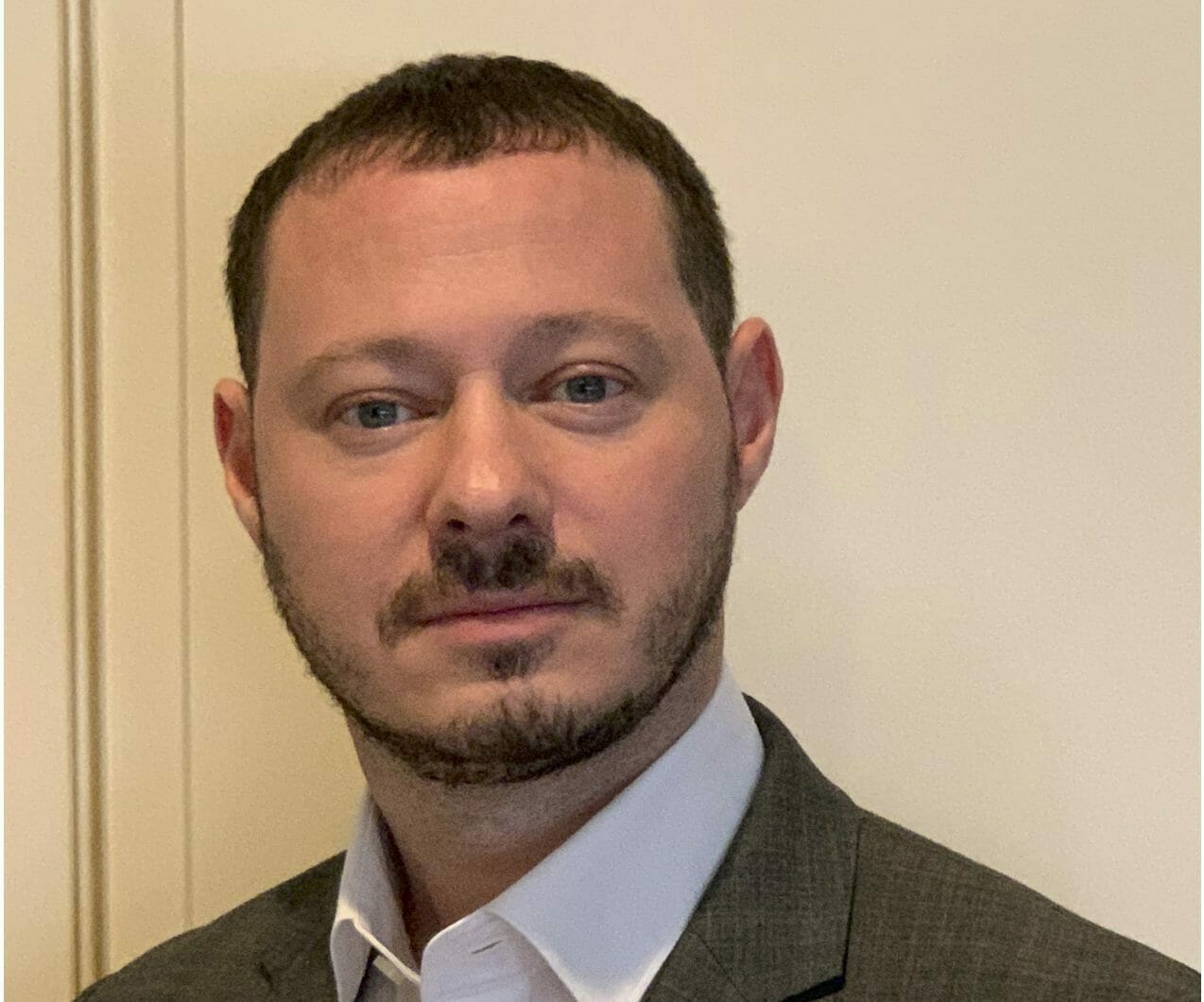
Roman Vinfield's day job is Brainchain AI, a supply chain intelligence company he runs out of a townhouse address on West 16th Street in Manhattan. The company's stated purpose - and this is a real quote from the homepage - is to use AI and ML to "identify and position ourselves ahead of these anomalies to generate revenue in highly volatile markets." Translated: it looks at logistics data the way a poker player looks at a table. When something is about to move, Brainchain wants to be the one that noticed first.
The team is three people. The last funding round, a Series A closed in June 2023, was $1.89 million. Neither of those numbers is what you'd expect from a company whose CEO shows up at the World Economic Forum, but this is where Roman Vinfield stops fitting his own biography.
In January 2023, Vinfield sat at a Davos roundtable that was ostensibly about post-war reconstruction in Ukraine. The organizers were the Ukrainian Venture Capital and Private Equity Association. The other seats at the table included JPMorgan Chase. Partway through, Vladimir and Vitaly Klitschko walked in. Then Boris Johnson. This is not a story most three-person startups have.
The reason Vinfield was in the room - and not just in the room but running the conversation about global supply chains - is that his other job, the one he does when he isn't running Brainchain, is Ukraine Friends. He co-founded it. It is a U.S. 501(c)(3). It has, according to its own tally, evacuated more than 30,000 people, housed more than 20,000, and delivered over 200,000 first aid kits. It has moved 23 ambulances into a country whose ambulances kept getting shelled. The through-line, if you want one, is logistics under pressure.
Vinfield's grandparents were born in Ukraine. They left to escape the Soviet persecution of Jews. He cites this when asked why he is doing what he is doing, which is a slightly unfair question, because most of the people asking it would not have done any of it themselves.
Before Brainchain, before Ukraine Friends, there was WeShield. That was 2020. Vinfield had a network with access to masks at exactly the moment the country needed masks. WeShield distributed personal protective equipment to frontline workers. He served as its Chief Revenue Officer. The company appeared on the Inc. 5000 list. This is the second time in his career he has turned a logistics network into a company in response to a crisis, and given how frequently the world produces crises, it may not be the last.
His origin story in business is unfashionably specific. Early in his career he had to end one Friday by terminating 500 employees. He came back the following Monday and rehired 100 of them. He talks about this now the way a surgeon talks about their first patient. In his telling: it teaches you how to say the true thing at the moment when saying the true thing costs you the most.
He graduated from Baruch College in 2004 with a degree in business. Baruch is the CUNY school that quietly seeds a lot of Manhattan-shaped careers. It does not usually seed careers that end up on Davos panels. Vinfield's did.
The name situation is worth noting. Records list him as both "Roman Vinfield" and "Roman Vintfeld." His LinkedIn, his Apollo record, and his Brainchain email use Vinfield. His personal blog, his Medium byline, and the Ukraine Friends team page use Vintfeld. This is the same person. It is a small, weirdly modern piece of identity friction, and it's the kind of thing that would drive Brainchain's own anomaly-detection software crazy.
What Brainchain actually does, mechanically, is take the noise of supply chain data - shipments, prices, port delays, ML-legible weather, the general nervous system of global commerce - and treat it as a pattern-recognition problem. Most companies want a forecast. Vinfield's argument is that forecasting is the wrong verb. The right verb is noticing. In a volatile market, whoever notices earliest is right.
He has been public about a daily meditation practice, yoga, and an interest in energy healing. He also, on any given week, is coordinating hardware into an active war zone. These are almost the same discipline. Both require sitting with information other people would rather look away from and deciding what to do with it before the moment passes.
Vinfield does not want a job. He wants an assignment. Brainchain is the current one. Ukraine Friends is the parallel one. The pattern in his career is not that he founds things - lots of people found things - but that he founds things exactly when something is already breaking and the market has not priced it yet. This is, coincidentally or not, also what Brainchain sells.
At Davos he made an argument that got quoted around a lot: "Without investment and a thriving economy, it doesn't matter who wins or loses the war." He is trying to say, in language international policy people can hear, that the supply chain and the geopolitical event are the same object. Ukrainian grain feeds North Africa. Ukrainian metals end up in your phone. If Ukraine's economy fails, the reader's economy notices. This is Brainchain's thesis at a global scale.
Whether Brainchain gets big is unclear. Whether it should is a different question. Three people can move quickly. Three people at a Series A do not have to build the org chart, hire the middle managers, or answer to a board that has stopped believing anomaly detection is a business. Three people can sit at a Davos roundtable and represent themselves.
Roman Vinfield's calendar next week is not public. Based on the pattern, some of it is meetings with logistics customers, some of it is meditation, and some of it is a phone call to Kyiv. It is possible he considers these the same call.