David K. Lam’s mother had already decided to invest when her son showed her the business plan. She did not need it. She did not read English, either. Before the venture firms, the factory evaluations and the stock exchange, there was a mother putting a little of her savings behind her son. Semiconductor equipment had acquired its first constituency at home.
Factories required more persuasion. Lam founded Lam Research in 1980; early customers took months to evaluate the equipment, while a recession squeezed their budgets. He expected one successful sale to bring the next. The orders kept him waiting. A machine could perform well and still leave its maker wondering when the telephone would ring.
“My mother was the first investor,” he recalled. It is an unusually economical origin story for a business devoted to making very complicated things. It also establishes a distinction that runs through his career: someone must believe in the engineer before a factory can learn to trust the equipment.
A long way to the factory floor
Lam’s route to California began in Guangdong, China, and passed through Vietnam and Hong Kong. He grew up in Cholon, near Saigon, before his family moved to Hong Kong in the 1950s. After Pui Ching Middle School, he travelled by ship to North America to continue his education. The journey took three weeks. There was time to think about the next chapter before arriving in it.
At the University of Toronto, he studied engineering physics, graduating in 1967. Graduate work at MIT followed: a master’s degree in 1970 and a doctorate in chemical engineering in 1973. He had changed fields from controlled nuclear fusion. His education crossed borders and disciplines before his business career had properly begun.
Then came industrial work at Texas Instruments and Hewlett-Packard. Semiconductor manufacturing supplied a different sort of examination from graduate school. A process had to give dependable results on actual production equipment. An elegant explanation would have limited charm if the next wafer came out differently.
That concern became central to Lam Research’s early system: process wafers individually, isolate the working environment, and use digital control and automation to make the results repeatable. The ambition was practical. Chipmakers needed finer features, and the equipment had to perform the same demanding operation again and again.
University of Toronto
MIT
founded
Nasdaq listing
The sale after the sale
Lam’s early business experience offers a useful correction to the tidy founding date. The interval between making something and making a business from it can be uncomfortable. A buyer’s approval of the engineering does not automatically become a purchasing budget. Nor does the first order establish a habit.
Lam Research eventually gained a foothold in Japan and survived the downturn. In 1984, Lam became the first Asian American CEO to take a company public on Nasdaq. Four years separate founding and flotation on a timeline. Living through them required considerably more patience than reading the dates.
The company’s name made its founder permanently visible. Yet the equipment itself was designed to disappear into the working routines of someone else’s factory. There is a pleasing tension there. A founder may want recognition; a production manager would quite reasonably prefer an uneventful shift.
Seen this way, repeatability gives the story its human scale. It is a promise made by one group of people to another: we understand what your work requires, and this machine will help you do it. The consequences of that promise explain why factory buyers are entitled to be particular.
The engineer becomes a mentor
After Lam Research came a career helping other technology businesses. Lam established the David Lam Group in 1995 to provide advice on growth. He served on boards and worked with founders whose command of their technology could be stronger than their experience of running a company.
He called himself a “mentor capitalist.” The phrase gives the cheque some company. Money can extend a startup’s runway; someone who has managed a growing technology business can help its founder decide what to do with the time.
“I call myself a ‘mentor capitalist’ as opposed to a venture capitalist.”
David K. Lam
His work also extended into institutions that connected businesses with one another. He led the Asia America Multitechnology Association as it developed into an international network. Through Joint Venture Silicon Valley, he helped smaller businesses approach global markets. These were settings in which knowing whom to call could matter alongside knowing what to build.
Public appointments followed a similar outward direction. President George H. W. Bush appointed him to the Minority Business Development Commission in 1989. In 1994, Commerce Secretary Ron Brown selected him for a presidential business development mission to China. The engineer’s working territory had expanded to include the relationships through which companies cross borders.
A football team in the biography
Recognition accumulated: the Silicon Valley Engineering Hall of Fame in 2013, then the Museum of Chinese in America’s Legacy Award in 2022. For MOCA, Lam’s work belonged within the history of Chinese Americans as well as the history of semiconductor equipment. The two histories had travelled together through his life.
His son, David J. Lam, shared the museum’s tribute film and congratulated his father. The film included reflections from semiconductor executives Lip-Bu Tan and Tim Archer. A company founder’s story was being told through colleagues and family, rather than through machinery alone.
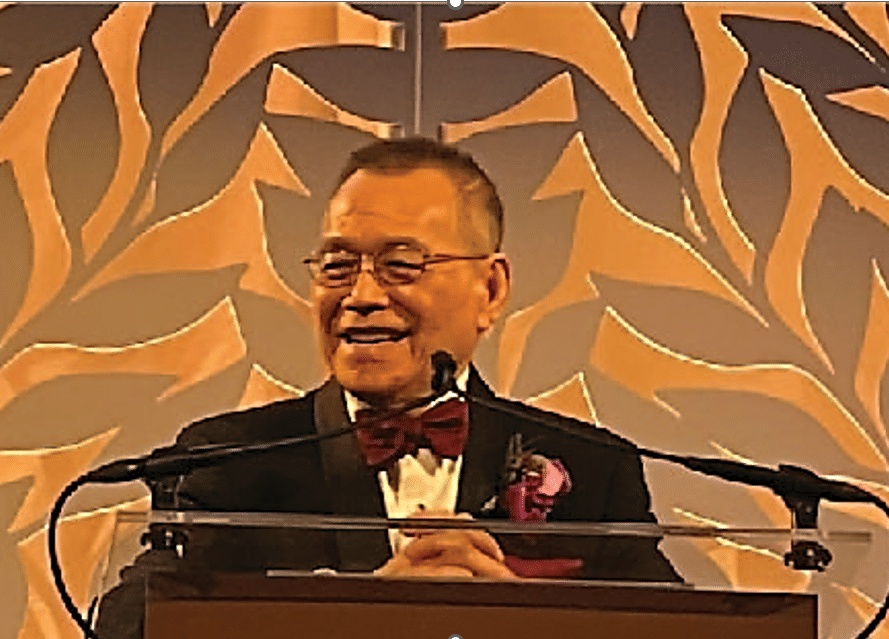
In 2013, the smaller details of Lam’s life included reading, music and watching the San Francisco 49ers. He and his wife, Lynn Barringer, lived in Saratoga. At the time, he was working on a book about entrepreneurial management. Football has the advantage of providing an interest in which even extensive management experience cannot guarantee a satisfactory Sunday.
Those details are modest, but they restore proportion. A doctorate, an IPO and a place in an engineering hall of fame can make a life look like a sequence of certificates. Reading, music and a team to follow suggest the hours between the framed achievements.
Writing without a mask
Today, Lam is founder, chairman and CEO of Multibeam. The company develops multicolumn electron-beam lithography, or MEBL: equipment that writes patterns using arrays of miniature electron-beam columns. It applies his attention to production machinery to another part of semiconductor manufacturing.
Here the attraction is direct writing without a photomask. Instead of making a mask for each new pattern, the system works from design data. For teams changing designs or testing new approaches, removing that intermediate object can make experimentation more practical.
The production challenge includes speed. A useful patterning method must do enough work to justify its place in a manufacturing process. Multibeam’s approach distributes the writing across multiple columns, addressing the throughput limitations associated with a single-column electron-beam system.
The company is pursuing applications in advanced packaging, silicon photonics, quantum devices and rapid prototyping. Such a list can become abstract quickly. The practical question underneath it is familiar: can a team try a design, examine the result, and make its next decision without an unnecessarily long wait?
For Lam, there is a clear continuity between this work and his earlier career. Both concern the passage from a technical process into equipment other people can use. The details of the beam have changed. The customer still needs a dependable tool.
Another order, another ocean
In July 2026, Multibeam announced that National Tsing Hua University in Taiwan had ordered its second-generation MBX platform for the College of Semiconductor Research. Shipment is planned for 2027. The university intends to use it for academic work and joint development projects with chipmakers.
The announced use is particularly revealing. The system is intended to help develop new chip-integration processes, including dense connections between chips. It can also support multiple design variations on a wafer, giving researchers a way to compare ideas within a shared experimental run.
That makes the order a continuation of Lam’s interest in making research useful in production. A university laboratory and a chip factory have different immediate tasks, but their work can meet through equipment, shared development projects and people trained to use both.
There is also a geographical echo. The young Lam Research entered Japan; Multibeam is extending its business in Taiwan. Entering a market involves more than sending a machine across an ocean. The equipment must find a place within the customer’s own plans.
The work after the announcement
A second July announcement concerned a letter of intent with the U.S. Department of Commerce for $140 million in proposed federal funding. The project targets research into fine-pitch advanced packaging and heterogeneous chip integration, with an initial focus on artificial intelligence and high-performance computing.
The objective is to connect chips more densely while addressing performance and power demands. These are manufacturing questions with consequences far beyond a factory: how much information systems can move, how much energy they use, and how quickly a new architecture can be tried.
In August, Multibeam appointed David J. Lam interim chief financial officer. The son had joined his father’s current business in an executive role. The company described up to $205 million in funding and financing, a total including the proposed federal component alongside Series B capital and venture debt.
The qualifiers belong to the story. An order has a delivery ahead of it. Proposed funding has further steps. A design has experiments still to run. Lam’s career makes these intervals visible, even when a list of achievements would hurry past them.
His first investor could decide on family confidence. The customers who followed needed confidence of a different kind, earned through equipment doing its job. Decades later, he is still working within that demanding arrangement. There is another machine to build, another result to repeat, and another order whose arrival matters.