Prakash Narain once went looking for someone to run his company. He had the CEO title. He had the technical direction. What he lacked, by his own account, was preparation for the job. During the dotcom boom, the people he approached had other plans. The vacancy, inconveniently, was already occupied by him.
It is a useful beginning for a founder’s story because it leaves room for learning. Narain, the co-founder, president and CEO of Real Intent, did not arrive with a finished theory of leadership. He had an engineering education, experience inside three chip-industry companies, and an opportunity he wanted to pursue. The rest required practice.
His career has since acquired a recurring plot: develop a conviction, put it to work, and revise it when the evidence becomes awkward. The revisions have touched his products, his management style, and, most recently, his view of artificial intelligence. For someone whose business is checking whether designs behave as intended, that seems an appropriate occupational habit.
The view from the other side of the tool
Narain did his undergraduate work at the Indian Institute of Technology Kanpur. In 1986 he came to the United States, studying at the University of Massachusetts Amherst before pursuing his doctorate at the University of Illinois Urbana-Champaign. His studies brought electronics together with algorithms; Jacob Abraham guided his doctoral work in testing.
His professional education continued at IBM, AMD and Sun Microsystems. The sequence mattered. At IBM he developed tools. At AMD he worked on design flows and became an architect of the Mercury Design System. At Sun he led test and verification for UltraSPARC III. He had moved from building instruments to understanding the work people needed those instruments to do.
That distinction gave him something an algorithm alone could not supply: the user’s predicament. A tool can be clever while leaving an engineer to bridge the distance between its output and a finished chip. Narain had now worked on both sides of that distance. The customers he hoped to serve would have constraints as real as his own.
- IBMBuild the tools
- AMDConnect the flow
- SunUse the tools
- Real IntentBuild the business
A smaller question worth answering
Real Intent dates its founding to 1998. Its early ambition was formal verification: applying mathematical analysis to the task of checking chip designs. The proposition had intellectual appeal. The commercial world had its own timetable, and the company’s arrival overlapped with the boom and subsequent bust of internet-era investment.
The first useful surprise came from a piece of supporting technology. While developing a broader formal solution, the team built a way to generate verification targets automatically. Technical adviser David Styles, then CTO of Siara Systems, tried it on a design. Strange results turned out to point to a real design problem, discovered after the chip had already been taped out.
There was a product hiding inside the preparation for another product. Nvidia became Real Intent’s first real customer. Narain still wanted to challenge simulation, and initially regarded this narrower success as a possible distraction. The customer, rather inconveniently for the original plan, appeared to find the distraction useful.
The company eventually chose products aimed at specific verification problems over the attempt to build a sweeping automated formal system. Its history places the move toward static sign-off in 2010. Formal technology remained part of the toolkit. The ambition became more precise: solve a bounded problem at a scale and speed that made the solution practical.
“I would have been less married to the technological concept.”
Prakash Narain, reflecting on Real Intent’s early direction, 2013
That admission gives the pivot its human weight. A founder can spend years acquiring the expertise needed to form an idea, then discover that running the business requires loosening his grip on it. Narain’s retrospective judgment was that he should have corrected course earlier. Experience had improved the question he was asking.
The customer is allowed to interrupt
By 2013, Narain described a different relationship with customers. Real Intent would listen carefully, understand the difficulty underneath the request, and craft a solution. Listening still required imagination. Taking every requested feature literally could miss the actual problem. An engineer needed to investigate what the customer was trying to accomplish.
That approach suits a business whose work is easy to overlook from outside. Static sign-off checks particular classes of design issues before a chip is manufactured. Clock domain crossing, reset domain crossing and RTL linting are among Real Intent’s applications. They concern the details that must behave reliably while a larger system performs its more visible tricks.
Narain’s writing repeatedly returns to the engineer reading the results. Reporting every possible violation can create a formidable review burden. False positives consume attention; excessive noise can make actual problems harder to recognize. A useful verification tool must consider the person who has to decide what each warning means.
A report’s usefulness depends on how efficiently an engineer can separate actual errors from warnings that need a waiver.
The practical test extends to support. In May 2024, lowRISC announced that it was deploying Ascent Lint, Meridian CDC and Meridian RDC for the OpenTitan project. Its CEO, Gavin Ferris, pointed to clear reporting and customer support in explaining the choice. Those are modest-sounding virtues until someone has to finish a design.
Learning to leave the work in other hands
Narain’s account of leadership follows the same movement toward practical usefulness. In a 2023 conversation, he described learning people management, product management, administration, marketing and sales as he built Real Intent. An engineering background gave him technical judgment and a shared language with his staff. It did not automatically furnish the rest of the job.
His preferred approach is to hire capable people and delegate. That involves accepting dependence on colleagues, including in the near term. The leader who insists on touching everything may leave a recognizable imprint, but also a queue. Narain’s stated aim is an environment where people can develop within their areas of competence and accomplish something together.
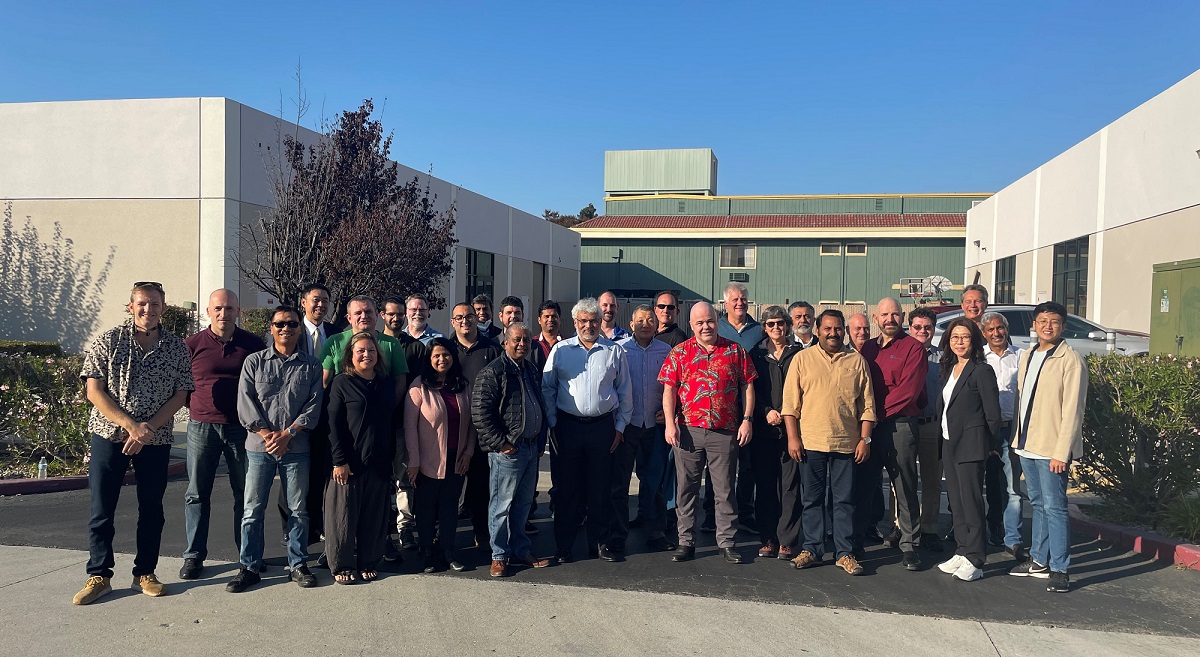
In October 2022 he marked the return of an in-person sales kickoff, the first since 2019. Colleagues had travelled from the United States, Germany, India, Israel, South Korea, Japan, Armenia and Ukraine. The gathering made the geography of the business visible: a Sunnyvale company whose daily work depends on people spread across borders.
He has also argued that the industry needs to cultivate its next generation. In his 2021 ESD Alliance council candidate statement, he called for stronger university relationships and better research funding. In 2023, he emphasized opportunities arising from the CHIPS Act. His interests reach beyond recruiting for one company to the conditions that let an engineering industry replenish itself.
A change of mind, delivered with a shrug
At the 2026 DAC Troublemakers panel, John Cooley pressed Narain about his apparent reversal on AI. Previously, the emphasis had been on core algorithms. Now Real Intent had announced an AI agent. Narain’s initial reply was brief: “Why Not?” The exchange drew laughter before he explained how advances over the previous year had changed his assessment.
The explanation retained two distinct strands. Real Intent was adopting AI for orchestration and debugging while continuing its work on the underlying analysis technology. A change in his assessment of AI had added another way to help engineers. It had not removed the need to understand a circuit.
Read the design
Microarchitecture analysis infers functional components from RTL and checks them in context.
Help the engineer
Riven uses generative and agentic AI to assist with knowledge, violation review and debug.
Riven, launched in July 2026, lets engineers ask for product knowledge, prioritize violations and investigate root causes. Its proposed fixes can be modified or accepted by the engineer before the checking tool runs again. Real Intent advertises up to tenfold faster sign-off workflows. That is a company performance claim; the workflow itself makes the continuing role of engineering judgment clear.
At DVCon India that September, Narain discussed microarchitectural analysis: recognizing familiar components such as state machines, counters and FIFOs within a design’s RTL description. His explanation starts from how designers think about their circuits. Identifying those components supplies context that a purely low-level view can lose.
He also urged care with autonomous agents, comparing the need for reliability to the brakes in a car. The analogy is pleasingly ordinary for a discussion full of acronyms. A suggestion that sounds plausible is useful only if the process surrounding it can support a reliable decision. Debug assistance offers a concrete place to begin.
Keep the curiosity. Revise the plan.
Today Real Intent describes a worldwide customer base of more than fifty major semiconductor companies. Narain remains responsible for its strategic, technological and business direction. The institution he once thought needed another CEO has become the setting for his continuing education in how engineers work and how a company serves them.
His story resists the tidy pleasure of a founder proving his first idea correct. Some of the consequential steps involved recognizing a useful accident, accepting a narrower product, or changing an opinion in public. The curiosity that took him from tools to chip design survived. It acquired a customer’s calendar, a colleague’s expertise, and permission to reconsider.
Continue the conversation
Meet the company, hear Narain explain his work, or read the longer conversations.