Federico Faggin left his initials on the Intel 4004. Look closely at the chip and there they are: F.F., a small assertion of authorship inside an object designed to disappear into other objects. Engineers rarely get a signature people can see. Faggin arranged matters so that a microscope would do.
There is a pleasing complication. On the pre-production design, the initials sat inside the circuit. When he needed room for additional circuitry, he moved them to the border. Even vanity, if that is what we choose to call it, had to observe the requirements of the floor plan.
The detail suits a career spent moving between the abstract and the stubbornly physical. An idea about computation had to become working silicon. A company needed customers. A finger needed a way to tell a computer where to go. Now Faggin asks what happens on the human side of that exchange: how information becomes experience, and whether a machine can ever know what anything feels like.
A boy who feared the inventing was over
Born in Vicenza on December 1, 1941, Faggin grew up with a taste for taking things apart. He has recalled his father telling a story about five-year-old Federico worrying that everything had already been invented. It was an admirably early encounter with the fear of arriving late. History would provide him with rather a lot of reassurance.
Model airplanes caught his attention, followed by electronics. He attended the Alessandro Rossi technical institute in Vicenza. By 19, working at Olivetti, he had helped design and build an experimental transistorized computer. That is a substantial answer to a childhood complaint about the shortage of things left to make.
He then studied physics at the University of Padua, graduating with a laurea, summa cum laude, in 1965. The combination matters: he had already worked on an actual computer before completing the academic training that would help him understand its physical ingredients. He approached electronics through both the bench and the blackboard.
In 1968, he moved to California to work at Fairchild Semiconductor. He brought experience with MOS circuits from SGS-Fairchild in Italy. The journey from Vicenza to Palo Alto is often told as a geographical transformation; the more consequential change was happening at a scale no passenger could see through an airplane window.
Before the processor, the process
At Fairchild, Faggin developed the MOS silicon-gate technology used in the Fairchild 3708 integrated circuit. The gate is part of a transistor, and the choice of its material affects how the device can be made. Replacing the earlier aluminum-gate approach with a practical silicon-gate process helped address problems of speed, reliability and density.
This was exacting work involving fabrication temperatures, alignment and unwanted electrical effects. The gate could help define the adjoining transistor regions during manufacturing. That self-alignment reduced troublesome overlap. A small improvement in how one transistor was made could become a large improvement when repeated across a circuit.
Such work tends to lose the publicity contest to a finished product with a memorable number. Yet Faggin’s next chapter depended on it. A processor design needed a method capable of putting the required circuitry onto silicon. His experience joined the proposed machine to a way of manufacturing it.
A central processor on one chip, working with separate memory and input/output components.
A calculator order with other ideas
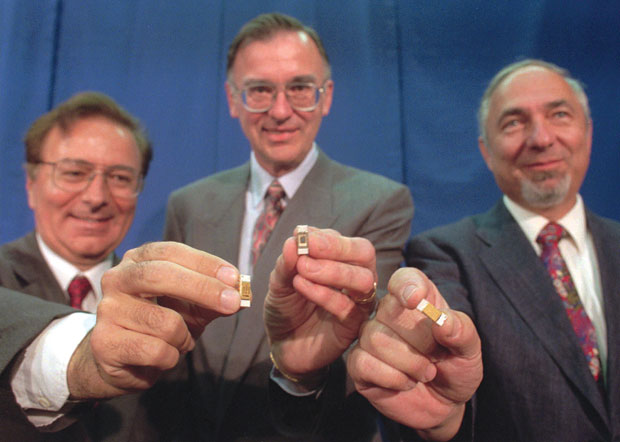
Faggin joined Intel in 1970. The company had accepted an order from the Japanese calculator maker Busicom, whose original proposal called for twelve custom chips. Ted Hoff and Stanley Mazor developed a simpler alternative around a programmable processor. Masatoshi Shima brought Busicom’s engineering requirements and worked on turning the system into a usable calculator.
Faggin led the chip design and development. His silicon-gate experience and logic-design methodology supplied a route from the architecture to the devices themselves. The familiar names belong together: Hoff, Mazor, Shima and Faggin. Their contributions differed, which makes the collaboration more interesting than a solitary-inventor fairy tale.
The resulting MCS-4 family comprised the 4001, 4002, 4003 and 4004. Faggin chose the related numbers to make the components read as a family. The 4004 contained the CPU; the other chips supplied supporting functions. A processor on a chip still needed companions. Miniaturization had not abolished the need for a good supporting cast.
The commercial twist came when Intel regained rights to sell the technology beyond calculators. Busicom wanted better pricing; Intel saw broader possibilities. In November 1971, the company announced the 4004 for the general market. A customer’s particular problem had produced a component that other customers could program for their own purposes.
Leaving Intel, keeping the question
Faggin’s Intel work continued through the company’s early processor generations, including the 8008 and 8080. At the end of 1974, he left to co-found Zilog with Ralph Ungermann. Moving from a design group to a company of his own put product decisions, financing and responsibility on the same desk.
At Zilog, he conceived the Z80’s architecture and directed its development. Introduced in 1976, the eight-bit processor extended his involvement in the hardware of personal computing. He served as president and CEO until 1980. His career had acquired another occupation, although “entrepreneur” rather understates the number of practical problems that arrive with the title.
Cygnet Technologies followed, working on voice and data equipment for personal computers. Then, in 1986, Faggin and Carver Mead co-founded Synaptics. The company’s early research involved neural networks, an interest that puts today’s fascination with machine intelligence into a longer perspective. Faggin was already exploring how computing might borrow from the organization of human capabilities.
The computer meets a fingertip
Synaptics brought his work closer to the surface of everyday life. Its touchpads and touchscreen technologies dealt with an unglamorous but persistent difficulty: communicating intent to a machine. A processor can perform calculations, but somebody still has to indicate which window, which line, which item.
A touchpad makes that negotiation feel simple. The finger moves; the pointer follows. Synaptics’ history records its notebook touchpad launch in 1995 and the use of its capacitive touch technology in the iPod click wheel in 2004. The engineering was becoming familiar through use, even when its users had little reason to learn the company’s name.
Faggin was Synaptics’ founding president and CEO, later serving as chairman. He also led Foveon, an image-sensor company, from 2003 to 2008. Across processors, interfaces and imaging, the recurring subject was information: how to compute it, how to communicate it, how to capture it. His later interests would ask what any of it means to the person receiving it.
- 1968Make the process
Fairchild - 1971Build the processor
Intel 4004 - 1974Start the company
Zilog - 1986Explore the interface
Synaptics - 2011Fund the questions
Faggin Foundation
When information meets experience
In 2011, Federico and his wife, Elvia, established the Federico and Elvia Faggin Foundation to support the scientific study of consciousness. The change in subject was considerable. A functioning circuit gives an engineer an observable result. Subjective experience raises a different sort of question: what is it like for the subject?
Faggin argues that consciousness is fundamental and cannot be generated by a conventional computer simply through computation. In his account, manipulating symbols and having an inner experience are distinct. He has used the example of a rose: detecting and identifying its chemical signals would not, in his view, give a machine the felt experience of its scent.
These are Faggin’s philosophical and theoretical claims. His role in building processors does not settle them. Their interest within his biography lies partly in the persistence of his inquiry: the engineer who helped make computation practical has spent years examining the assumptions people attach to it.
“We live in a special time when physics is rethinking many fundamental concepts.”
Federico Faggin, 2015
He has also put money behind open questions. In 2015, his $500,000 gift to UC Santa Cruz, matched by the UC Regents, established a $1 million endowment for the Faggin Family Presidential Chair for the Physics of Information. Its remit spans fundamental questions connecting physics with other disciplines. His son Marc had graduated from the university in chemistry and mathematics in 2002, adding a family connection to the intellectual one.
A new book, an unfinished conversation
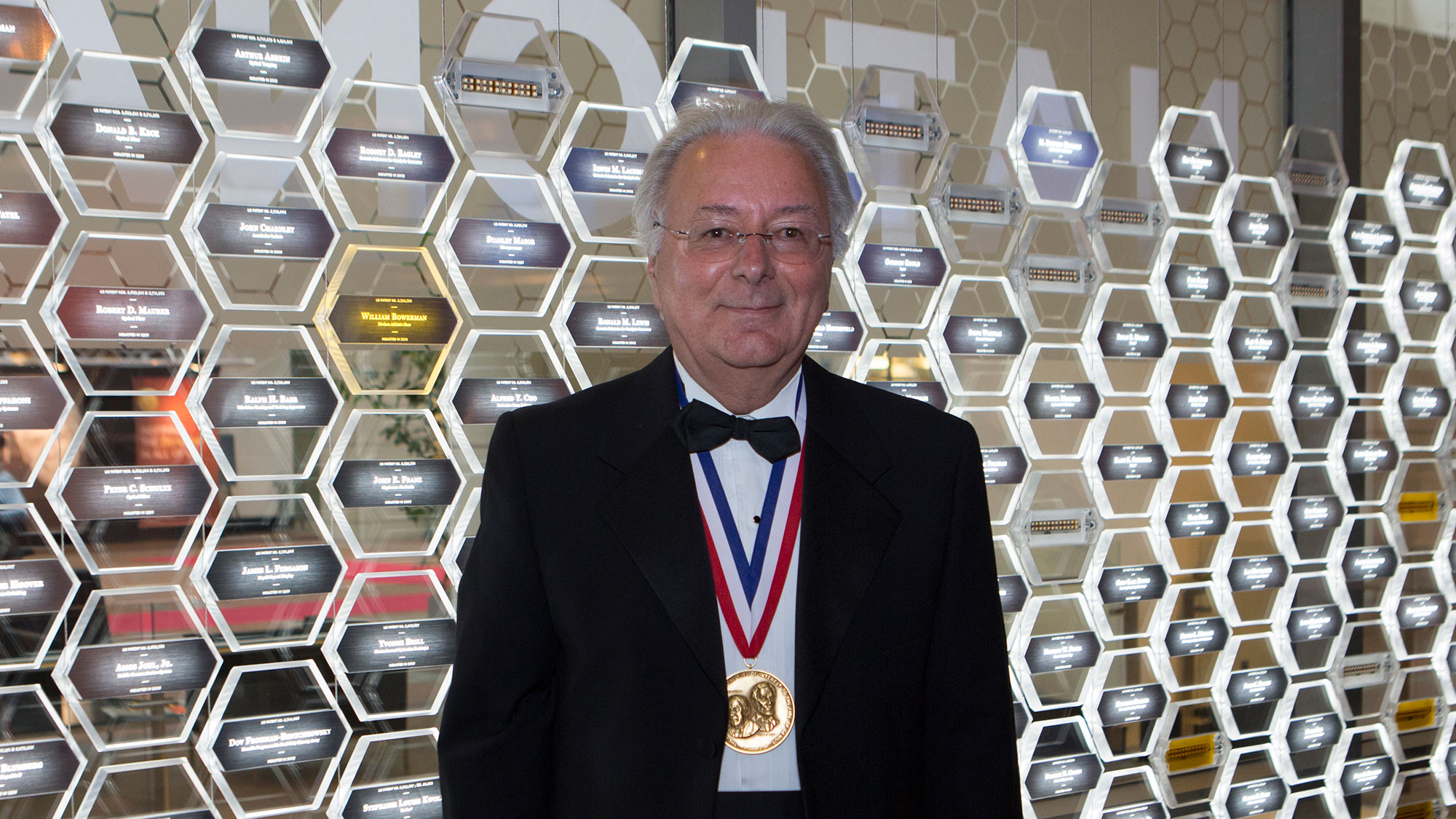
The honors make a substantial collection: the Marconi Prize, the Kyoto Prize shared with his 4004 colleagues, and the 2009 National Medal of Technology and Innovation, presented by Barack Obama in 2010. They recognize work that became part of the physical equipment of modern life. Faggin’s books give a more personal account of where that work led him.
Silicon, his memoir, follows four phases of his life, from Italy through microelectronics and entrepreneurship to consciousness. Irreducible develops his thinking about experience, computers and human nature. Beyond the Invisible, whose English edition is dated October 27, 2026, takes the form of an extended exchange of questions and answers about science, philosophy and spirituality.
That format seems appropriate. Faggin has spent a career making things that accept instructions; he now spends much of his public life inviting questions. The tiny signature remains on the 4004. The larger questions have proved less obliging about staying within a border.