The new laptop was ready for the future. The camera card was still living in the present. In late 2016, Apple’s redesigned MacBook Pro presented its owners with Thunderbolt 3 connections in the shape of USB-C. Daniel Chin’s HYPER responded with an object that looked almost comically modest beside the computer it served: an aluminum hub, fitted against the laptop’s side, with room for the plugs people already owned.
The pitch required very little explanation. Your computer had changed. Your desk had not. HYPER eventually reported more than 30,000 backers and over $3 million for the HyperDrive campaign. Chin had found an audience in the distance between an elegant product announcement and the untidy business of getting something done.
A business small enough to fit in a bag
Chin had arrived in California from Singapore in 2005, after university, a short semiconductor engineering job and a camera-accessory distribution venture. Establishing Sanho Corporation meant learning American business procedures while doing the ordinary work himself. He even bought Starting a Business for Dummies. It is a pleasantly unceremonious prop for a Silicon Valley origin story.
Photography supplied the first market. Then the 2008 financial crisis undermined orders collected at Photokina in Cologne. An irritation from the journey offered another direction: his MacBook battery had not lasted through the flight. The resulting external battery, HyperMac, later became HyperJuice. The company’s attention moved toward Apple users and the equipment they needed around their devices.
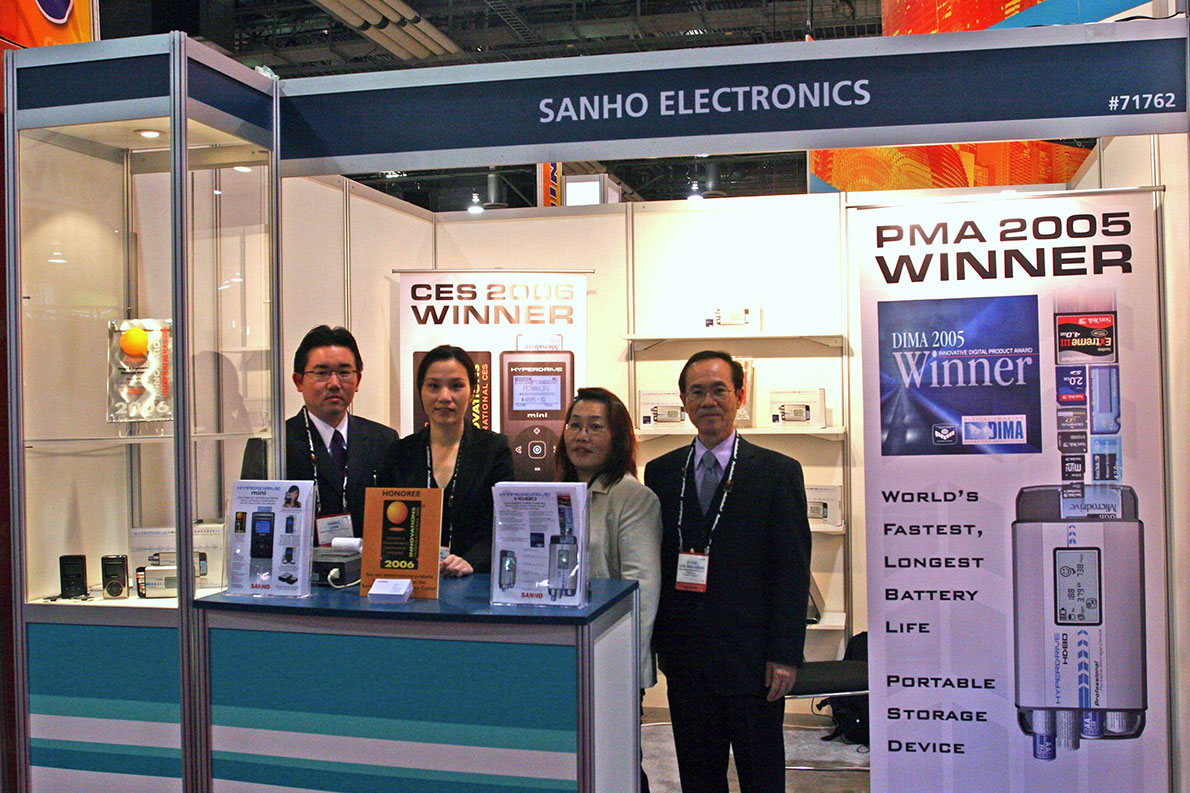
A photograph from CES 2006 preserves that earlier business: Chin, his wife Valerie and his parents behind a counter of portable-storage products. Before the crowdfunding totals, there were display cabinets to fill.
A thumb drive with two passports
By 2014, HYPER was working on another small nuisance. A computer and an iPhone could both contain your files, yet moving those files between them could involve more ceremony than the task seemed to deserve. The iStick placed a conventional USB connector and an Apple Lightning connector inside one flash drive. A sliding switch exposed whichever end you needed.
Its companion app handled viewing and moving files. Music, movies, photographs and documents could travel on the drive; some content could be opened without first copying it onto the phone. The attraction was physical and legible. Put the files on a thing. Plug the thing into the other device.
The iStick also made software part of the accessory. Its companion app was necessary to get beyond the physical connection and browse the contents on an iOS device. A plug could join the hardware; the app supplied the next step in using it.
This is a useful way to understand Chin’s work. The product often occupied an awkward border. Here it was the border between computer storage and a phone. Later it would be the border between a laptop’s new connector and a photographer’s existing card. A connector is a tiny piece of industrial diplomacy. It succeeds when the two sides can finally exchange something.
Two sockets, seven ways back
Apple unveiled the new MacBook Pro on October 27, 2016. Its Thunderbolt 3 ports could carry data, video and power through the same connector. That versatility was part of the appeal. For owners of equipment with other plugs, the transition also created a shopping list.
HYPER’s answer used two adjacent USB-C ports to provide seven connections: HDMI, two USB-A connections, SD and microSD slots, and two USB-C connections with different capabilities. The enclosure came in silver or space gray. The hub was meant to sit beside the MacBook as a compact extension, rather than hang from a cable.
Two ports used. Seven connections provided.
The campaign began on December 5, 2016, with a $100,000 goal. Chin had chosen something prospective buyers could understand from a photograph. The missing sockets were visible. So was the proposed remedy. Crowdfunding let customers put money behind that preference before a conventional retail launch.
“I only design and sell products that I would personally use and buy.”
Daniel Chin
The hub also offered a rather good joke at the expense of progress: buy the new computer, then buy a small piece of the old one. Chin’s business depended on taking the customer’s side of that joke seriously.
The wall socket joins the argument
Portable power gave him another version of the same problem. A person traveling with several devices could accumulate a collection of chargers almost as impressive as the devices themselves. In December 2019, HYPER and semiconductor company Navitas described their collaboration on a four-port, 100W HyperJuice charger.
It combined two USB-C ports and two USB-A ports in a body measuring 85.3 by 60.8 by 28.9 millimeters. Gallium nitride power technology helped make that compact arrangement possible. The object was designed to reduce the volume of equipment someone needed to carry, while retaining connections for different generations of hardware.
The word shared matters. The charger’s 100W rating was a total budget. Connecting more devices divided that budget; it did not create a separate 100W supply for each socket. Those trade-offs determined what each connected device could receive. This is where an accessory earns its keep: after the photograph, when everything is plugged in and the numbers have to add up.
The next problem was distribution
By February 2020, Chin was being invited to explain crowdfunding to other creators. He was announced as a keynote speaker for FCBC Go Global, an event organized around helping crowdfunded products reach wider markets. The subject suited a founder whose products had traveled from campaign pages toward retail shelves.
There is a practical distinction between persuading someone to back an object and building a business that can keep selling it. Production, channels and repeat purchases have to follow the launch. For Chin, those questions eventually led to a larger partner.
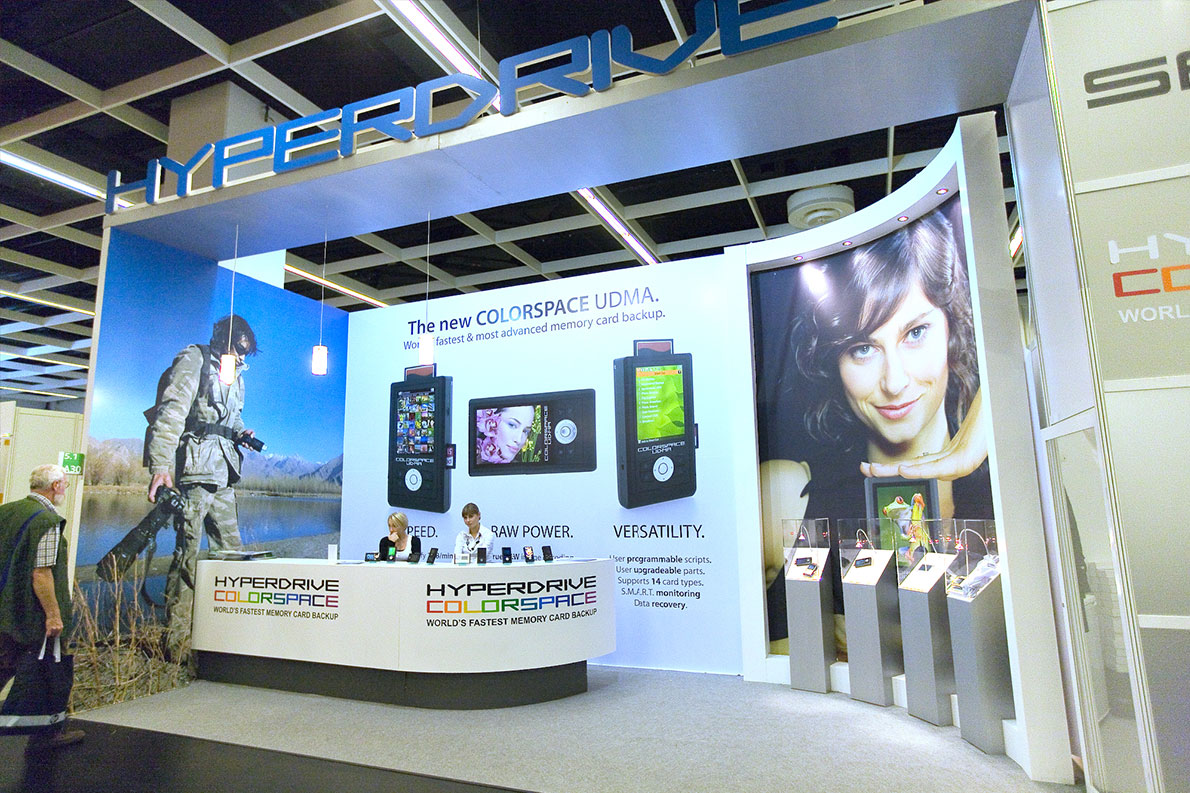
On May 4, 2021, Targus announced that it had acquired Sanho and the HYPER brand. Its plan retained separate brand identities and headquarters. Chin would continue managing HYPER as President. Mikel Williams, Targus’s CEO and chairman, became his reporting line.
The commercial fit was clear in the companies’ explanation of the deal. HYPER had a particular connection to Apple customers; Targus brought a broader distribution network and an established PC audience. Their product ranges were largely complementary. For Chin, the combination offered access to business customers and stronger international sales and marketing resources. A small accessory still needs a surprisingly extensive route to its owner.
The acquisition plan also preserved HYPER’s own product development, sales and marketing focus. Some functions, such as finance and legal, could be considered for integration. That left Chin leading a recognizable business inside a larger organization. Customers would continue to encounter the HYPER brand, while the work behind it gained a different corporate setting. The arrangement gave the founder a new set of resources and an established team to work alongside.
Even a desktop had room to move
The post-acquisition product work included a dock for Apple’s 24-inch iMac, announced for CES 2022. Besides adding connections and storage, the design incorporated a 360-degree swivel. A desktop screen could turn toward a colleague or customer without requiring its owner to rearrange the entire machine.
That detail brings Chin’s approach down to a recognizable gesture: somebody wants to show somebody else what is on the screen. Extra bandwidth may help a workflow. So can turning the display. The accessory brief allowed both kinds of improvement to share the same object.
It also widened the territory beyond the travel bag. A desk could have its own awkward steps. HYPER’s product proposition reached into those steps, looking for a useful place to intervene.
Another company, familiar company
The Targus transaction was one chapter in Chin’s career. By August 2025, he had left HYPER and was building Better Mobile Xperience, or BMX, with Barry Miller and Fred Ghaderpanah, former HYPER colleagues. Their opening product was a magnetic battery pack in the SolidSafe range.
The new company put semi-solid-state cells at the center of its portable-power proposition. BMX describes those cells as using less liquid electrolyte than conventional lithium-ion designs, helping reduce fire risk. Its stated ambition is to make that approach available in products people can carry and buy. The claim concerns the design of the battery; it should be read with the precision any battery specification deserves.
There is continuity in the people as well as the category. Chin returned to portable power with colleagues who already knew the accessory business. The company name changed. The familiar tasks remained: choose the technology, decide on the form, and make a product that fits into somebody’s day.
Back to the bag
At CES 2026, BMX announced an expanded lineup spanning SolidSafe Air power banks, other SolidSafe batteries, GaNsta chargers and ByteSize mobile SSDs. The storage products were aimed at people creating and moving content on phones. The chargers and batteries addressed the other recurring requirement of mobile work: eventually, everything needs power.
The portfolio reads like a return visit to familiar territory. Storage, connections and charging have accompanied Chin through different devices and different company structures. They remain practical concerns even as the particular plugs, cells and screens change.
Chin’s work now sits within BMX, whose products include SolidSafe batteries and GaNSta chargers. HYPER belongs to his history; the work of making devices easier to live with continues under another name.
A laptop bag offers an unusually candid assessment of technology. Open it and you find the extra cable, the card reader, the backup battery - small admissions that the main device could use some help. Chin has spent his career taking those admissions seriously. There is still quite a lot to do before the bag closes.
Follow the next connection
Explore Chin’s work, the original products and the next chapter.