In October 2016, Apple unveiled a new MacBook Pro and, in the process, deleted almost everything you could plug into it. Gone were the USB-A ports, the HDMI output, the SD card slot, the MagSafe connector. In their place: four identical USB-C holes and a marketing line about courage. Within weeks, a small Silicon Valley company you had probably never heard of turned that decision into one of the most successful crowdfunding runs in gadget history. The pitch was almost insulting in its simplicity - a hub that plugged into the laptop and gave the ports back.
That company is HYPER, the consumer brand of Sanho Corporation (now Hyper Products Inc.). The product was HyperDrive. And over the following weeks more than 30,000 people paid it upward of $3.1 million on Kickstarter and Indiegogo - enough to make HyperDrive the most-crowdfunded MacBook and USB-C accessory ever recorded. It was not a new category. It was not a moonshot. It was a fix for a problem Apple had introduced on purpose.
Which is, more or less, the entire strategy.
The IdeaSell back what the big company removes
HYPER's founder, Daniel Chin, is a Singaporean engineer who took an unusually direct route to consumer electronics. After graduating from the National University of Singapore he took a job in the semiconductor industry and left roughly six months later to co-found EastGear, a Singapore distributor of camera accessories, memory cards, batteries and GPS gear. By 2005 that business employed more than 70 people. Then Chin pulled up stakes and moved to California, setting up Sanho Corporation in the heart of Silicon Valley to build his own products under a brand called HYPER.
The timing meant the young company had to survive the 2008 financial crisis early in its life - not a small thing for a hardware business carrying inventory. It did, in part by picking a lane that never really goes quiet: the gap between what a device ships with and what people actually need to use it. Laptops get thinner and lose ports. Phones lose headphone jacks and SD slots. Every removal is a small inconvenience for the manufacturer and a market opening for someone else.
Read cynically, that is a company whose roadmap is partly written by Apple's design team. Read generously, it is a business with a durable, repeatable insight: people will pay to make the thing they already own usable, and they will pay quickly if you are first. HYPER kept being first.
Ports, power, and cables - in that order
HYPER's catalog splits into a few clear families. HyperDrive is the flagship: USB-C hubs and docking stations for MacBook, iPad and PC. The record-setting model was notable for a specific piece of industrial design - it plugged into two of the MacBook Pro's USB-C ports at once and hugged the side of the machine, so it read less like a dongle and more like a missing part of the laptop. HYPER later took that design seriously enough to file a $1 million patent-infringement suit against a rival, j5create, which tells you it viewed the shape of the solution, not just the chip inside, as the thing worth defending.
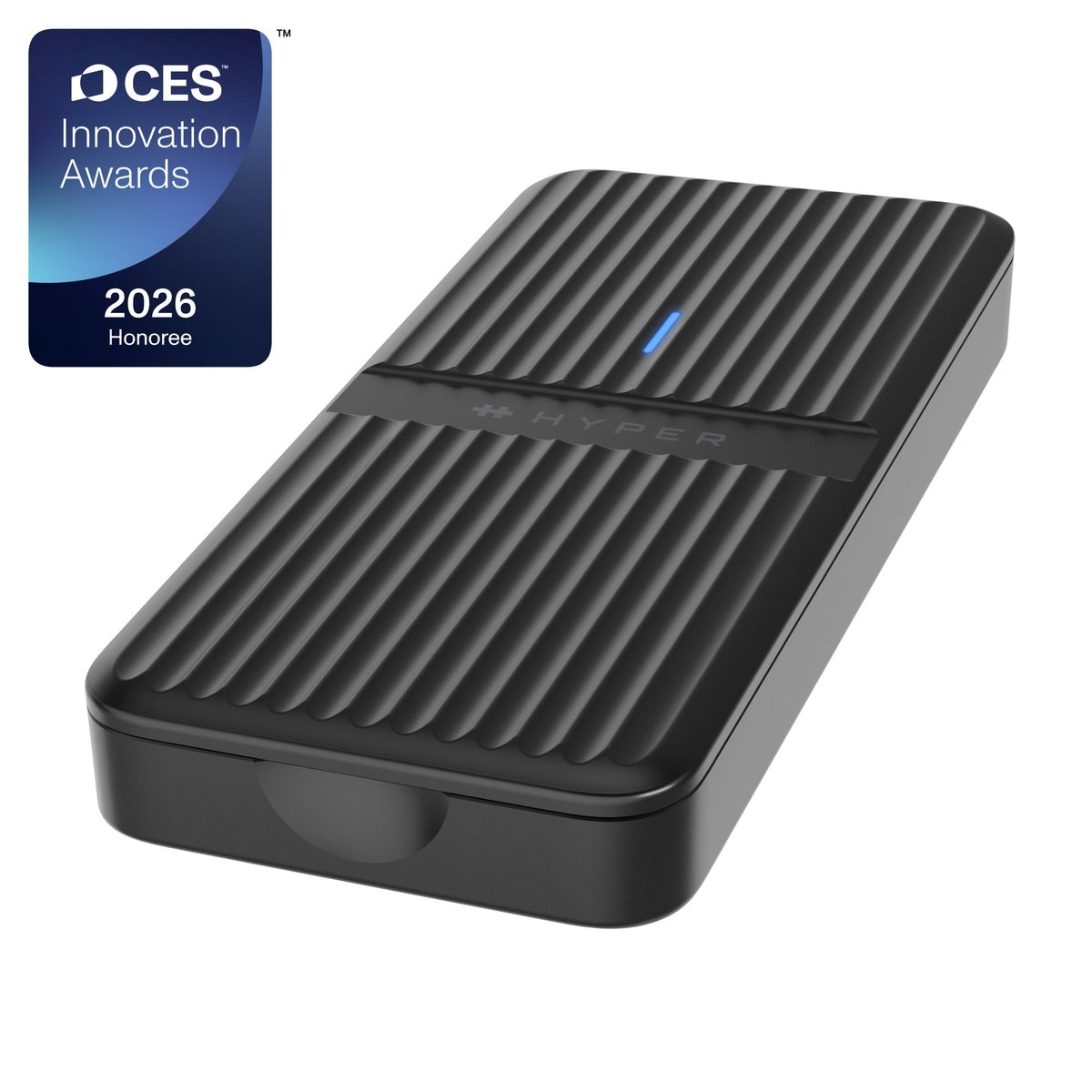
HyperJuice is the power line - portable batteries and chargers, including what the company bills as the world's first MacBook battery pack. Its headline act is the 245W generation: a GaN desktop charger with four 100W USB-C ports, and a matching 245W USB-C battery pack with an OLED readout that recharges in about an hour. For scale, HYPER points out the charger delivers more than four of Apple's own 61W wall adapters combined - enough to feed a 16-inch MacBook Pro, a tablet and a phone at once. HyperThin covers ultra-slim cables, and the early back catalog includes firsts like iStick, an early flash drive for the iPhone, and iUSBport, a wireless USB port.
Charging power, in context
Rated output, watts - HYPER's 245W flagship vs. familiar Apple bricks
Whoever just bought a device with too few ports
The core buyer is an Apple and mobile power user - the person with a MacBook, an iPad and an iPhone who resents carrying six adapters. But HYPER never limited itself to enthusiasts buying direct. HyperDrive landed in more than 900 Best Buy stores across North America, alongside Amazon, Walmart and B&H. That mix - crowdfunding to prove demand and fund tooling, then mainstream retail to scale - is the spine of the business. The company uses a launch on Kickstarter or Indiegogo as a form of paid market research: if 30,000 people pre-order, you have both your validation and your production budget before you commit to a factory run.
A crowded shelf, and how HYPER stands on it
The accessory aisle is not a gentle place. HYPER competes with Anker, Belkin, Satechi, UGREEN and a long tail of white-label hubs and power banks, many of them cheaper. Commodity pressure is constant, which is why HYPER leans on two things competitors find harder to copy at once: a reputation for being early to each new Apple transition, and design specific enough to defend in court. When the differentiator in a category is largely the same reference chip, the moat becomes timing, the exact fit of the product, and the brand people already trust to work with their expensive laptop.
Power is where the engineering fight is most visible. HYPER's move to 245W rides gallium-nitride (GaN) power chips, which run cooler and shrink dramatically compared with old silicon. It partnered with Navitas Semiconductor on GaNFast technology to build what the two companies called the world's smallest 100W four-port wall charger. That is the tell that HYPER is not purely a marketing shell reselling generic parts - it works upstream with chip makers to hit numbers rivals have not.
The ExitBought, but left alone
In May 2021, Targus - the laptop-bag and accessory giant based in Orange County - acquired HYPER. By then the brand had grown into a roughly $30 million business. The structure of the deal is the interesting part. Rather than fold HYPER into the parent, the two agreed the brands would stay "uniquely independent," with HYPER remaining in its own Silicon Valley office and Daniel Chin continuing to run the company as President. Targus got a modern, Apple-native accessory line and a crowdfunding muscle it did not have; HYPER got distribution and stability without losing the team and taste that made the products work in the first place.
That arrangement is itself a lesson. When an acquirer keeps the founder and the office, the value it bought usually was not the factory or the patents alone - it was the judgment about what to build next. In HYPER's case, that judgment has a track record you can plot on a calendar of Apple keynotes.
The TimelineTwo decades, one seam
What an operator can copy
HYPER is a useful case study precisely because it is not glamorous. The transferable moves are plain: watch what a dominant platform removes and be first to sell it back; use crowdfunding as both validation and financing so you never guess at demand; make the design specific enough to defend rather than shipping a reference board; and work with component suppliers so your headline spec is one competitors cannot instantly match. None of that requires inventing a new category.
The honest caveat is that the same strategy has limits. A business partly steered by another company's design choices is exposed when those choices reverse - Apple has quietly added ports back to recent MacBook Pros, softening the exact pain HYPER was built to solve. Commodity pressure never lets up, and a $1 million lawsuit is a sign of how thin the defensibility can be. HYPER's answer has been to keep moving up the power curve and into new device transitions faster than the copycats. So far, that has been enough.