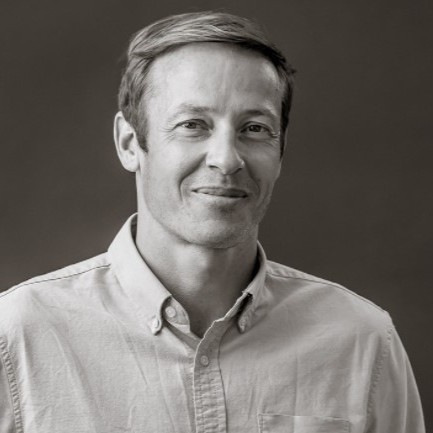
He Started at Google at 22. It's Been One Long Streak Since.
In 2003, Dan O'Connell joined Google. The company had been public for exactly one year. AdWords was still finding its stride. Most people couldn't explain what a search ad was, let alone sell one. O'Connell could. He built Google's AdWords inside sales organization under Sheryl Sandberg - a job that taught him something he has never forgotten: growth doesn't happen by accident. It happens because someone builds the system, hires the people, and clears the path.
He spent nine years at Google. Not the kind of nine years where someone coasts on the brand - the kind where they run New Business Sales for one of the most important advertising products ever created. When he left in 2012, the muscle memory was there: how to build a sales machine, how to scale it without breaking it, how to find the moments before revenue becomes obvious and bet on them anyway.
"Front is already the platform of choice for companies looking to offer exceptional service. By leaning even harder into AI-enhanced technology, Front has the potential to become the uncontested leader."
- Dan O'Connell, on joining Front as CEOTalkIQ: Building Speech AI Before It Was Cool
AdRoll came next - VP of Sales, $100M+ in revenue - but the move that defined the decade was founding TalkIQ. The premise was simple and, in 2008, genuinely strange: what if software could listen to sales calls in real time and surface intelligence while the conversation was still happening? Not transcription. Not post-call summaries. Live speech recognition wired into the workflow, alerting reps to what to say and when.
Nobody was doing it yet. Siri didn't exist. GPT was a decade away. O'Connell built TalkIQ on Salesforce Ventures backing and ran it for nearly ten years - long enough to define the category of conversational intelligence for sales and service teams. Long enough to see Dialpad come calling.
The acquisition closed in May 2018. O'Connell moved with the company.
Chief Revenue Officer, Then Something Stranger
At Dialpad, he took the CRO seat and did what he always does: built the machine. The company scaled from $30M ARR to over $200M under his watch - not in a decade, but in roughly two and a half years. Then, before the ink dried on those milestones, he took on a second title that was new to almost everyone: Chief AI Officer.
He was characteristically direct about what it meant. "Chief AI Officer," he said, "is more of a temporary gig - and that's the point." The job isn't to be the AI person forever. It's to guide a company into a future where AI is embedded in everything, not siloed in one executive's portfolio. When that happens, the role dissolves. He delivered Dialpad's first proprietary large language model, monthly generative AI releases - AI CSAT, AI Scorecards, AI Playbooks, AI Coaching Hub, churn prediction, revenue prediction - and then, in early 2024, left.
"When AI can handle complex customer interactions at scale, the real competitive advantage won't be the quality of your chatbot - it will be access to actual humans."
- Dan O'ConnellFirst Outside CEO in Front's 11-Year History
Front was founded in 2013 by Mathilde Collin and Laurent Perrin. For eleven years, Collin ran it. The company reached unicorn status in 2022 - a $1.7B valuation on $65M in new Series D funding from Salesforce Ventures and Battery Ventures. Over 9,000 companies were using it. ARR crossed $100M. And then Collin made a decision: the next chapter of Front needed a different kind of operator.
The announcement came in March 2024. O'Connell would become CEO. Collin would move to Executive Chair. On May 1, 2024, the transition was complete.
He was the first person from outside the founding team to hold the role. That distinction matters. Front was not a company in distress looking for a turnaround artist. It was a company at $100M ARR, sitting at the edge of the AI wave, with 540 employees and a very specific question to answer: who do you want building the next version of this?
They wanted someone who had already built it once.
The Contrarian Bet on Human Connection
The thesis O'Connell carried into Front was not the obvious one. Most AI-era pitches are some version of: automate everything, reduce headcount, lower cost-to-serve. His is different. He argues that when AI gets good enough to handle any customer interaction, the companies that win will be the ones that still pick up the phone.
The logic runs like this: if AI handles all routine interactions at scale, then human attention becomes scarce. Scarce things become valuable. The company that can route a difficult situation to a real, skilled, informed human - and do it fast - has a moat that no chatbot can replicate. Front is his vehicle for proving it.
Under O'Connell, the product strategy leans into AI as a force multiplier for human teams rather than a replacement. AI handles routing, triage, and suggested responses. Humans handle the moments that matter. The customer operations platform positions itself not as cheaper support infrastructure, but as the system that makes support teams genuinely excellent.
Change Management, Measured in Miles
There's a detail about O'Connell that surfaces in almost every profile and podcast: he competes in Ironman triathlons. 2.4-mile swim, 112-mile bike, 26.2-mile run. The logic of endurance sport isn't metaphorical flair - it's a structural habit. You do not finish an Ironman on talent. You finish it on systems, training blocks, nutrition protocols, and the kind of stubborn patience that most people find difficult to manufacture under race conditions.
The same disposition shows up at work. At SaaStr, he gave a talk on change management for new leaders that was unusually concrete: don't overcommunicate your vision in week one, figure out who the decision-makers actually are (not who they're supposed to be), listen more than you talk for the first ninety days. It was the kind of advice that sounds obvious until you watch someone ignore it.
He said he wanted to be captain of every sports team growing up. He has been, more or less. But the version of competition that stuck wasn't the zero-sum kind. It was the kind where you build something excellent and the proof is in the numbers.
What He's Building Now
Front under O'Connell is not a startup pivot story. It's an established category leader navigating a technology transition that is rewriting the rules for everyone. The $338M in total funding raised, the Salesforce Ventures relationship, the 9,000-plus company customer base - these are assets. The question is whether the product can evolve fast enough to capitalize on a moment when the definition of great customer service is being rewritten in real time.
O'Connell's answer is already in motion. AI-native features. Human-centric design. A bet that the companies willing to invest in the quality of human interaction - not just the automation of routine ones - will win the next decade of customer operations. It's a contrarian position delivered by someone who has been contrarian, quietly and consistently, since 2008 when he was building speech AI for sales calls with no market and no roadmap.
He was right then. He's making the same bet again.
AI will not replace SDRs and BDRs - the best ones will use it to become unstoppable.
The Chief AI Officer role is more of a temporary gig - and that's exactly the point. You're guiding a company into a future where AI is embedded everywhere, not siloed.
When AI becomes ubiquitous, human empathy becomes the competitive moat. That's the future we're building toward at Front.
Front has the potential to become the uncontested leader in AI-enhanced customer service. That's the goal. Not one of the leaders. The leader.
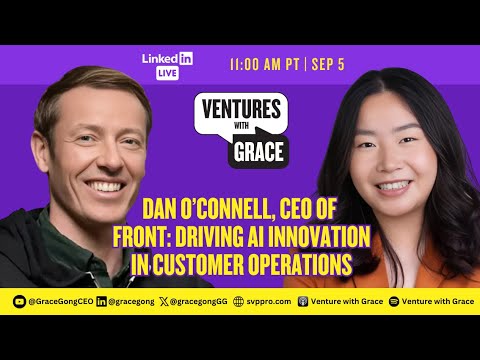
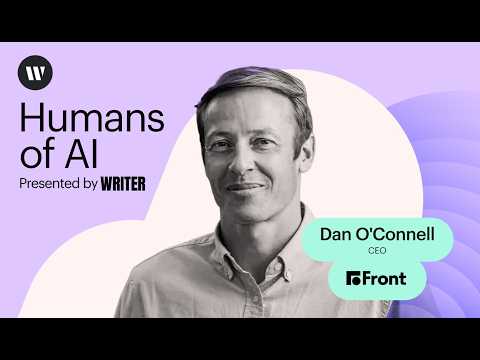
Competes in Ironman triathlons - 2.4 miles swimming, 112 miles cycling, 26.2 miles running. The endurance-sport discipline bleeds into how he runs companies.
Built a speech recognition company for sales calls in 2008. No iPhone app ecosystem, no GPT, no market. Just a bet that real-time AI voice would matter one day.
Started at Google at 22, under Sheryl Sandberg, building the AdWords inside sales org - before most people understood what a search ad was.
Publicly called the Chief AI Officer role "a temporary gig" while holding the title - arguing that when AI is truly embedded, the dedicated role becomes redundant by design.
Front's first outside CEO in 11 years. Not a turnaround hire - a bet on who could accelerate a $1.7B unicorn through the most significant technology shift in its history.
Passionate musician alongside everything else. The competitive kid who wanted to be captain of every team found that music is the one arena where you don't keep score.