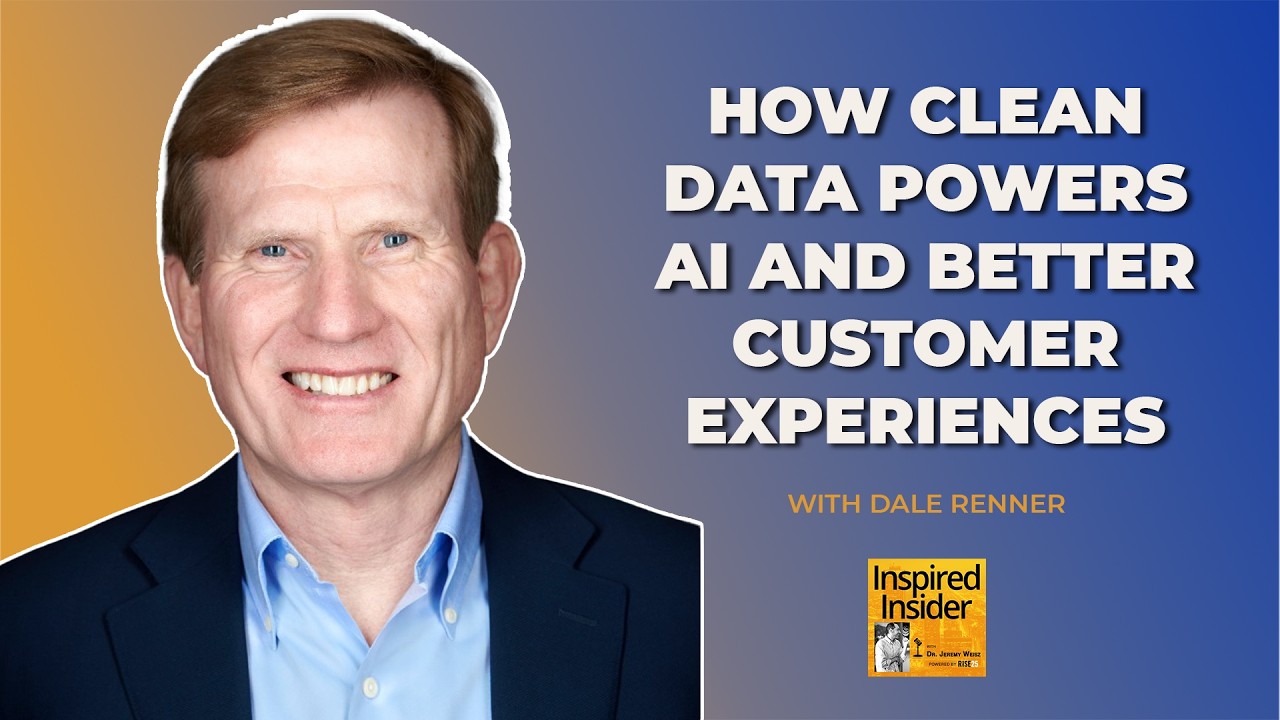
Before Dale Renner sold customer data software, he watched a milkman get the quantities right. Growing up on an Iowa farm, he remembered bottles arriving with such regularity that their clink was a warning to get ready for school. What stayed with him was a small mystery: how did the milkman know how much to leave?
Years later, Renner made that memory the opening of an essay about brand promises. The delivery was routine. The knowledge behind it was personal. Someone understood a household well enough to turn up with the right thing, at the right time, without requiring a meeting about it.
It is an appealing starting point for a software executive. Enterprise technology usually introduces itself with a diagram. Renner can begin with breakfast. His working subject has remained remarkably consistent: what a business knows about its customers, how that knowledge travels, and whether the resulting interaction deserves the customer's trust.
A contractor before the consulting career
Renner's childhood in northwest Iowa was materially spare. His family lived without running water until he was 16. While still a high school junior, he started a business doing painting, maintenance and construction. Customers already had established contractors to choose from. He had to make his work worth choosing.
He attended Westmar College on a football scholarship, then transferred to Iowa State University and earned a business degree. After graduation he chose Arthur Andersen's consulting operation despite having better paid offers. The attraction was the chance to learn. Minneapolis became the next stop.
Those choices give the later career a useful scale. Before the sprawling databases came a job that somebody could inspect with their eyes. A painted surface offered little refuge in terminology. The subsequent move into consulting enlarged the problems, while preserving the awkward obligation to produce something useful for the person paying.
The customer would not stay inside a department
At Accenture, Renner became a global managing partner and founded the firm's global customer relationship management practice. That business reached $1.5 billion in worldwide revenue. He later served as CEO of Seisint and ClarityBlue, moving between consulting and businesses built around processing and using data.
His eventual Redpoint co-founders, Lewis Clemmens and George Corugedo, had also worked at Accenture. Their shared professional history matters because the company brought together experience in CRM and data management. The founding group had spent time with the practical difficulty of turning information into something a business could act on.
By 2014, Redpoint was describing software that joined data integration, data quality and customer engagement. It offered a visual interface intended to make work accessible without programming. That detail makes the ambition more concrete: a useful answer trapped behind a specialist's queue is still a difficult answer to use.
Renner's interest in the problem also extended beyond software. In a 2017 discussion, he questioned the proliferation of executive titles and the conflicts between people responsible for digital activity, email and call centers. A customer crosses those boundaries casually. A company's organization chart tends to take the boundaries rather more seriously.
A customer moves between channels. Their records need to make the journey, too.
A climbing name, a commercial rule
Redpoint began in May 2006. Renner funded it himself and went six years without paying himself. Its name borrowed from climbing: he liked the connection between preparation and executing a planned ascent. The founding principles included execution, delighting customers and transparency about what the business could deliver.
“Our currency was going to be trust.”
Dale Renner, describing Redpoint's founding principles
There is a pleasing severity to choosing trust as a currency. It cannot be booked merely because a presentation went well. It has to survive the installation, the unexpected request and the conversation after something goes wrong. For a company selling other companies a better understanding of their customers, its own customer relationships become a recurring examination.
The early product vocabulary was less settled. Redpoint used the description Convergent Marketing Platform. Its offering combined data, analytics and interactions across channels. The phrase asked a buyer to hold several capabilities in mind at once, which was the point of the architecture even if it was rather a mouthful.
- 01Master the dataBring customer information together.
- 02Find the insightUse that information to guide a decision.
- 03Take actionMake the next interaction relevant.
Recognition comes before relevance
Renner's writing about identity resolution has a wonderfully ordinary concern at its center: the embarrassment of getting somebody wrong. He distinguishes a superficial identifier match from an understanding that connects a person's identities with their transactions and behavior. An address, device or spelling variant is only part of the picture.
The consequences are familiar even without the technical language. A business can recommend something the customer already purchased through another channel. It can make an offer that clashes with what the customer has just experienced. In Renner's argument, context gives recognition its value; a match without that context can still produce an irritating interaction.
Here the milkman's lesson becomes more demanding. Remembering a household is manageable on a delivery route. Keeping a useful understanding across stores, websites and service conversations requires different machinery. The courtesy is recognizable. The infrastructure behind it has become a considerable undertaking.
The difference between the applause and the audience
In December 2021, Renner highlighted a Harris Poll survey commissioned by Redpoint. Fifty-one percent of marketers said brands consistently delivered an excellent customer experience. Only 26 percent of consumers agreed. The gap supplied a brisk correction to the view from the marketing department.
Renner connected those disappointments to incomplete, duplicated, delayed and disconnected customer information. The implication is uncomfortably practical. A brand may intend to be attentive while its systems repeatedly make it appear forgetful. Good intentions do not accompany the customer into the next channel unless the relevant knowledge gets there as well.
There is also a useful caution in the survey's structure. The people producing an experience and the people receiving it are answering different questions from different positions. Renner's case for better information begins with a willingness to take the second group seriously, even when the first group has already congratulated itself.
A familiar name on a crowded shelf
As customer data platforms attracted larger software companies, Renner kept asking what those platforms would actually do. In a 2020 account of the market, he emphasized bringing together information beyond conventional CRM and marketing applications. His concern was the completeness of the working picture of a customer.
That gives his competitive position a discernible shape. The label on the box provides little guidance if two products bring together different information or support different decisions. A buyer still has to ask which records are included, which relationships can be recognized and what happens after the information is assembled.
Security became an explicit executive responsibility in May 2022, when Redpoint promoted Ron Sanderson to chief information security officer. Renner linked the appointment to protecting customer data. Redpoint also described deployment choices that allowed brands to keep information within their own environments. A promise about personalization carries a second promise about stewardship.
Enjoy the sale. Know when to leave it.
Renner remains candid about enjoying the commercial side of the work. “I love the hunt. I love the sale.” It is a useful admission from someone who also talks about delivery discipline. Enthusiasm for winning business makes the decision to pass on unsuitable work a real management choice.
In a Signal & Noise conversation, he described regretting sales that required the company to twist itself around an unsuitable need. Yet following customers too closely brings another difficulty: their immediate requests can crowd out future innovation. The customer needs an answer today. The product team must also leave room for tomorrow.
That is a more interesting aspiration than simply promising to listen. Renner wants a business close enough to clients to understand the work, with enough judgment to decide which work belongs in its future. Agreeableness alone would make a poor product roadmap. So would treating every customer request as an interruption.
The next promise has to show its workings
By April 2026, Renner was discussing the fragmentation of the customer data platform category with Signal & Noise hosts Rio Longacre and Brett House. The conversation examined identity, segmentation, activation and the role of data readiness as AI changes enterprise software. His subject had acquired new vocabulary while retaining familiar dependencies.
On June 1, 2026, Redpoint introduced Identity Studio on Snowflake Marketplace. The company described matching that runs inside a customer's Snowflake environment, with inspectable results and configurable rules. Renner's emphasis was visibility: teams should be able to understand how records were matched before trusting what they build above them.
The emphasis fits the arc of his career. Selling a result creates an obligation to explain and deliver it. Organizing customer information creates an obligation to get the relationships right. Adding AI raises the stakes of those earlier choices. For Renner, the next conversation still begins with whether the underlying information deserves belief.
The milkman did not need to explain a matching algorithm on the doorstep. His customers could count the bottles. Renner now works in a world where the counting is harder and the decisions are further removed from view. His enduring ambition is to make the promise just as accountable.
Keep the conversation going
Explore the reporting links
- Career and company origins: 2018 interview
- The milkman and the brand promise: Renner's essay
- The founding team: George Corugedo's 2015 interview
- Convergent marketing: 2015 company profile
- Data management and visual tools: 2014 profile
- Channel responsibilities: 2017 interview
- Identity and context: Renner's 2020 essay
- Standalone platforms and larger competitors
- Ron Sanderson's May 2022 appointment
- Customer requests and product innovation: interview clip