Dimitri Sidney started his career looking for things that did not work. He was a software tester, then a test automation specialist, then a developer and a project manager. Eventually he became an entrepreneur. It is a useful education for a chief executive: before you are allowed to explain the future, spend some time checking whether the present behaves as advertised.
That progression gives his story its particular texture. The co-founder and CEO of Customertimes did not describe his working life as a succession of inspired declarations. He described wearing different hats. Anyone who has worked on a software project knows that those hats come with competing requests, uncomfortable deadlines and very different definitions of “finished.”
The interesting question is what survives the climb. When someone moves from checking another person's work to running the organization, does the old perspective remain useful? Sidney's answer, in the way he discusses colleagues and customers, is respect. Having occupied several places in the process, he wants the people doing the work to have room to advance.
A tester’s route to the corner office
His education includes Taras Shevchenko National University of Kyiv, which he attended from 1995 to 2000. Today he is based in Boca Raton, Florida. Between the university years and the present-day CEO role lies the career ladder he later laid out himself: testing, automation, development, project management, entrepreneurship.
Each step changes the scale of the problem. A tester examines behavior. A developer changes it. A project manager coordinates the people responsible for changing it. A founder has to make the whole arrangement worth sustaining. Read as a progression, those roles help explain why his account of leadership spends so little time on the glamour of the title and so much on the people around it.
A business card can be replaced in an afternoon. The harder adjustment is accepting that the people who once sat beside you now need something different from you. They need decisions, opportunities and a reason to believe that good work will be recognized. Sidney's career supplies a concrete starting point for that conversation.
- 01Software tester
- 02Test automation
- 03Developer
- 04Project manager
- 05Entrepreneur
Five friends, a very practical proposition
Customertimes grew out of five friends' experience inside large organizations. Sidney and fellow co-founder Max Votek are among its public leaders. The company dates its co-founding to 2007. Its original proposition concerned customer relationships and the systems employees used to manage them: a business already full of software could still need help making that software useful.
That puts Sidney in a particular kind of entrepreneurship. A consultancy lives close to other people's unresolved work. The client arrives with an operating problem; the consultant must understand enough of the business to avoid solving a tidier, less relevant one. A handsome diagram can have a splendid career in a meeting room while contributing very little outside it.
The company that followed is headquartered in New York and has more than 1,000 specialists, with customers served across more than 60 countries. Those are company figures, rather than a measure of one person's individual output. For Sidney, their significance is organizational: the small founding group became responsible for maintaining working relationships across a much larger operation.
Scale makes an appealing number and a demanding daily practice. People cannot all know one another. A client cannot rely on having met everyone who touches a project. The founder's preferences have to become decisions other people can make without waiting for the founder to enter the room.
The photograph with sixteen little offices
There is an unexpectedly modest picture attached to Sidney's June 2020 leadership essay: a grid of colleagues on a video call, captioned as a work-from-home happy hour. Sixteen rectangles, headsets, domestic rooms, varying degrees of enthusiasm for the camera. It is a recognizable corporate gathering stripped of the corporate furniture.
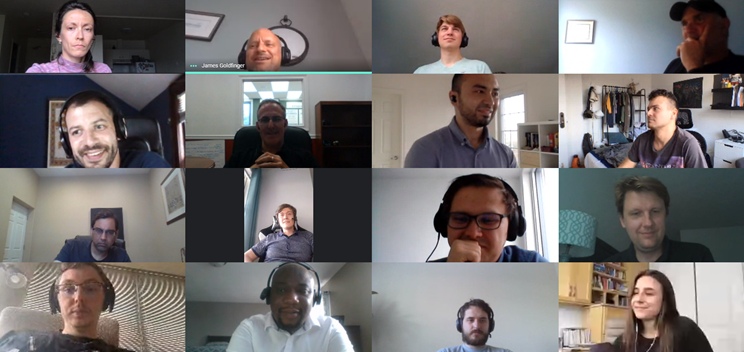
The image suits the argument. A company can describe itself through its offices and still depend on something much less photogenic: whether people will ask questions, admit uncertainty and help one another finish a job. A video grid supplies no imposing reception desk to hide behind. Everyone gets roughly the same rectangle.
Read beside the photograph, a founder's concern with trust becomes easier to understand. Consider how much cooperation is packed into an ordinary project. Someone estimates a task. Someone else depends on that estimate. A customer shares a difficult business problem. A colleague flags a mistake before it becomes more expensive. The work advances through those small exchanges.
“Trust matters.”
Dimitri Sidney, June 2020
The phrase is short enough to escape a strategy presentation intact. Its practical force lies in the amount of supervision a relationship requires. Trust has to be supported by competence and follow-through, but when those are present, people can spend more time doing the work and less time establishing that they are entitled to do it.
What a former colleague remembers
Alexander Skorobogatko offered a more personal view in a farewell reflection. He had encountered Customertimes as a vendor while working on a project. When he was preparing to move back from the United States, Sidney's description of the company helped persuade him to join.
Looking back, Skorobogatko thanked Sidney for his trust, support and openness to new ideas. He also credited Anton Miliaev with giving him space to experiment while providing guidance as he helped develop a branch of the business. The recollection places Sidney inside a network of working relationships rather than alone on a founder's pedestal.
That distinction matters. A departing employee's account is one person's experience, and it should be read that way. Still, it offers something a corporate value statement cannot: a named person recalling a decision, an invitation and a chance to take responsibility. The aspiration becomes easier to picture when somebody remembers being on its receiving end.
It also supplies a quieter definition of influence. A CEO may spend years building a company and appear in a colleague's story at the moment he makes the next job seem possible. The memory belongs to the person who took the opportunity.
A donation with work attached
Sidney publicly welcomed Customertimes' partnership with PepUp Tech, presenting it as a way to help people find opportunities in the Salesforce ecosystem. The partnership was announced in November 2020. Its design tied company support to training and access to experienced practitioners.
By March 2021, chief customer officer Jim Goldfinger had joined PepUp Tech's board. Customertimes planned learning content and mentorship for graduates. PepUp Tech works with motivated people from underserved communities who want to enter technology careers. Here, the company's knowledge could be useful before a person ever became its employee.
Later that month, Customertimes and PepUp Tech announced support for the Pennsylvania Innocence Project. A directed donation funded PepUp Tech resources to improve the organization's Salesforce case management. The beneficiary works to secure exoneration for people wrongly convicted of crimes.
The arrangement is unusually concrete. Money supports skilled work; skilled work improves a system an organization relies on. It connects a consultancy's ordinary capabilities to a purpose outside its commercial client list. For a business whose product is partly other people's expertise, that is a sensible form of participation.
The next opportunity still needs a result
By 2025, Customertimes' responsibility work included two internal AI hackathons and a Salesforce consultant trainee program whose six graduates joined the team. The company also supported education initiatives and families in Ukraine. These are company activities, but they give substance to the learning and community commitments Sidney has discussed.
There was a lighter detail that year: Manu, a Pallas cat mascot, became part of a charity initiative involving support for real Pallas cats in zoos. Enterprise technology can accommodate a little fur. Even a business occupied with systems and implementation schedules occasionally benefits from a creature with no apparent interest in either.
Sidney's current remit includes applying AI to enterprise growth and operational performance. His public activity has also included sharing the company's 2026 Milwaukee Innovation Day announcements, which focused on moving AI work toward business results. The vocabulary changes faster than the underlying management question: what will the customer actually be able to do better?
The products around him have changed, too. Customertimes combines consulting with its own software, including tools for field sales and retail execution. Its published company material describes a Salesforce partnership dating to 2008 and a portfolio on AppExchange. That combination puts the business on both sides of a useful conversation: advising clients about platforms while building things people must actually use.
Sidney's route makes the final question feel fitting. A tester begins by checking whether a system does what it promises. A chief executive must ask that of an organization: its promises to clients, its offers of responsibility, its invitation to stay and grow. The objects under examination are larger now. The value of checking remains.
Keep reading, keep in touch
- Dimitri Sidney on LinkedIn ↗
- His essay: Lessons learned from my years as the CEO of Customertimes ↗
- Customertimes: company and leadership ↗
- Watch: About Customertimes on Vimeo ↗
- Customertimes on YouTube ↗
- The Pennsylvania Innocence Project partnership ↗
- Customertimes’ 2025 community and education update ↗