The airline had his business. It had his travel history. It also had a suggestion: download the mobile app. Kabir Shahani already had it. He used it regularly. For a frequent flyer, this was a small irritation, the sort of thing you delete before boarding. For Shahani and his business partner, Derek Slager, it became a question worth pursuing: how could a company know so much about a customer and still fail to recognize him?
That question helped give rise to Amperity, the customer-data company they founded in 2016. In June 2026, the partners became its co-CEOs, with Slager continuing as chief technology officer. Shahani returned to executive leadership four years after stepping down. He is based in New York; Slager is in Seattle. Their latest arrangement puts a familiar partnership across two of the company's major hubs.
The return gives Shahani's career an unusual shape. He has built a company, left its top job, worked on other ventures, and come back to share the job with the person who helped start it. Through those changes, a remarkably ordinary ambition persists: help a business understand the person on the other side of the transaction.
A complaint with a spreadsheet attached
The Alaska Airlines episode began with communications that puzzled two loyal customers. A connection through Slager's neighbor, who worked in the airline's IT organization, led them to Jeanne Jones. They wanted to understand the mismatch between the airline's reputation for service and messages that seemed to forget what it already knew.
Jones showed them the problem from inside the company. Customer information lived in seven different places. She also had a spreadsheet containing 45 things her team wanted to do if it could assemble a complete view of the customer. The list was evidence of demand sitting beside evidence of obstruction. People had ideas; their systems made carrying them out difficult.
Shahani and Slager went on to interview roughly 20 to 30 potential customers. That sequence matters. The business began by investigating an annoyance, then asking whether other organizations had the same difficulty. A marketing email had inadvertently volunteered for product research.
Different systems hold different pieces. Identity resolution connects records that belong to the same person.
The appeal before the startup
Shahani's own route into technology involved persuading an institution to reconsider its picture of him. He attended Issaquah High School and began college at American University before seeking a place in the University of Washington's Informatics program. His application was initially rejected. He built a portfolio, pursued an appeal, and eventually spoke with program chair Batya Friedman. He got in.
He earned his informatics degree in 2004. Avanade came next, followed by Blue Dot, a consumer internet startup where he was employee number four. The duties ranged from product specifications to partnerships. Blue Dot eventually closed. In 2007 he co-founded Appature, an enterprise marketing-software business acquired in 2013.
In 2014, the iSchool named him its Distinguished Alumnus. At 32, he was the youngest recipient and its first informatics graduate to receive the award. The rejected applicant had become someone the school wanted its students to meet. University admissions rarely come with such a satisfying return receipt.
Can the machine make the connection?
By Amperity's public unveiling in September 2017, Shahani and Slager had assembled a 40-person company. An initial $9 million financing round had given them room to investigate the technical problem. They worked with University of Washington computer scientist Dan Suciu on connecting customer records when a common identifier was missing.
Consider the practical difficulty. A transaction, an app interaction and an email response may all describe the same customer while using different identifiers. A business needs a way to make those connections before it can sensibly ask how that person's relationship with the brand is changing. Otherwise, even a straightforward question can require a miniature expedition through databases.
At launch, Amperity also had a Microsoft partnership. Shahani had worked with Satya Nadella, who encouraged compatibility with Azure. The research problem was becoming a commercial product, with the partnerships and infrastructure that large customers would need. Getting an algorithm to work was only part of getting a company to work.
Knowing someone is only the beginning
In November 2019, Amperity acquired Custora. The pairing extended the business from bringing customer information together toward extracting useful predictions and insights. Custora's team brought expertise in customer analytics; Amperity brought its work on unifying records. The acquisition also expanded Amperity's presence in New York.
In his account of the deal, Shahani described meeting Custora founders Corey Pierson and Jon Pospischil in early 2018. He saw common ground in the companies' missions and their connections to academic research. Amperity drew on Suciu's work; Custora drew on Wharton professor Peter Fader's work on customer lifetime value.
The logic was sequential. First understand which records describe the same customer. Then ask what the relationship might be worth, how it is changing, and what to do next. Joining the businesses gave that sequence a broader home. It also required Shahani to build through another founding team, rather than treating every useful capability as something his own engineers had to invent.
The useful art of saying no
For all that expansion, Shahani was willing to describe limits. In a 2020 interview, he explained that prospective customers sometimes wanted capabilities outside Amperity's focus, including sophisticated journey orchestration. Being clear about the product's boundaries, he said, helped win business.
“We focus on the customer pain and needs, not on what everybody else is doing.”
Kabir Shahani, 2020
That is a useful detail about his operating style. Software sales reward the expansive answer. A prospect asks for something, a competitor announces something, and suddenly the roadmap needs an extension. Shahani's stated discipline was to keep attention on the customer's problem and be candid about what the company could handle.
The distinction has practical consequences. A buyer who understands the product's boundaries can make a more informed decision. A team with a defined problem has a better chance of knowing what to build next. The modest word “no” can save an impressive amount of engineering.
- 2016Amperity founded
- 2021$100M Series D
- 2022Shahani steps down as CEO
- 2026Returns as co-CEO with Slager
A billion-dollar valuation, then a different job
In July 2021, Amperity announced $100 million in Series D financing at a valuation above $1 billion. It also reported nearly 100 percent revenue growth in the preceding year. Those were company milestones: capital to expand and a valuation attached to investors' expectations.
The board had acquired an unexpected connection earlier that year when Ciara joined to help guide corporate social responsibility. Shahani emphasized her experience building and representing brands. Starbucks executive Kevin Johnson was also on the board. For a company concerned with how brands understand people, those appointments brought perspectives from businesses whose customer relationships extend far beyond a database.
In February 2022, Shahani relinquished the CEO title. President and chief operating officer Barry Padgett succeeded him. The departure broke the tidy progression from startup to financing to the next round of expansion. Shahani's career would continue through a different arrangement.
Building, with room for a life
By December 2024, he was discussing Amp It Up Ventures and his involvement in building Adora and Avante. He described working closely with founders, helping companies secure funding and applying particular company-building approaches. He resisted putting the operation into a familiar investment-industry box. The work was still taking shape.
He also spoke about wanting his professional life to fit his family priorities. That gave the venture-building work a personal purpose alongside a commercial one: a way to keep creating while thinking more deliberately about how he spent his time.
His explanation included a compact statement of values: “Learning and relationships are the two currencies of life, in my opinion.” It helps explain why his work kept bringing him into partnerships. The product may concern disconnected records; the career depends on connections between people.
The classroom has another use for experience
The University of Washington supplied one such connection. Shahani joined the advisory board of its iStartup Lab and served as a co-instructor for Jeremy Zaretzky's entrepreneurship course. In photographs from the fall 2023 classes, he appears alongside other founders and with a student team celebrating a competition win.
The lab's purpose included giving students a realistic view of entrepreneurship, including difficulties often left out of accounts dominated by funding numbers. Shahani's experience offered material for that conversation: an early startup that closed, an acquisition, a second company, an executive departure and work with new founding teams.
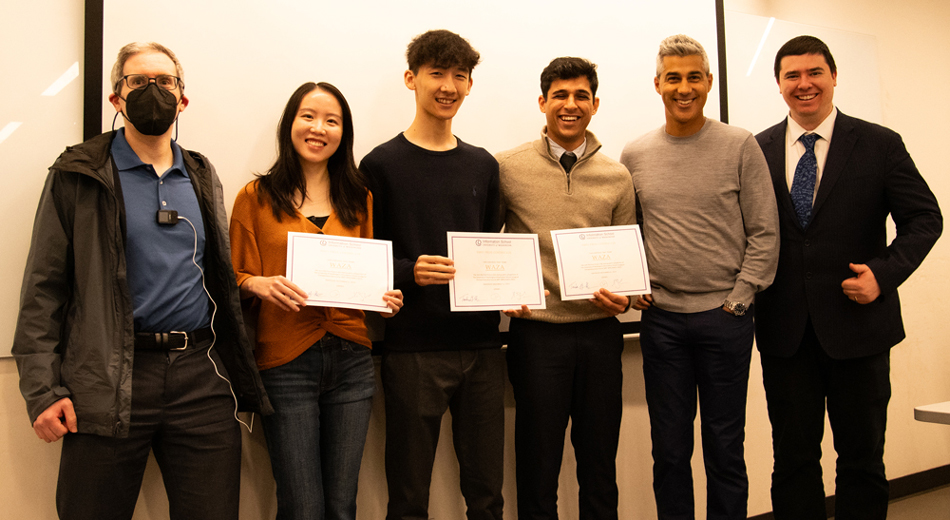
There is something appealingly practical about this return to campus. Students can ask someone who has done the work what the work actually involves. The institution that helped him find his direction becomes a place to help others try theirs.
A draft folder and a second turn
For a founder selling sophisticated data software, Shahani has described a pleasantly uncomplicated personal organizing tool: email drafts. In 2018, he said he used them to keep track of priorities. He was also reading Nadella's Hit Refresh. His favored sales advice was brief: “Don't talk past the sale.”
That combination offers a small, human counterweight to the funding announcements. Complex software does not require its builder to make every habit elaborate. An unsent message can be a to-do list. Once someone has agreed, another paragraph of persuasion may be surplus inventory.
Now he has another turn at Amperity, alongside Slager, as AI gives their original customer-data problem renewed relevance. The task still begins with recognizing who a customer is before deciding how to act. For Shahani, the route back leads to a familiar question, first made irritatingly clear by an airline email: what should a company already know about the person it is addressing?
CONTINUE THE CONVERSATION