Anastasios Papadopoulos has a useful description of his place in a start-up: the people tuning the racing car. The founder drives. IMS supplies some of the machinery, the technical judgement and the people who keep the thing moving. It is an unusually practical image for a business often described through valuations and funding rounds. Someone still has to open the bonnet.
That division of labour runs through his career. Papadopoulos, the founder and CEO of IMS Group, trained in mergers and acquisitions before establishing a software business in Hong Kong. He went on to build an investment operation around the ability to make things. The sequence matters. Engineering came first; taking equity stakes followed. His proposition to entrepreneurs grew out of work his company was already doing.
The attraction is easy to understand from a founder’s side of the table. A cheque can pay for a team, provided the founder knows whom to hire, what to ask them to build and how to judge the result. Papadopoulos offers participation in those decisions. The promise brings responsibility with it: an investor who helps construct the business has fewer places to hide when the construction goes wrong.
Paris law, Hong Kong software
Before IMS, there was law in France and the UK, a management degree at HEC Paris, and work in the Paris office of Skadden, Arps, Slate, Meagher & Flom. Exposure to technology transactions helped draw Papadopoulos towards the industry. He had been close to the deals. He wanted to participate in what made the companies worth buying.
He founded Integrated Management Systems in 2016. Its early business was enterprise software and digital transformation for corporate clients in Asia. This gave the firm a specific starting point: established businesses with systems to improve, requirements to meet and projects to deliver. Software sold to a company has to survive contact with that company’s habits. The glamour is optional; the implementation is compulsory.
IMS’s current corporate timeline places the launch of its venture-building arm in 2018. The transition took the capabilities developed for clients and put them behind new companies, with technology contributing to an equity position. Papadopoulos was changing the commercial relationship around the work. An agency completes a project. A shareholder continues to care about what happens after delivery.
- 2016Enterprise software
Integrated Management Systems - 2018Engineering meets equity
IMS Digital Ventures - 2023Private markets
IMS Capital Management - 2025Americas expansion
A wider investment footprint - 2026Four operating divisions
Technology across the group
A founder with a day job
One of his revealing early pieces of writing appeared in March 2019. Its imagined reader was an experienced executive in their late forties, carrying an idea for improving an industry but hesitating over the practicalities. The obstacles were familiar: assembling technical talent, designing software, finding customers and raising money. Papadopoulos addressed the reader who already knew the problem and needed help making a company out of the answer.
He even proposed fitting strategic meetings around that person’s existing schedule, allowing the would-be founder to keep a day job until ready. The detail is refreshingly domestic. In the standard entrepreneurial melodrama, commitment is demonstrated by burning every bridge. Here, somebody might begin with a calendar invitation after work.
This was a recruitment argument as much as a philosophy. Deep experience can supply knowledge of customers and recurring frustrations. It can also come with commitments that make an abrupt departure difficult. His model offered a way to connect that experience with engineers and commercial support. The founder’s previous career became useful material for the next one.
What the workshop actually does
The companies make the argument more concrete. In October 2019, IMS announced OrgHive, a platform for the Chinese organic-products market. It combined product-certification verification with content, reviews and tools for brands to reach consumers. The venture connected a trust problem with a commercial one: customers wanted reliable information, while brands needed ways to engage them.
Another example was OwlGaze. In 2021, IMS Digital Ventures led a US$1.5 million pre-seed round for the cybersecurity company. Its Blacklight product used data collection and AI analytics to detect and respond to threats. Papadopoulos’s interest in enterprise software had found a market where technical performance was central to what customers were buying.
The venture-building work extended into recruitment, marketing and expansion. OwlGaze CEO Ralph Chammah described the difficulty of attracting strong technical people before raising capital, and the help available through IMS. WhiskyGenius’s Murray Holdgate likewise valued access to several kinds of expertise without immediately hiring a full team. These accounts explain the service in ordinary terms: useful people, available when a young company needs them.
Customer problem
Commercial support
An equity relationship
The downturn arrives at the door
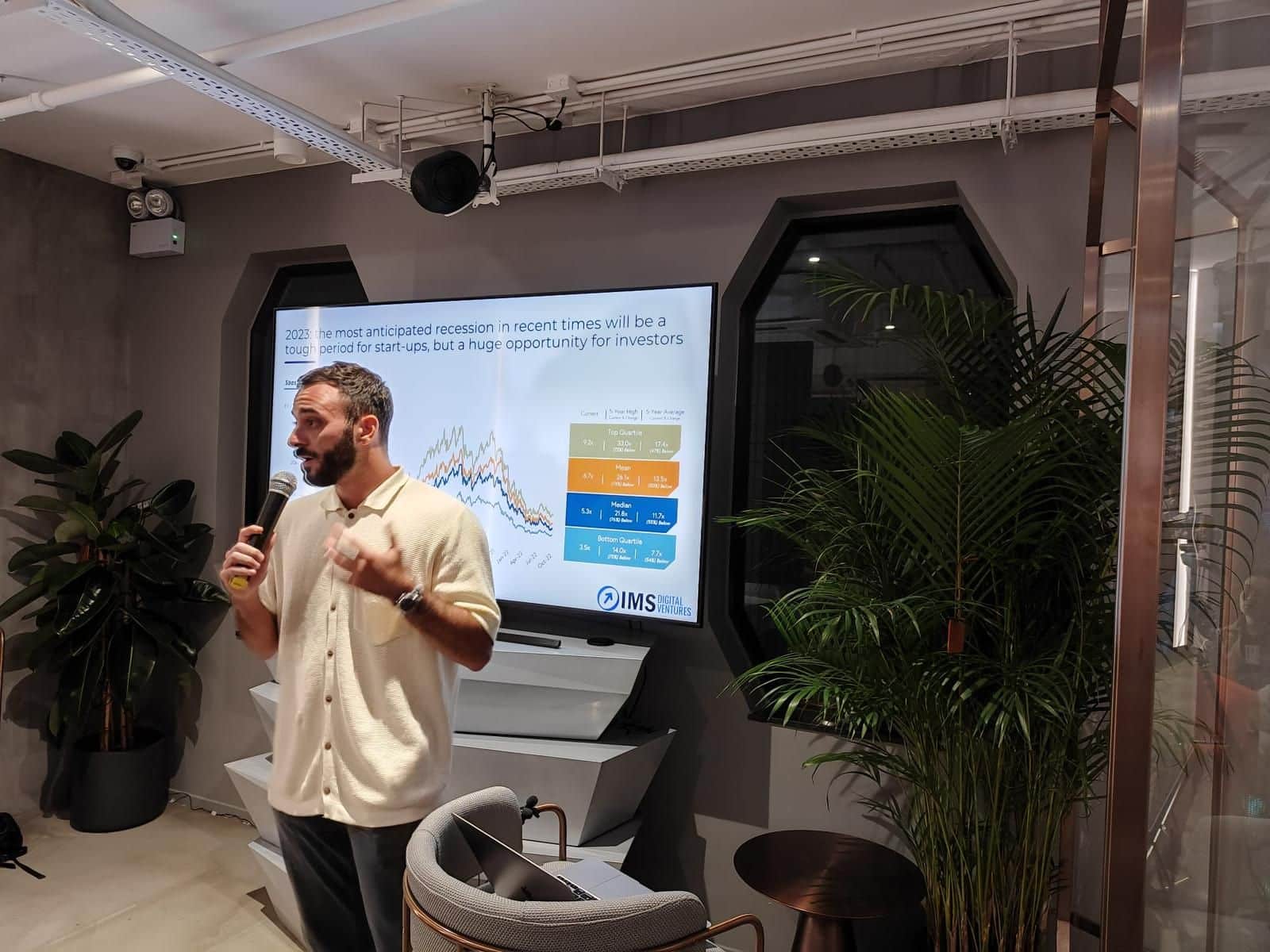
By early 2023, Papadopoulos was putting resilience at the centre of his argument. He emphasised evidence of customer demand and a route to profitability. A difficult funding environment, in his view, could create opportunities for businesses that had taken those questions seriously. The emphasis suited a builder whose pitch depended on improving the business underneath the valuation.
His January comments also distinguished companies sustained by favourable market conditions from companies with durable business models. The distinction is less entertaining than a funding announcement and considerably harder to put on a celebratory cake. It asks what customers will keep paying for when investors become harder to impress.
Later that year, discussing execution alongside partners Ed Myer and Angus Walker, Papadopoulos focused on enterprise technology, profitability drivers and testing product-market fit. He added the need to respond intelligently to feedback. This gives his approach a necessary flexibility. A carefully built product still needs customers, and customer behaviour has an inconvenient habit of editing the plan.
“Resilience is my word for 2023.”Anastasios Papadopoulos
Fairness has a business case
Papadopoulos has repeatedly connected his legal education with a concern for fairness. In describing negotiations, he has talked about protecting investors’ interests while creating a relationship that works for partners too. That is a recognisable lawyer’s problem carried into entrepreneurship: the agreement has to support cooperation after everyone leaves the room.
His interest in blockchain has often followed the same concern. He has discussed its potential to make opaque supply chains more transparent and to give consumers better evidence about what they are buying. Diamonds, whisky and agriculture featured in his account of industries where verification could have commercial value. The technology was supposed to serve an identifiable transaction.
There is a demanding practical question beneath this ambition. A record is only as useful as the information that enters it, and a product must make sense to its users. In his public discussion of impact investing, the focus reaches beyond a technical demonstration to adoption and commercial viability. A system that nobody uses leaves the original problem comfortably employed.
Who sits beside the founder
The people around Papadopoulos help explain how IMS moved towards a broader investment partnership. Dennis Plomp joined in 2020, bringing experience in private equity, venture capital and M&A advisory across Europe and Asia. Ed Myer became a partner in 2023, with family-investment experience and a role in Horizons, a network of next-generation family offices.
The team also includes Manuela Buerki, a founding IMS member whose background combines law, financial regulation and risk management with portfolio expansion and go-to-market work. These are useful companions for someone trying to connect software development with private investment. Each side has its own vocabulary, deadlines and reasons for rejecting an attractive idea.
In 2025, Buerki described the gap between having capital and having the capability to turn a product into a business. Distribution and regulatory knowledge belonged in that calculation alongside engineering. Her account gives texture to Papadopoulos’s proposition: a venture can need several forms of help at once. Raising money solves one scheduling problem; it does not automatically solve the others.
“Execution is in our DNA.”Anastasios Papadopoulos, 2023
The model leaves the start-up room
IMS’s expansion brought the same operating proposition into other settings. In October 2024, IMS Digital Ventures announced IMS Sports, led by Vatche Manoukian. The initial focus was football, with London and Dubai as key locations, and a plan to pair software and digital tools with sports organisations. For Papadopoulos’s group, sport became another place to apply an existing set of capabilities.
In January 2025, the group announced IMS Credit with a New York-based team. The stated target fund size was above US$300 million, aimed at mid-market borrowers needing US$10 million to US$50 million of financing. Those figures describe the announced mandate and ambition, rather than a completed fundraising result.
The shift widened the operating challenge. Supporting a software founder and financing an established borrower involve different decisions, but both require detailed knowledge of a business. Papadopoulos’s interest had extended from helping companies get started to identifying opportunities within private capital. Technology remained part of the proposed method, including the work of assessing and monitoring investments.
A decade later, still building
Today, Papadopoulos is based in New York and leads IMS Group across four operating divisions: IMS Capital Management, IMS Digital Ventures, IMS Labs and IMS Sports Capital. His responsibilities include setting the investment thesis and representing its partnership internationally. The geography of his career has widened from the Paris law office and Hong Kong software business to a network spanning several financial centres.
His more recent writing shows where his attention is moving. A June 24, 2026 article on his LinkedIn profile considers digital assets as infrastructure for an AI economy. He has also discussed Cortex, IMS’s proprietary platform for investment underwriting. These are current directions in his public thinking, following years spent connecting technology to business operations.
Yet the personal ambition he expressed in 2023 was broader than another asset class. He wanted corporate success to leave a tangible positive impact. That aspiration gives a human scale to a career described through platforms and partnerships. The interesting test is what those arrangements enable people to do.
Papadopoulos began with the work of building software and made that work part of an investor’s offer. He now proposes carrying it across a larger range of businesses and financing relationships. The racing analogy survives the expansion rather well. Whatever is written on the car, somebody has to make it run.