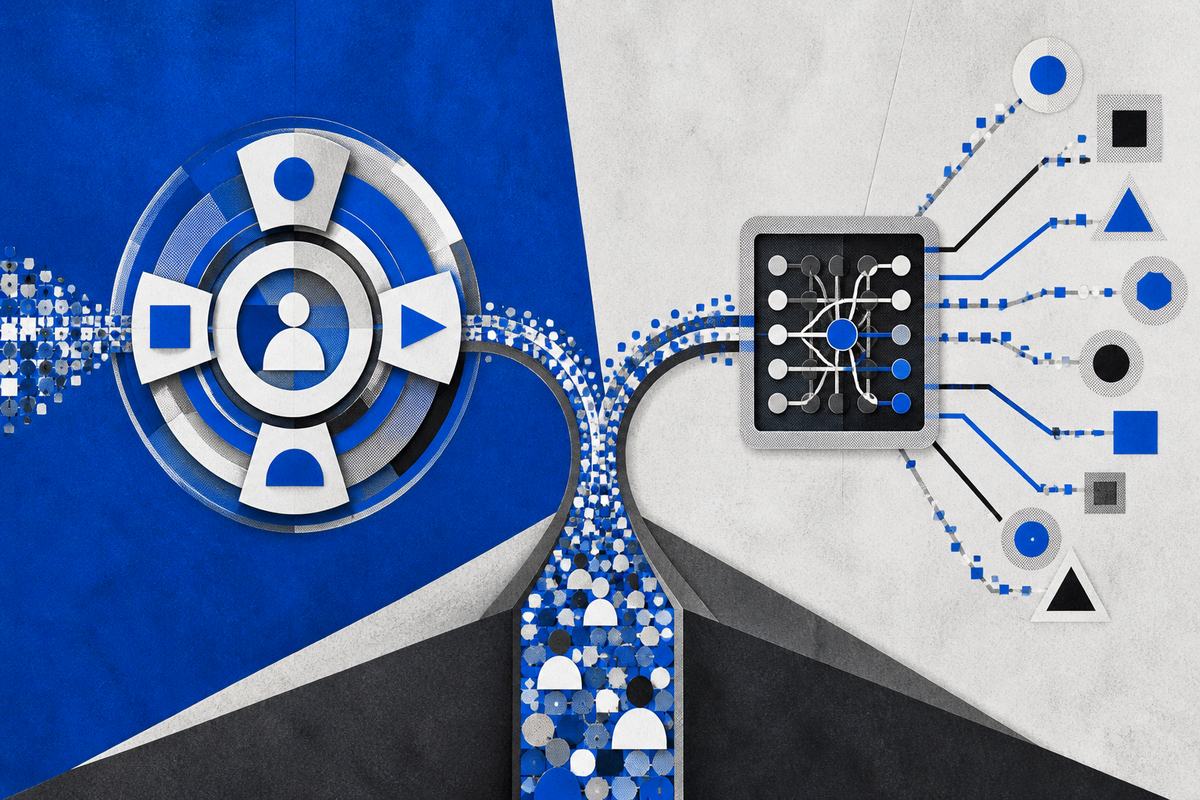
Most software comparisons begin with a feature grid. This one should begin with a wiring diagram and a procurement calendar. Segment and mParticle can each collect events from apps and websites, reconcile identities, police data quality, build audiences, and send those audiences elsewhere. Their product pages differ in vocabulary, but the verbs overlap. The useful question is not which vendor can place more checks in more boxes. It is what becomes easier after you choose one, what becomes harder to leave, and who gets to make the next decision.
That distinction matters because a customer data platform, or CDP, sits in an unusually consequential place. It watches what customers do, decides whether two devices belong to the same person, and carries that understanding into analytics, advertising, support, and messaging. A CDP is sold as plumbing. In practice, it also sets policy. Event names, identity rules, consent states, and destination filters become institutional memory. Once other systems depend on them, changing the pipe can feel like changing the foundation.
The bundle has a point
Twilio completed its acquisition of Segment in November 2020 in a stock deal valued at approximately $3.2 billion. The industrial logic was plain: Segment could help a company understand a customer, while Twilio could help it contact that customer. Twilio’s announcement described one platform spanning data and communications, including SMS, voice, video, email, and other channels. Segment became a Twilio division, not merely a favored integration.
For a team already committed to Twilio, that proximity can be useful. Fewer commercial relationships may shorten security review and procurement. Engineers familiar with Twilio’s APIs encounter a related developer culture. Data collected in Segment can feed identity-resolved profiles and audiences, then travel toward Twilio Engage or communications products. Segment still connects broadly outside its parent company. Its current pricing page advertises more than 450 prebuilt sources and destinations, so describing it as a closed pipe would be wrong.
The bundle advantage is less about a secret technical tunnel than organizational default. When the communications platform and the data platform arrive from one account team, the integrated option gets invited into the room first. Its roadmap is easier to explain. Its line item may be easier to approve. Each convenience is legitimate. Together they create gravity.
A connector list shows where data can go. It does not show how expensive it will be to change your mind.
Independence needs a footnote
mParticle takes the other side of the positioning contest. Its documentation calls the platform a hub that receives data from apps, web clients, feeds, and APIs, then forwards events and audiences to downstream services. The company now markets a hybrid model in which real-time pipelines and warehouse-native activation can operate together. It advertises more than 300 integrations and emphasizes fitting the tools a company already owns.
That is the practical meaning of vendor independence here: a CDP designed to sit between many analytics, advertising, messaging, and warehouse providers rather than pull the stack toward one communications suite. It does not mean mParticle floats outside corporate ownership. In January 2025, mParticle announced a merger with ecommerce technology company Rokt. The combined business said it would double investment in the CDP roadmap. A buyer should therefore separate two claims that sales language can blur: architectural openness and corporate independence.
The actual job, stripped of branding
web
warehouse
consent
quality
ads
messages
Segment can also send data to many independent vendors, and mParticle now has its own strategic parent. The clean binary dissolves under inspection. What remains is a difference in product and commercial center of gravity. Segment’s coherent next step is deeper into Twilio’s customer-engagement stack. mParticle’s sales argument is that the center should remain a switching layer across a heterogeneous stack, even after its Rokt merger.
Choose the failure you can debug
The ordinary proof of concept flatters both products. A clean purchase event enters, a tidy profile appears, and an audience arrives at an email tool. Production is ruder. A mobile release renames an event. Two family members share an email address. A customer revokes consent while a batch job is delayed. An advertising destination rejects a field without explaining why. The valuable platform is the one that lets the team see, contain, and repair those moments.
Lean toward Segment
Your engineers already build around Twilio, the organization wants fewer platform seams, and the data-to-communications path matters more than preserving equal distance from every messaging vendor.
Lean toward mParticle
Your stack deliberately mixes vendors, mobile data and governance are central concerns, and the CDP is expected to arbitrate among tools rather than extend one engagement suite.
This is why logo counting is a poor buying method. A connector can be server-side or device-side, real-time or batched, configurable or rigid. It can support events but not audiences, consent deletion but not historical replay. It can exist in a catalog and still fail the one field mapping that matters to your business. Ask each vendor to demonstrate the exact path, direction, latency, and error handling for your critical destinations.
Run the breakup drill
Before signing, write the migration memo you hope never to use. List who owns the canonical event schema, where the raw history lives, how identity mappings can be exported, and what happens to audience definitions when the contract ends. Price the expected event volume, profile count, warehouse sync, governance add-ons, and professional services. Then raise those assumptions. Customer data expands more reliably than budgets do.
- Break an event. Send a malformed payload and watch how quickly the team can locate, quarantine, correct, and replay it.
- Stress identity. Merge two profiles, split them again, and inspect the downstream consequences.
- Exercise consent. Withdraw permission across regions and confirm that every connected destination receives the right instruction.
- Move a destination. Replace one messaging or analytics provider without changing the collection layer.
- Export the memory. Retrieve schemas, profiles, mappings, and logs in forms another system could realistically use.
The result may still favor the bundle. If Twilio is already the communications substrate, choosing Segment can reduce integration surface and give one team more context from event to message. That is not lock-in by definition. It is an architectural bet whose benefits arrive early and whose constraints tend to arrive later.
The result may favor the switching layer. A company that negotiates hard across messaging providers, runs several consumer brands, or treats its warehouse as the durable center may value mParticle’s orientation. But neutrality must be proven at the level of data models, exports, billing, and operational control. A broad integration catalog is evidence of reach, not proof of easy substitution.
The decision behind the decision
A CDP purchase usually arrives wearing the clothes of efficiency: remove duplicate SDKs, standardize tracking, give marketers self-service audiences, and stop rebuilding integrations. Those gains are real. Yet the platform also becomes the place where a company encodes its theory of the customer. Which identity wins? Which behavior counts? Which systems may act on it? Those choices outlive the implementation project.
Segment and mParticle can each be a sound answer. Segment is persuasive when suite coherence is a deliberate strategy. mParticle is persuasive when a governed middle layer and mixed-vendor freedom are deliberate strategies. Trouble begins when either outcome happens by default: the bundle wins because it was already on the invoice, or “neutrality” wins because a diagram showed many arrows.
The honest scorecard has only a few lines. Can the platform improve data quality? Can operators understand failures? Can privacy choices travel with the data? Can the company switch a destination without surgery? And does the commercial model remain tolerable when the event stream doubles? Answer those with production-shaped evidence, and the hidden fork becomes visible before concrete is poured around it.
This comparison uses vendor documentation and announcements for product capabilities and transaction history. Integration totals are vendor-stated and can change. “Vendor independence” is treated as a product-architecture claim, not a claim about ownership.
Questions buyers actually ask
What is the main difference?
Both platforms collect, govern, unify, and activate customer data. Segment offers a particularly coherent path into Twilio’s communications and engagement products. mParticle emphasizes operating across a mixed stack with hundreds of third-party integrations.
Is mParticle an independent company?
No. mParticle announced its merger with Rokt in January 2025. Its vendor-neutral positioning concerns product architecture and integration breadth, not corporate ownership.
Does Segment work only with Twilio?
No. Segment advertises more than 450 prebuilt sources and destinations, including many non-Twilio systems. Ownership creates a suite advantage, but the product remains broadly integrated.
Which one fits a Twilio-heavy team?
Segment is often the lower-friction candidate when Twilio communications products are already strategic. The team should still test governance, observability, pricing, and data export.
What belongs in a proof of concept?
Use messy cases: malformed events, identity collisions, consent deletion, failed destinations, replay, data export, and pricing at realistic peak volume.