Chintu Patel grew up in a joint family of 45 people. Long before there was a company to run, there was already a sizeable organization to belong to. His brother Chirag shared that upbringing in India. When the family moved to the United States in 1987, the brothers carried an unusually well-populated idea of what family meant.
The household is a useful place to begin a story that now includes Amneal Pharmaceuticals, a public company, a partnership between brothers, a charitable foundation with his wife, and a daughter starting a business of her own. Patel’s professional biography keeps introducing relatives. The cast is remarkably consistent even as the settings change.
“We started working from Day 1 and continued to study,” he recalled of arriving in America. He earned a pharmacy degree at Rutgers. Chirag pursued business and technology. Their father, Kanu, had worked as an industrial pharmacist and regulatory inspector in India, giving the family both a trade and a set of expectations about how to practise it.
By 2002, those different preparations had come together in Amneal. Its early funding amounted to $200,000. Credit cards and second mortgages helped keep it going. There are more glamorous opening scenes in business, but very few in which the stakes are easier to understand.
The father’s part in the partnership
Kanu Patel’s influence ran beyond choosing an industry. He raised his sons with Gandhian ideas of truth and service, teaching them to pursue prosperity through work, honesty and integrity. These were principles the family brought with it when it emigrated. The business would eventually give them a much larger place in which to apply them.
Chintu followed the technical route. Before Amneal, he worked at Eckerd Pharmacy from 1994 to 2002, becoming a senior manager. Those eight years gave him a working life before the founder title arrived. He had trained for a profession, worked inside an established organization, and taken on responsibility before attempting to build an organization himself.
Chirag brought experience from technology businesses and finance. In 2005, he devoted himself to Amneal full time. An outside investor, described in the early company history as a family friend, supplied capital that allowed the business to acquire product rights and other companies. Personal relationships were part of the financing story, too.
The brothers’ division of experience helps explain the partnership without requiring a theory about their private conversations. One had worked in pharmacy and management; the other had built businesses in technology. They were combining skills developed in different places, with a father’s example behind both of them.
- 01Kanu PatelIndustry experience and guiding principles
- 02Chintu PatelPharmacy training and retail management
- 03Chirag PatelFinance, technology and business building
An award, then a room full of questions
In November 2011, Chintu and Chirag received the Ernst & Young National Entrepreneur Of The Year Life Sciences Award. The recognition was shared, fittingly, and acknowledged their work on manufacturing processes, people and technology. By then the small, personally financed venture had become a business other entrepreneurs were being invited to study.
Three months later, Chintu was announced as the opening speaker in HIA-LI’s 2012 CEO Roundtable series on Long Island. The setting was a breakfast for business owners and executives in Hauppauge. A founder who had once needed support was now being asked to explain his decisions to a room of people making decisions of their own.
His explanation left plenty of space for everyone else: “I attribute much of my success to the support I have received from my family and the terrific staff of Amneal.” It is a generous sentence, and a practical one. A manufacturing company requires people who can turn the founders’ intentions into repeatable work.
The breakfast invitation also catches him at an interesting point in the chronology. He had enough experience to describe a journey, but many of the later changes were still ahead: a combination with another company, changes in his executive role, and the continuing business of sharing authority with his brother.
“I attribute much of my success to the support I have received from my family and the terrific staff of Amneal.”
Chintu Patel · 2012
The title changes; the brother remains
Amneal combined with Impax Laboratories in 2018. Chintu served as co-chairman from May of that year until August 2019, then became co-chief executive officer and a director. He had previously held the co-chairman and co-CEO roles before the combination. The dates matter because this has been a career with different chapters of responsibility.
It is tempting to draw a founder’s life as a single arrow pointing upward. Patel’s record has more movement across the organization chart. The company changed its structure, his title changed with it, and he returned to executive leadership alongside Chirag. The prefix “co” has had a notably durable career of its own.
Their interests also extended beyond Amneal. The brothers co-founded and invested in Asana Biosciences, Kashiv BioSciences and Prolong Pharmaceuticals. That made them participants in several enterprises, rather than founders whose entire working identity sat inside one corporate boundary.
In August 2026, Amneal completed its acquisition of Kashiv, bringing one of those longstanding connections into the company. An independent committee of Amneal’s board had been given responsibility for reviewing the related-party transaction. A family connection can help explain how businesses meet; a public company also has a formal process for deciding what happens next.
A gown joins the business wardrobe
In 2018, Long Island University awarded Patel an honorary Doctor of Science degree. Photographs from its commencement record show university president Kimberly Cline placing the academic hood around his shoulders. The entrepreneur was, for the occasion, dressed for a different kind of institution.
His earned degree came from Rutgers College of Pharmacy. The LIU doctorate recognized his subsequent work. Keeping that distinction clear makes the story more interesting: professional training led to a career, and a university later marked what he had done with it. The two qualifications belong to different moments in his life.
LIU also became a place where he took on continuing responsibility as a trustee. The university’s 2025-26 catalog lists him on its board. Along with his involvement in the Long Island Association, it places him in the institutional life of the region where his public profile lists him as based: Brookhaven, New York.
A degree ceremony supplies a photograph and a date. A trusteeship supplies an ongoing obligation. Together, they show how a business career can acquire work outside the company itself. For Patel, the connections around education include studying, being recognized, and helping govern an institution that educates other people.
Eighty-six backpacks, and a family resemblance
Chintu and his wife, Falguni, created the Irada International Foundation. Its work includes education and community outreach in India and the United States. The geography follows the family’s own life: one country where their story began, another where they built a business and a home.
On Long Island, the foundation worked with HELP USA’s Suffolk shelter. Before the 2015-16 school year, it provided stocked backpacks for 86 children. Other activities included pumpkin picking, Halloween costumes, a Thanksgiving meal and a Mother’s Day lunch. These are wonderfully specific entries in a calendar otherwise prone to the word “philanthropy.”
The backpacks had a reported value of $14,000 in school supplies and equipment. Another account credits Kanan, Chintu and Falguni’s daughter, with arranging a catered Thanksgiving meal for families at the shelter. The household that appears so often in the business story appears again in the details of who organized an afternoon or a meal.
Years later, Chintu publicly congratulated Kanan on launching her company, KAYURA. His LinkedIn message celebrated her dedication and entrepreneurial spirit. A father who had built a business with his own father’s guidance was now watching his daughter build one. The family resemblance was in the activity as much as the surname.
There was also a film
The Patel family’s interests include cinema. Falguni founded Irada Entertainment, a production house whose account of its beginnings emphasizes her enthusiasm for films and their ability to communicate. Her role in that venture gives the family story another center of initiative, beyond the brothers’ business partnership.
In May 2018, the film Irada received India’s National Film Award for environment conservation and preservation. Divya Dutta also won the supporting actress award for her performance. The cast included Naseeruddin Shah and Arshad Warsi. Falguni accepted the film’s award in New Delhi, with Chintu there to cheer her on.
He was looking ahead to further films, web series and other media ventures at the time. The ambition belonged to a different business from Amneal, with its own participants and its own audience. Even in a career chiefly associated with manufacturing, there was room for a trip to the film awards.
“Irada” means resolve. It is an apt word to find in the names of both a foundation and a film enterprise connected with the family. Across those ventures, the work takes different forms: running a company, supporting a schoolchild, producing a picture. The people involved keep finding additional things to organize.
What he tells the next person starting out
At Columbia University’s India Business Conference in February 2025, Patel spoke about business strategy, including the importance of knowing when to grow internally and when to grow through acquisitions. By then he had spent years with both approaches. The topic was less an abstract choice than a recurring decision in his own career.
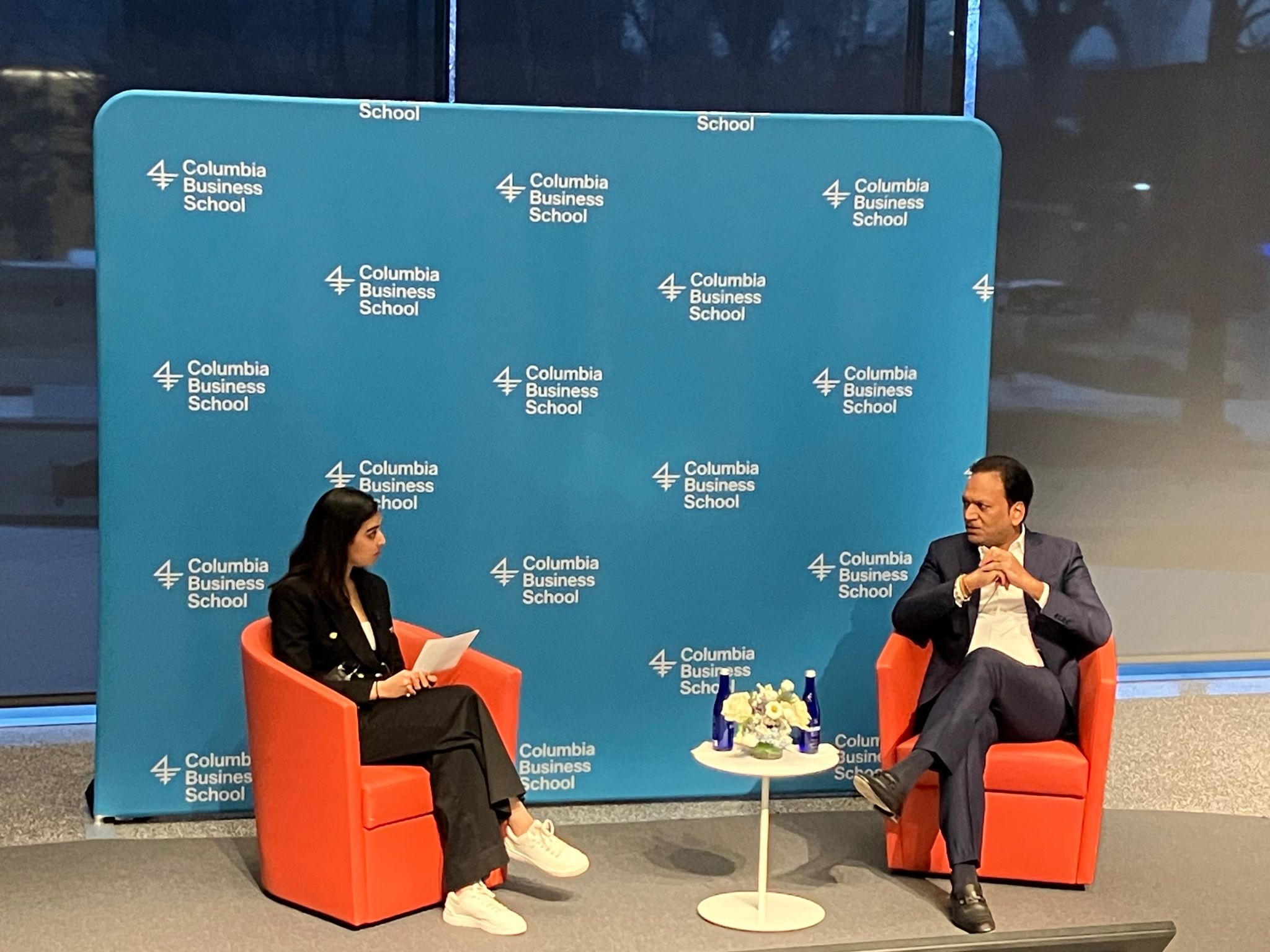
His conversation with Sanjay Puri on the Indianness podcast also returned to the people around a founder. They discussed learning from each job, the importance of emotional as well as financial support, and using individual success to support a community. Those themes connect the early working years to the later public roles.
At a Long Island community gala in July 2025, he was asked what advice he would give younger people. “Keep your goals simple and clear,” he said. He urged aspiring entrepreneurs to start, accept risk, and bring discipline and work to the task. He also spoke about wanting his experience to encourage younger members of the community.
The advice is easy to fit on a card. The career behind it takes longer to read: studying while working, eight years at Eckerd, a family-funded start, a brother joining full time, and decades of changing responsibilities. Somewhere between the packed family household and the next generation’s new company, Patel has accumulated plenty of evidence that beginning is a shared undertaking.