Audrey Wystrach arrived at a New York hotel after a day of meetings and discovered that her reservation belonged to another date. Nearby rooms were unavailable. The United Nations was in town, she was told. Her answer was a trip to Target for a sleeping bag and a pillow, followed by a night in an office where sleeping was, technically, forbidden. Entrepreneurship had provided accommodation. It had been economical with the amenities.
She had come to Manhattan to raise money for a veterinary startup. The city was unfamiliar; so were investor presentations and the business of asking strangers to believe in her. She had spent years learning her profession. Now she was learning how much remained outside it.
The episode is a useful place to meet the Petfolk co-founder and co-CEO. A funding announcement offers the tidy version of a business. A mistaken hotel booking supplies the person: capable, caught out, obliged to improvise. An office with a bathroom and a sink would do.
The ranch had its own curriculum
Wystrach grew up on a cattle ranch in southern Arizona. Animals were part of daily life, and the family veterinarian, Jim Pickrell, became an early example of how a person might work. He came to the ranch, answered questions and spent time explaining things to the family, including the child following him around.
Her brother Mike remembers those visits as an education in availability. Distance made telephone calls and house calls ordinary parts of the relationship. The professional came into the family’s world. That detail would remain useful when Audrey began thinking about customer service on a larger scale.
Her mother provided a different sort of example: a woman running a ranch with determination. Wystrach credits her parents with encouraging independence and treating obstacles as challenges to work through. There is something bracingly practical about that inheritance. A ranch is an awkward place to wait for circumstances to become convenient.
She graduated from Colorado State University’s veterinary program in 1994. Her subsequent working life included private practice, a mobile concierge business in Arizona and work for Banfield Pet Hospital. Ownership and corporate employment gave her different views of the same operation: the work itself, the customer’s experience and the machinery required to bring them together.
In Austin, she became co-founder and chief operating officer of ZippiVet. This was an apprenticeship in building across locations, with questions of design, staffing and workflow attached. A useful idea in one building has to survive repetition in another. The founder becomes responsible for the conditions under which other people can do their jobs.
An experienced operator learns a new room
New York introduced a less comfortable curriculum. Wystrach had never been to Manhattan before the fundraising adventure she later described. She had to figure out the subway and prepare an investor deck. Professional confidence did not automatically supply the vocabulary, connections or habits of a startup fundraiser.
The distinction matters. A founder with substantial experience can still be a novice at raising money. Knowing what customers need and persuading someone to finance the answer are separate skills. Wystrach’s account leaves room for the awkwardness between them, including meetings in which her ideas were taken apart.
She also found a modest networking advantage in Blu, her brother’s Bernese Mountain dog. Walking him made strangers easier to approach. A large dog had supplied an opening that the pitch deck could not. Even an ambitious business plan sometimes benefits from a colleague with four feet.
Eventually she took her ideas to Nashville and Charlotte, and Petfolk started in Charlotte. Her willingness to change the setting is part of the story. She could hold on to the ambition while revising the route. The place she first chose did not have to become the place where everything happened.
“put on my big girl boots”
Audrey Wystrach, on learning to raise capital
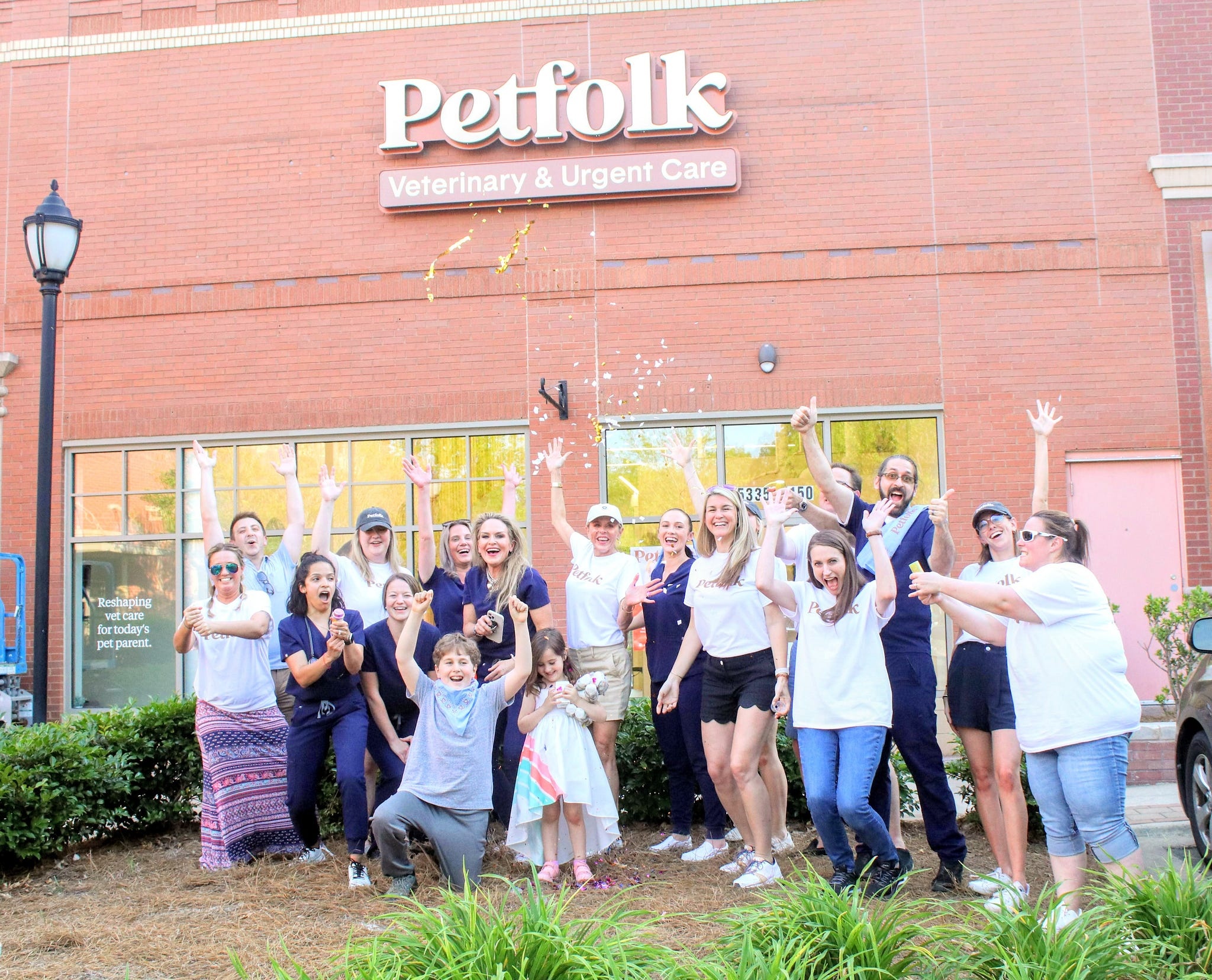
Petfolk launched in 2020. Its first location opened in Charlotte in 2021. Those dates can look reassuringly neat on a timeline; construction was less cooperative. Wystrach described supply shortages while the company was trying to build its spaces from scratch. A founder could revise a presentation overnight. Materials had their own timetable.
Two siblings, different toolkits
Mike Wystrach brought experience from Freshly, the prepared-meal company he founded and sold to Nestlé in 2020. His background included finance, real estate, entrepreneurship and technology. Audrey brought years inside her industry, including ownership and multi-location operations. The siblings shared a childhood; their professional toolkits had developed along different paths.
In August 2022, Mike publicly announced that he had joined his sister as Petfolk’s co-founder and co-CEO. His account of the company returned to their family veterinarian. The future they were trying to build had an old reference point: someone who was reachable, helpful and willing to explain.
Audrey’s interest in hospitality runs through her professional biography. It gives her operating questions a particular emphasis. How does someone enter a space? How easily can they communicate? Does the arrangement make sense to the person using it? The customer encounters all of those things together, however many departments a company has behind the scenes.
Petfolk’s August 2022 Series A brought $40 million, led by White Star Capital and Mike. The investor list included Miranda Lambert, Dierks Bentley, Jimmie Johnson and Danica Patrick. It was a fundraising announcement with enough entertainment and racing connections to make an unusually busy dinner table.
For Audrey, the practical consequence was capital to expand an operating business. Recognizable names could draw attention to the announcement. The rooms, teams and customer relationships still required the daily work of building. The hotel story belongs alongside the investment story because it preserves some sense of the distance between the two.
Individual financing rounds announced by Petfolk. Company capital, not personal wealth.
A calendar is a company decision
Some of the more revealing evidence of Wystrach’s leadership concerns a calendar. An early Petfolk employee, Cayla Couch, wanted a schedule that made trips to see family more practical. Wystrach and the people team were willing to adjust it. The arrangement changed again when Couch’s family circumstances changed.
There is a concrete operating choice here. A company can value an employee enough to reconsider the shape of the job. That requires coordination and a willingness to revise something already working on paper. The calendar becomes a place where the organization demonstrates what keeping a person is worth to it.
Ownership is another part of Wystrach’s thinking about careers. In 2023, Petfolk introduced a partner program offering a progression from associate to partner, with shared economics in individual locations and equity in the company. The announcement specified that no buy-in was required.
The offer connected advancement to a different structure from starting an independent business. For Wystrach, whose own career had included ownership, the question was familiar: how can people have a stake in what they are helping to build? Petfolk proposed one answer inside its expanding organization.
Who gets a chair
A 2025 podcast conversation supplies another scene. Before interviewing Wystrach, the host had experienced her willingness to bring another person into an industry leadership meeting. The invitation stayed with her. Later, reflecting on their conversation, she returned to the importance of making room for someone who was still finding her place.
That is a smaller unit of leadership than a company-wide program, and easier to picture. There is a meeting. Someone has access. Someone else could benefit from being there. Wystrach made the connection. The result, in the host’s account, was a lasting sense of being included.
“If it's not an incredible yes, it's a no.”
Audrey Wystrach
Her phrase for choosing commitments has a decisive rhythm. Taken alongside the invitation, it suggests that selectivity can leave space for other people. A busy founder still decides which conversations deserve her time. The host remembered that Wystrach treated the interview as one of those commitments.
The operation keeps moving
Petfolk announced another $40 million round in October 2023, led by Movendo Capital, and a $36 million Series C in October 2024, led by Deerfield Management. At the latter announcement, it reported nineteen locations across seven markets. The business had moved beyond the first building and its immediate neighborhood.
The more recent map keeps expanding. In April 2026, Petfolk announced locations in Fishers and Noblesville, Indiana. In May came Fulshear, Texas. A June announcement set out plans for a Riverton location in the Salt Lake City market, expected that fall. Expansion involves both doors already opened and doors still on a construction schedule.
Wystrach was named to the 2026 Inc. Female Founders 500 for work that included redefining core values, doubling the team and changing leadership structures. Petfolk also ranked No. 160 on the 2026 Inc. 5000. One recognition concerned her work inside the organization; the other marked the company’s growth.
Those milestones give the story scale. The earlier scenes give it texture: a child listening to the ranch veterinarian, an operator learning the subway, a founder walking Blu, a leader bringing someone into a meeting. Wystrach’s career has accumulated knowledge without eliminating the need to learn. Somewhere between the ranch and the investor room, she also learned that an office floor could be a place to begin again.
Keep the conversation going
Interviews, public profiles & company updates