Before there was a veterinary app, a board, or a term sheet, there was a girl riding along with a country doctor. Audrey Wystrach grew up with five siblings on a cattle ranch in southern Arizona. The family veterinarian, Dr. Jim Pickrell, came to them. He made house calls, took phone calls at unhelpful hours, treated animals where they stood, and explained what he was doing to the people gathered around. Wystrach was six or seven when she decided that this was the work for her.
The scene matters because Petfolk, the company she later co-founded with her brother Mike, can look at first glance like a bet on the new: carefully designed care centers, digital records, app-based scheduling, virtual conversations around the clock. Yet Wystrach's animating idea is older than any of those tools. She wanted to retrieve the continuity of the ranch call, then make it work for people who live nowhere near a ranch.
Her brother has put it neatly: Audrey did not invent the future of veterinary medicine; she remembered it. The distinction spares the story from the usual technology fable in which an app descends and everyone becomes efficient. Wystrach's app has a humbler assignment. It is meant to keep a relationship from disappearing when the clinic door closes.
A beginner with thirty years of experience
Wystrach graduated from Colorado State University's veterinary program in 1994. She remembers that cohort as the first at the school in which women outnumbered men, and then only by one. What followed was a tour through the business of care: rural practice, ownership, corporate medicine, and multi-site operations. She owned and sold a practice. She became co-founder and chief operating officer of ZippiVet, an Austin group built around hospital design, workflow, and a people-centered version of pet care.
By the time Petfolk took shape, she knew the exam room from nearly every angle. She also knew its frictions. An owner might wait, repeat a history, lose the thread after an appointment, or struggle to reach someone when a small concern arrived at a large hour. The clinician, meanwhile, worked through systems that were not always designed around clinical attention. Wystrach's question was practical: could physical medicine, communication, data, and hospitality behave like one service instead of four neighboring departments?
Expertise did not protect her from becoming a beginner. To fund a veterinary startup, Wystrach moved into a New York world whose customs were foreign to her. She had never assembled an investor deck, had never asked someone to finance her idea, and had never learned the subway. The city supplied brisk instruction.
After one day of meetings, she reached her hotel and discovered she had reserved the wrong date. The United Nations was in town; nearby rooms were gone. She bought a sleeping bag and pillow at Target and spent the night in the office. There was a sink. There was a bathroom. There was, one gathers, no room service. A founder's education is sometimes a seminar and sometimes a receipt for camping equipment in Manhattan.
Walking Blu, her brother's Bernese Mountain Dog, proved useful because strangers were more willing to talk to a woman with a splendid dog than to a woman with a pitch deck. The pitch itself shifted under pressure. Wystrach left New York, took meetings in Nashville and Charlotte, and ultimately started Petfolk in Charlotte. “The city tried to defeat me, but it also built me,” she later said.
The technology has an old job
Petfolk was co-founded in 2020 and opened its first care center in 2021. Its model joined the tangible and the ambient: clinics for primary and urgent care, digital records that travel, and a virtual team available after the appointment. The point was not to replace the examination table with a glowing rectangle. It was to keep the owner from feeling dropped between visits and to give the clinical team a continuous view.
The connected-care loop
That loop owes as much to hospitality as to software. Wystrach has repeatedly talked about the physical space, the flow of a visit, and the way a customer is heard. These may sound like softer matters beside diagnostics and surgery. In practice, they decide whether expertise can be understood, whether instructions survive the trip home, and whether a person returns before a concern grows.
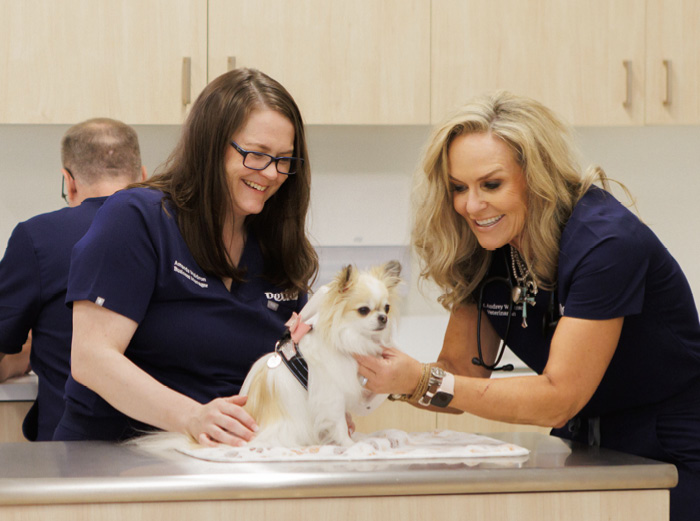
The idea attracted capital. Petfolk announced a $40 million Series A in 2022, a $40 million Series B in 2023, and a $36 million Series C led by Deerfield Management in 2024. Funding is not a verdict, but it does buy a young company more chances to prove its operating thesis. By 2026, Petfolk landed at No. 160 on the Inc. 5000, based on reported revenue growth of 2,016 percent over three years.
- 2020Petfolk is co-founded; Wystrach also helps found the Veterinary Virtual Care Association.
- 2021The first Petfolk care center opens in Charlotte.
- 2023A $40 million Series B supports a growing network of centers.
- 2024A $36 million Series C, led by Deerfield Management, backs further expansion.
- 2026Wystrach joins the Inc. Female Founders 500; Petfolk reaches No. 160 on the Inc. 5000.
The schedule is part of the design
Wystrach's critique of the traditional model is not limited to the customer journey. Early in her career, flexibility was scarce. She has recalled working five conventional days, having little permission to discuss a different arrangement, and once working every day of the year. She did not take a vacation during her first three years in practice. At home were three children and a husband whose job required frequent travel.
Owning hospitals gave her some control, but it also sharpened the problem. A veterinary company could not promise calm and continuity to clients by exhausting the people expected to provide it. At Petfolk, that memory became policy: four-day full-time options, part-time schedules, telehealth, flexible relief work, and the willingness to change an arrangement as an employee's life changes.
One example involved veterinarian Cayla Couch, who wanted longer stretches to visit family across the country. Petfolk adjusted her schedule. When Couch later needed a more predictable routine, the company changed it again. Wystrach described the decision without management varnish: they valued her, wanted her to be happy, and were willing to alter the system to find a workable answer.
This is one of the clearest ways biography enters the Petfolk operating manual. Wystrach is not treating flexibility as a perk attached after the important work is designed. The schedule is part of the work's design. So is a path for veterinarians to become partners without assuming the debt and administrative load of starting a practice from zero. Her stated aim is to let doctors concentrate on medicine while still gaining ownership and shared economics.
Growth, with the ranch still visible
There is a family symmetry in building Petfolk with Mike. The six Wystrach siblings grew up watching their mother run a ranch at a time when that made her an exception. Audrey has credited both parents with raising children to be independent and to treat obstacles as problems to solve. Mike arrived at Petfolk after building the meal company Freshly. Audrey brought the lived detail of clinical work. Their shared memory supplied the premise.
Wystrach's professional circle widened beyond the company. In 2020 she became a co-founder, founding board member, and co-chair of the Veterinary Virtual Care Association, an organization formed to make virtual care part of standard veterinary practice. The work positioned her inside debates about access, regulation, and what responsibly connected care should include.
Her public advice to founders is short on romance. Know the industry. Expect loneliness. Make decisions outside your expertise. Accept that an idea is only an idea until someone begins. Be willing to pivot. The confidence in these rules is earned by their accompanying embarrassment: the bad hotel date, the empty room after an investor says no, the need to change cities and change the plan.
Petfolk's 2026 recognition gives this story a tidy present-tense milestone. Inc. included Wystrach in its Female Founders 500 for rebuilding company culture, revising core values, doubling the team, and changing leadership structures. She answered the growth news by pointing back toward the people, the culture, and the medicine. “Growth is exciting,” she wrote, “but what I'm most proud of is how we are growing.”
The real test will not fit neatly on a list. It is whether a larger network can preserve the attention of a ranch call; whether virtual access feels like access rather than a queue; whether clinicians receive the room that earlier versions of the profession denied them; and whether technology leaves more time for teaching instead of merely creating another place to type.
At seven, Wystrach saw a veterinarian do two jobs at once. He cared for an animal and enlarged the confidence of the people nearby. Three decades into her own career, that remains her most durable product brief. The screens are newer. The promise is not.