- Small Door sells primary veterinary care with an annual membership, longer appointments, an app, and 24/7 telehealth.
- The membership is currently $149 per pet. It includes one exam and access benefits, not unlimited treatment.
- Its useful invention is operational: remove uncertainty from the minutes before and after the medicine.
- In July 2026, it merged with Bond Vet. The combined company says it spans more than 55 clinics and 500,000 pets.
- The idea travels best in dense markets where enough members can support available clinicians and expensive facilities.
Before Small Door was a veterinary company, it was an itinerary. Josh Guttman took his boxer, Morris, to eight clinics while trying to explain a mysterious stomach problem. There were thousands of dollars in bills, tests that did not settle the question, waiting rooms that made a sick dog no calmer, and records that did not seem eager to follow the patient. The medical system had many doors. None felt like an entrance.
Guttman and Florent Peyre drew an unusually literal lesson from the ordeal. Veterinary medicine did not merely have a diagnosis problem. It had a choreography problem. The owner waited too long, knew too little, repeated too much and discovered the price too late. Even when the clinical work was competent, the experience around it kept announcing disorder.
So Small Door, founded in New York in 2018 and opened in the West Village in 2019, began by redesigning the hour. Appointments would not be double-booked. Visits could run 30 to 60 minutes. Prices would be discussed before a test or procedure. The floors would give paws traction. Cats and dogs would not be forced into the same social experiment. An owner awake at 4 a.m. could message the medical team instead of consulting a search engine built to produce panic.
The product is the missing middle
Small Door is not pet insurance. Its membership does not turn blood work, vaccines, medicine, dentistry or surgery into freebies. The annual fee is $149 per pet at the time of writing. It includes one wellness or sick exam, 20 percent off additional exams, round-the-clock telehealth and same- or next-day appointment access. A non-member can also pay for an exam without committing for a year.
That distinction matters. The company is selling access and continuity, not a magic shield against veterinary bills. Its public price list gives the shape of the economics: vaccines can run from $58 to $179, blood tests from $136 to $447, and six months of flea, tick and heartworm medication from $155 to $244. The promise is not cheapness. It is legibility.
What the public menu makes visible
The clinical menu is broad enough to make the relationship useful: wellness care, sick visits, urgent concerns, vaccines, on-site diagnostics and radiology, dental cleanings and radiographs, spay and neuter procedures, other surgery, pharmacy, nutrition, behavior consultations and travel certificates. The app handles appointments, prescription requests, invoices and health records. Telehealth handles the important question that precedes many appointments: must we leave the house right now?
The clever thing Small Door sells is not unlimited medicine. It is fewer minutes in which the owner has no idea what happens next.The operating thesis
Hospitality with a lab coat
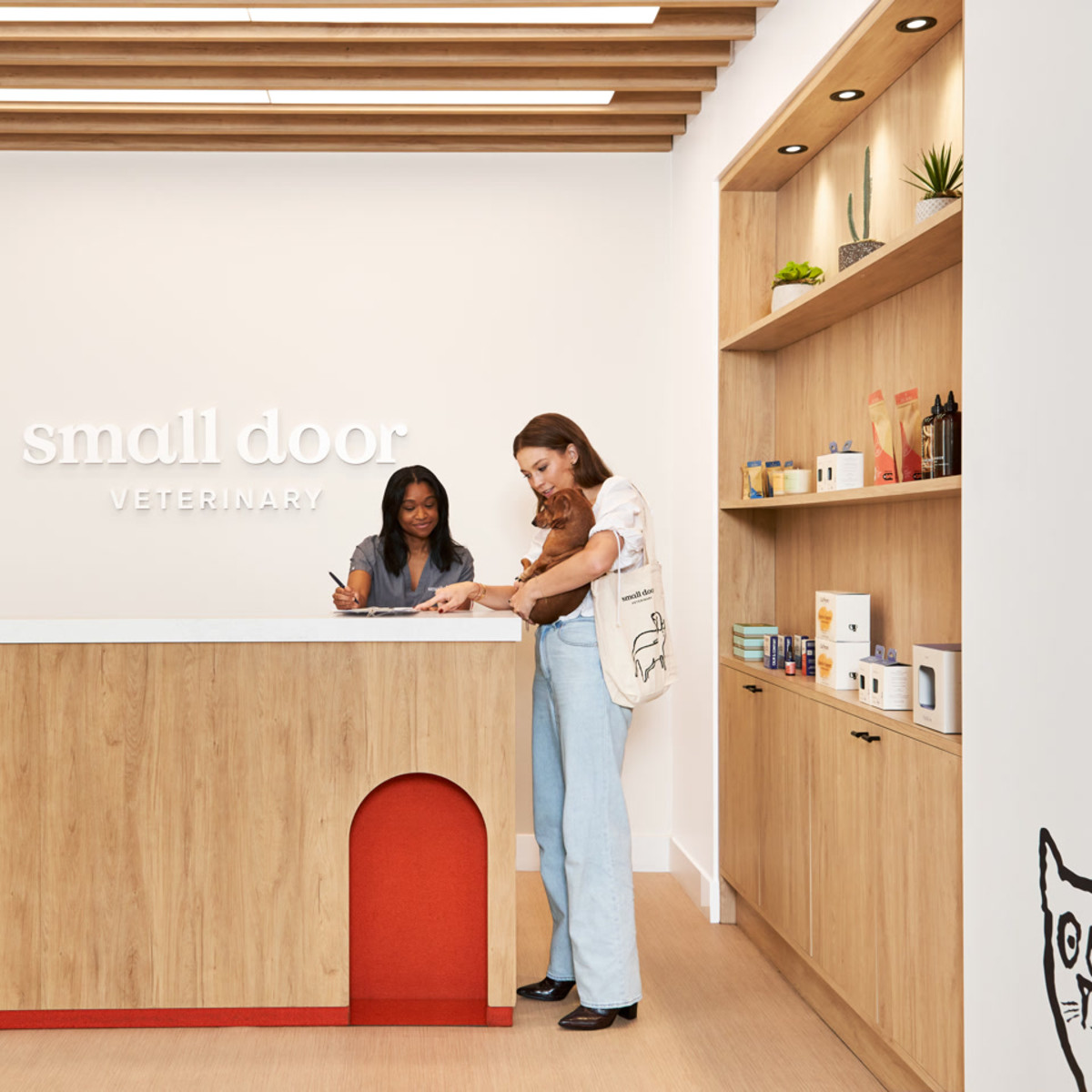
There is a temptation to dismiss the warm wood, arched alcoves and friendly app as tasteful packaging. But animal stress changes a visit. A frightened patient is harder to examine. A worried owner hears less. A hurried clinician explains less. Small Door's rooms are designed to lower that collective temperature, and its staff receive Fear Free training in handling and procedures. Its clinics are also accredited by the American Animal Hospital Association, a voluntary standard that examines hundreds of measures behind the pretty lobby.

The more consequential design choice may be invisible. Small Door says its veterinarians are salaried rather than paid according to production. The company has also advertised student-debt repayment and built clinician well-being into its public-benefit commitments. That does not abolish the commercial pressure of a venture-backed clinic chain. It does remove one obvious suspicion from the exam room: that the person recommending a test gets a direct commission from it.
The target they missed, and the door they found
Small Door raised $3.5 million before its first clinic, then $20 million in 2021 and announced an ambition to reach 25 locations by 2025. It did not. By the time of its next large financing in July 2025, it was opening in McLean, Virginia, and Park Slope, Brooklyn, and said the model had become repeatable. The package was substantial: $35 million in equity led by Valspring Capital and a $20 million debt facility from Bridge Bank. Later that year, Small Door reported a record year of profitability and plans for six openings in 2026.
Then the expansion plan changed shape. In July 2026, Small Door finalized a merger with Bond Vet, the larger urban veterinary network that had often occupied the same comparison set and, sometimes, the same neighborhoods. Financial terms were not disclosed. The combined organization reported more than 55 clinics, over 1,000 employees, more than 170 veterinarians and over half a million pets served. Peyre became chief executive of the combined company; Small Door's Dr. Jamie Richardson became chief medical officer. Both names remain on their respective doors for now.
This is the interesting part, because Small Door's original product depended on controlled intimacy. More time. Familiar teams. Records that follow the animal. A room that does not feel processed. Bond Vet contributes a much larger footprint and strength in accessible primary and urgent care. Small Door contributes membership, continuity and 24/7 digital access. On a slide, the pieces interlock beautifully. In a clinic at 5:40 on a wet Tuesday, integration is a less geometric affair.
The part worth stealing
Most companies cannot copy the dental suite. They can copy the sequence. First, list every moment when a customer is forced to wonder: When will someone see me? What will this cost? Who has my history? Is this urgent? Then attach an answer to each moment before polishing the brand. Small Door used scheduling rules, upfront estimates, portable records and persistent messaging. The attractive clinic is the receipt for those decisions, not the decisions themselves.
The second lesson is to design incentives where the customer can feel them. Salaried clinicians, longer visits and referrals to outside specialists can all be explained in one sentence. They make the company's claim of trust inspectable. A mission statement becomes more persuasive when it alters a calendar or a pay plan.
Copy this
Map uncertainty, publish useful price ranges, preserve records, create a fast triage channel, and compensate experts in a way that does not make every recommendation look like an upsell.
Check the conditions
Membership works poorly when customers visit too rarely to value access, when local density cannot support spare appointment capacity, or when the core service itself is inconsistent.
There are limits. An annual fee can look like a cover charge if the member still faces substantial treatment costs. Telehealth cannot take an X-ray. A calm room cannot compensate for a weak diagnosis. And density is the quiet prerequisite: same-day access is much easier when enough nearby members and clinicians can keep the network busy without keeping every slot full.
Morris eventually got his diagnosis and returned to tug-of-war and bodysurfing. Small Door got a founding myth with unusually practical instructions. Eight clinics had treated pieces of the problem; the company would try to hold the whole experience together. The merger now asks whether that wholeness can survive a much larger map. If it can, the most important feature will not be the small door. It will be the long memory on the other side.