The modern video call is a ruthless little editor. It removes the shoes, forgets the trousers and crops a person into a rectangle that begins somewhere around the ribs. For millions of workers, personal style was suddenly asked to perform in a very small space. Raquel Robertson noticed what remained in the frame. Hair. Face. A sliver of shoulder. The part of getting dressed most likely to be dismissed as an accessory had become the principal event.
Robertson was working remotely and wanted to feel comfortable without surrendering the expressive pleasure of putting herself together. She had always worn headbands, scarves, clips and wraps. Yet the available choices seemed to impose a dreary bargain: choose the beautiful thing that might tug or damage natural hair, or choose the sensible thing and lower one's aesthetic expectations. Commerce is crowded with grand problems. Robertson found a business in a small, persistent irritation.
Her answer became Nadora Iman, an Atlanta label that describes its accessories as wearable art. It began with hair, but the thought behind it was larger. An accessory could perform a function, carry a story and announce its wearer without punishing her for the pleasure. Robertson's compressed summary of the leap is better than any founder mythology: “So I created what I wished existed.”
Before the product, there was the mirror
The idea did not arrive in an empty room. Robertson had spent years in beauty, helping women construct looks that felt recognizably their own. Her Atlanta practice, Raq Natural Beauty, offers hair and makeup for weddings, photographs, films and special events. Its range is practical and broad: locs, natural Black hair, extensions, complexion work across skin tones, the calm choreography of a wedding morning. The job is intimate. A client is not asking merely to look good. She is asking to look like herself on a day when everyone will be looking.
That difference matters. It explains why Nadora Iman's public language returns to authenticity, confidence and story instead of treating the wearer as a display stand. Robertson's beauty brief has long been to add something distinctive without disguising the person beneath it. A scarf or scrunchie simply makes that negotiation portable.
Her own natural-hair story supplied the other half of the education. In a 2017 interview, Robertson said that a photograph of full, curly hair and a friend's wash routine nudged her toward going natural. She also named the difficult part with disarming economy: patience. Anyone who has grown out one texture while learning another knows the peculiar delay built into the process. The desired result cannot be rushed without defeating the point.
“The most challenging thing about going natural was having patience while transitioning.”Raquel Robertson, 2017
Patience is an underrated design credential. It teaches a founder to distrust the product that photographs well and behaves badly after an hour. It also teaches respect for the person whose routine the product enters. Nadora Iman states its standards plainly: pieces should be distinctive enough to collect, gentle on hair and capable of becoming part of a ritual. The ambition is not to defeat the ordinary morning. It is to improve it.
The operator and the artist share a desk
Robertson's other professional life is conducted closer to systems than silk. She works at Amplify, the education company, and describes her specialty as revenue operations. The phrase is not glamorous, which is one reason it is useful. Revenue operations is the connective work: aligning information, tools and teams so that a promise made in one department can survive its journey through the next. It is a profession of handoffs, definitions and fewer unpleasant surprises.
At first glance, that work appears to sit across the room from illustrated scarves. Look again. A collection also depends on handoffs. An idea becomes a drawing, a material choice, a product, a photograph, a listing, a parcel and finally an object in somebody else's routine. Inspiration may begin the sequence. Operations prevents it from becoming a pile of beautiful intentions.
Three practices, one recurring question
Make systems dependable
People can do their work
Listen before styling
The client still feels like herself
Join care with expression
The useful object carries a story
Robertson calls herself a multi-passionate entrepreneur. It is tempting to read that as a polite refusal to specialize. Her history suggests something more coherent. At Colorado State University, where she studied from 2010 to 2014, her activities ranged across student-fee review, concert programming, campus recreation and the Black/African American Cultural Center. As a mentor, she explained that new Black students confronting college and cultural adjustment should have someone they could approach. The settings change, but her work repeatedly concerns the conditions that let people participate with confidence.
In operations, those conditions may be invisible. In beauty, they are personal. In retail, they become objects. The medium changes more than the motive.
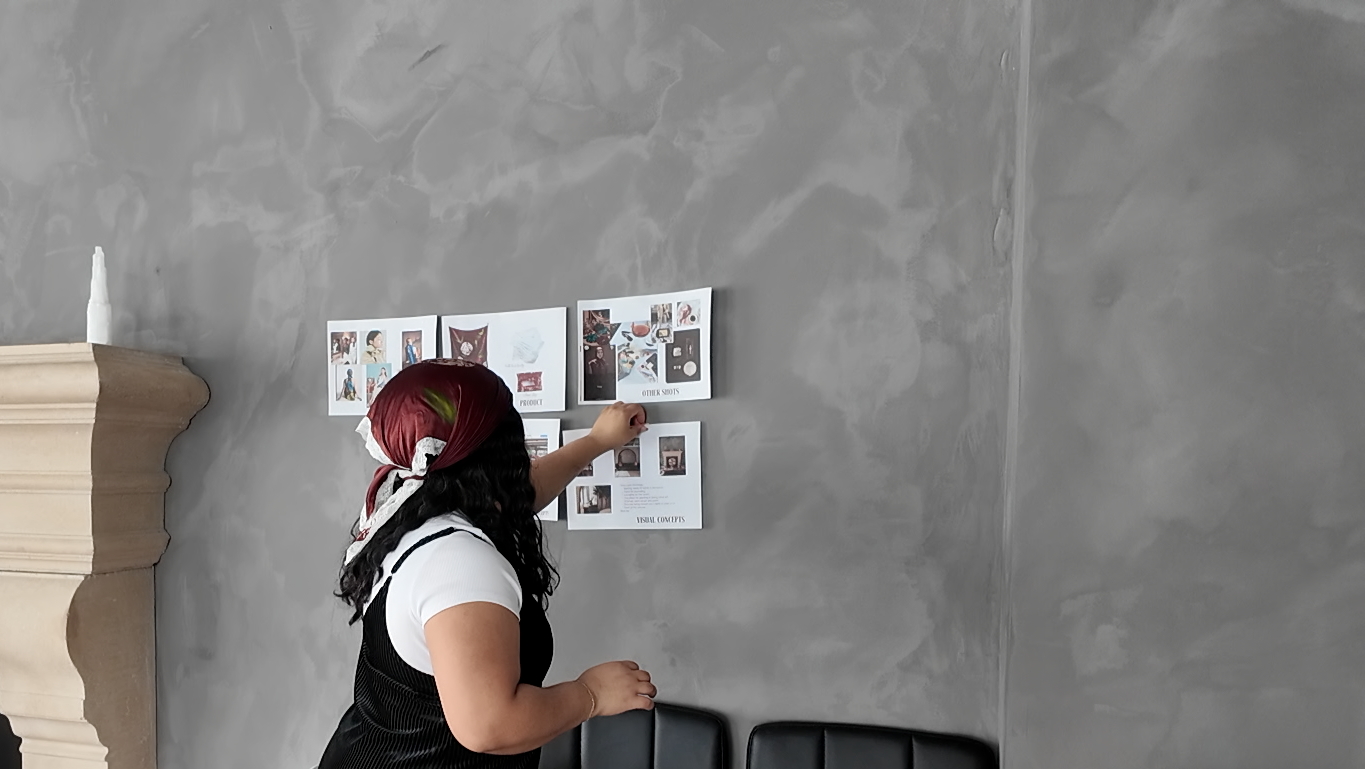
A collection should have something to say
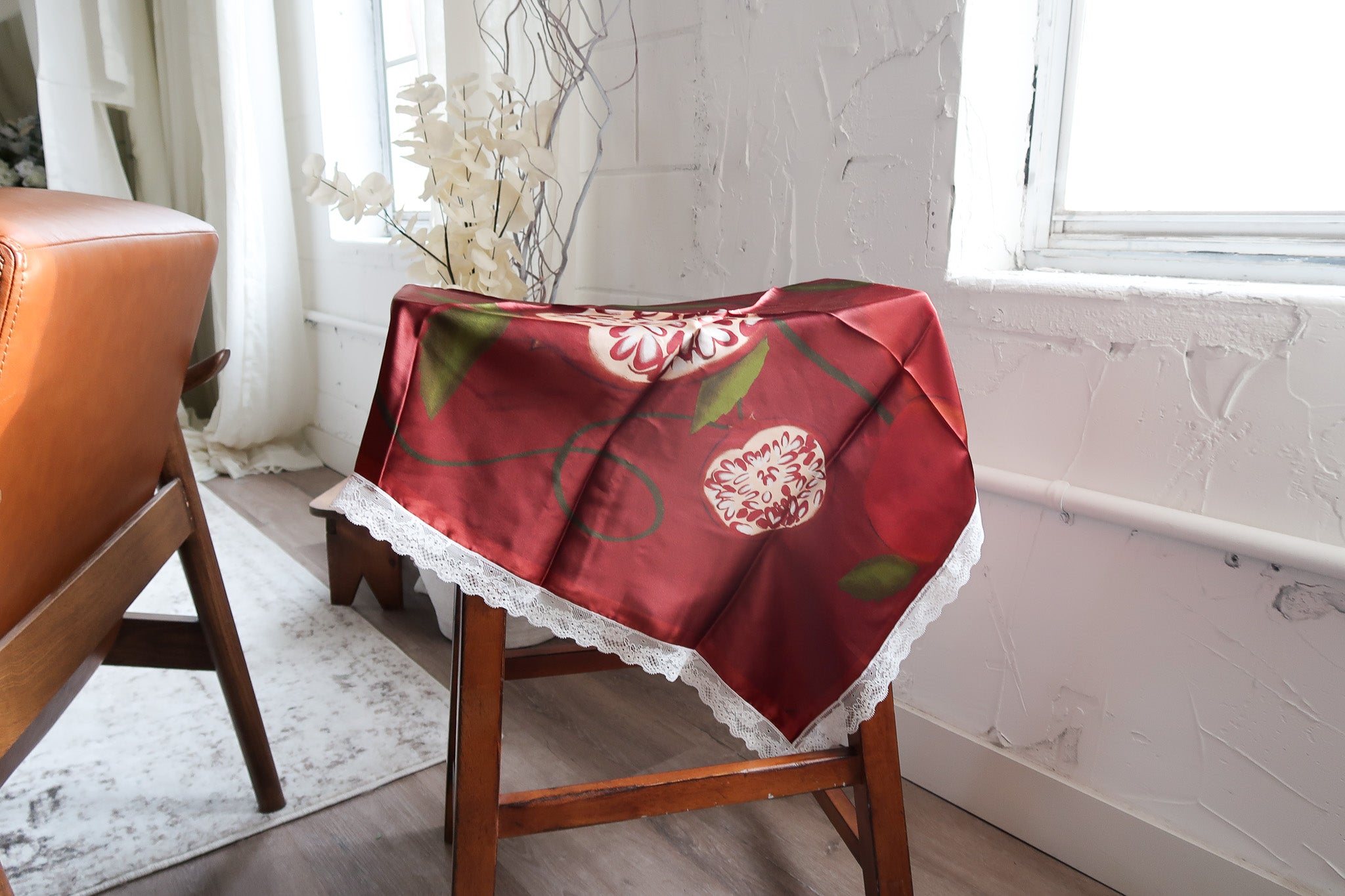
As Nadora Iman developed, Robertson began bringing original art into the pieces. The first hand-illustrated silk scarf and scrunchie pushed the brand beyond the familiar territory of accessory basics. A scarf is already an unusually mobile canvas. It can sit around the neck, cover the hair, trail from a bag or live framed on a wall. Give it an original illustration and the object begins to resist a single job description. That suits its founder.
The brand's stated preference is story over trend. In retail, trends are efficient little dictators: they tell makers what color, shape or mood must be produced before the public tires of it. Robertson's alternative is the collection as narrative. The current range includes silk, lace, illustrated florals, claw clips and objects for the home. The pieces are designed to be used, but they are also meant to be kept and collected. Utility does not have to dress like austerity.
Even the brand name carries more freight than a conventional label. Nadora Iman is presented as “Beautiful gift, powered by faith,” a phrase that makes giving and belief part of the commercial identity. The idea of gift operates in both directions. Robertson makes an object for somebody else to wear, but the wearer completes it by deciding how it belongs in her life. Faith, meanwhile, is not offered as a marketing flourish so much as a theory of encounter: the hope that a piece reaches a person for a reason. This is unusually earnest territory for a claw clip. Yet the smallness of the object may be precisely what allows the sentiment to remain light on its feet. A grand declaration can exhaust a room. A scarf can simply enter it.
Nadora Iman's community project, The Collective, sharpens that philosophy by putting wearers and their own work beside the products. A poet and yoga teacher, a makeup artist, a model coordinator, a studio founder, an educator and a manicurist speak about legacy, authenticity and refusing to blend in. The usual retail arrangement places the brand at the center and the customer around it. Here, the women have biographies, trades and declarations of their own. The accessory joins the portrait rather than replacing it.
A camera reduced the room available for style. Robertson treated the constraint as an invitation to say more with less.The idea behind Nadora Iman
There is a dry joke hidden in the origin story. Remote work was supposed to make dressing easier. Instead, it produced a new costume department: the respectable upper half, ready for an unexpected meeting, floating above whatever the camera mercifully omitted. Robertson did not attempt to restore the old office uniform. She asked what the new frame made possible. The answer was color near the face, comfort that could last the day and a piece interesting enough to survive beyond the meeting.
The small thing is the whole thing
Founders are often encouraged to describe a market as if they have discovered a continent. Robertson's work is more persuasive at human scale. She noticed a compromise because she had lived it. She understood the client's desire because she had stood beside the mirror. She knew an expressive object would fail if it ignored the physical realities of natural hair. Then she built the operational path from wish to product.
That path is still unfolding. Nadora Iman remains a small, self-owned label, and Robertson remains employed in the exacting work of education-company operations. The combination is not a footnote to the founder story. It is the story. One practice teaches her to make the machine run. The other insists that the machine produce something with feeling.
Return to the video-call rectangle and the insight looks almost comic in its modesty. A scarf. A clip. A scrunchie. Yet identity is assembled from such minor nouns. Robertson's wager is that an everyday object can protect, decorate and communicate at once. The camera may see only a square inch. She intends to make it count.