At Rich Ford, two support staff members were responsible for answering all the inbound calls. In a Car Wars testimonial, marketing director Allison Kemp described an arrangement without structured training or scripting. The callers were real. So was the demand. What was missing was a dependable way to handle it.
- Car Wars tracks and reviews dealership calls, then flags opportunities that need attention.
- Its CRISP scorecard measures connection, invitation, appointments, and follow-up.
- Cari, its AI receptionist and scheduler, can put service bookings into supported dealership systems.
This is the territory Car Wars occupies: the distance between a customer expressing interest and a dealership doing something useful with it. Advertising can deliver the first half of that journey. A phone system, a busy advisor, and an unreturned message can complicate the second. Counting incoming calls tells a manager remarkably little about where the trouble began.
“There wasn’t any structured training or scripting.”
Allison Kemp / Rich Ford
Car Wars customer testimonial
The call that disappears in plain sight
Car Wars is the automotive business of Call Box. Its roots run through Century Interactive, founded by Jack Doege in 1988. Doege studied geology and started in oil and gas, an unexpected route into listening to dealership conversations. The company now combines software, human review, artificial intelligence, and consulting for Sales and Service departments.
Its customers include single dealerships and dealer groups. Public testimonials name Rich Ford, Trophy Nissan, The Niello Company, and Schomp Automotive. The everyday users are salespeople, service advisors, business development teams, and managers trying to understand which conversations need another attempt. The product belongs near the CRM and the phone system, where marketing promises become operational work.
The distinction matters because a call can look successful from a distance. Someone picked up. A transfer happened. There is a recording. Yet the customer may still have reached nobody who could answer the question. Car Wars builds its reporting around the content and outcome of the conversation, giving managers a way to inspect that apparent success.
A stricter meaning of connected
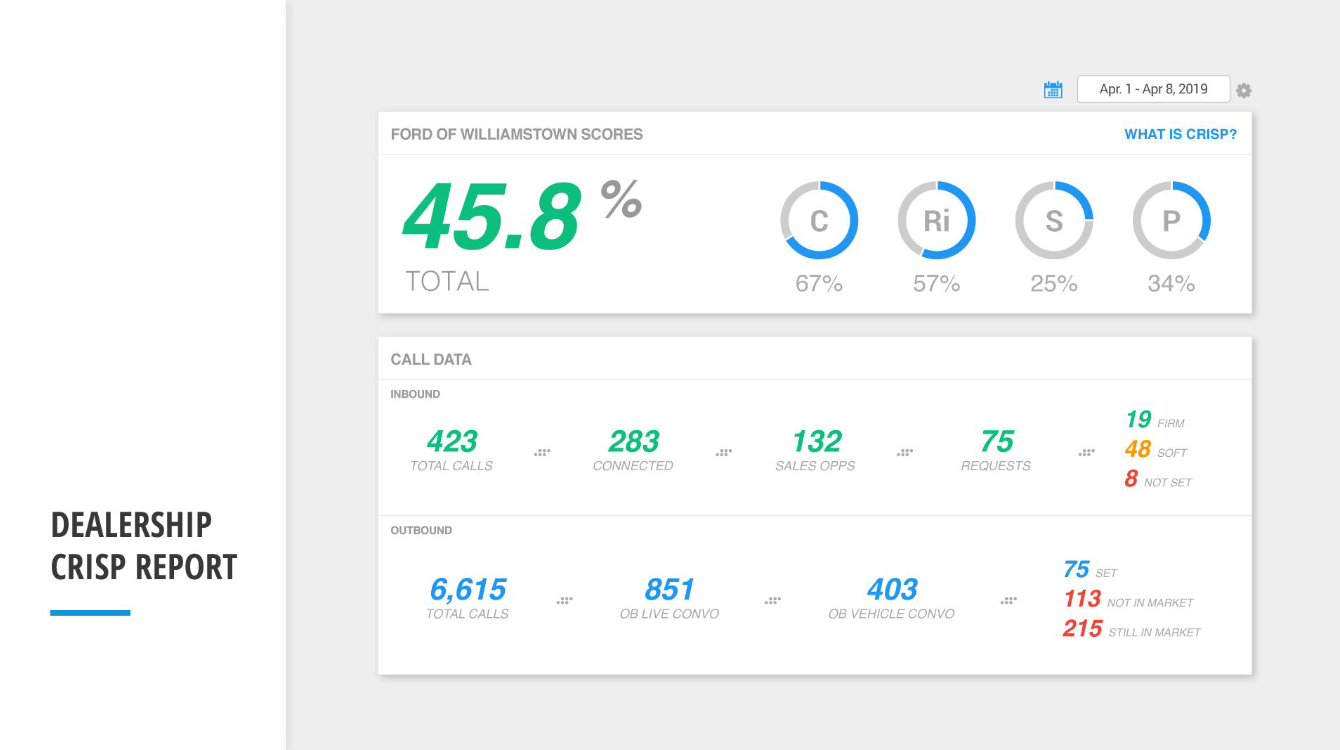
Car Wars’ CRISP framework begins with a demanding definition. A connected customer reaches a qualified agent and gets questions answered. A receptionist transferring someone to voicemail does not qualify. Next come Request and Invite, Set, and Pursue: ask the customer in, agree on a firm appointment, and follow up on unfinished opportunities.
& Invite
There is pleasing precision in the word “firm.” A promise to drop by sometime is different from an agreed date and time. That difference gives a manager something to coach. Rather than delivering a general lecture about friendliness, the manager can examine whether an agent actually offered an appointment and secured a commitment.
Who actually got connected?
The useful lesson in those figures is the choice of measurement. A dealership that celebrates answered calls can overlook callers who never got help. A stricter definition makes the report less flattering and more useful. It also points toward a fix: routing, staffing, or the handoff, rather than another advertising campaign.
The recording has to go somewhere
Car Wars tracks inbound and outbound calls, reviews conversations, produces recaps, and alerts managers to missed opportunities. Dynamic website numbers connect phone inquiries with marketing sources. Agent voice recognition helps assign calls in the CRM. Human reviewers remain part of the offering, alongside AI, rather than disappearing behind a transcription feature.
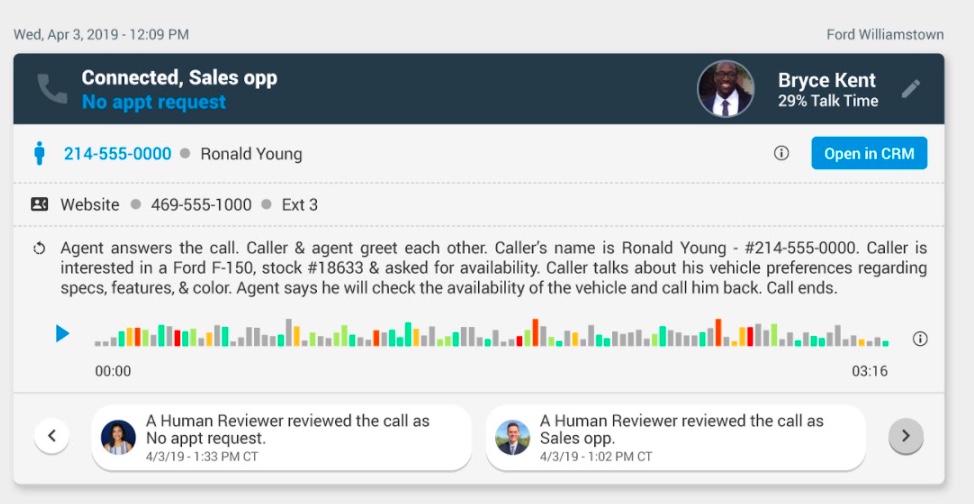
The integrations make that information easier to act on. GoTo describes an end-to-end recording that survives holds and transfers, with activity pushed into dealership CRMs. Car Wars announced an ELEAD1ONE integration back in 2013. The ambition is consistent: keep the conversation attached to the customer, so follow-up does not depend on someone remembering to type a note.
This is a competitive market. CallRevu also offers automotive conversation intelligence, CRM connections, and coaching. Car Wars’ particular package brings together its CRISP method, human and AI review, dealership integrations, and consulting. The sensible comparison is how those pieces work in a store: who sees an alert, where the record lands, and what happens afterward.
First listen. Then book.
Cari Phone Assist moves Car Wars further into the conversation itself. The AI receptionist and service scheduler handles routing and routine booking calls. Through its Xtime integration, Cari checks availability and books directly into the scheduling system, where existing workflows can continue. That is a concrete task with a concrete destination: an appointment in the calendar.
Customer calls Cari checks availability Appointment enters the dealer’s system
Recent announcements follow that direction. Car Wars announced a CDK connection through Fortellis in October 2025, followed by direct myKaarma and UpdatePromise scheduling integrations in April and May 2026. July brought a Revvable partnership for powersports conversations and deal records. These are company announcements of capabilities, rather than proof of any particular revenue gain.
Buy the system. Budget for the habit.
Car Wars sells through a demo and quotation process. An archived setup sheet priced Essentials implementation at $490 and Pro at $2,190, with training and configuration in the mix. Those are historical setup charges, not today’s subscription prices. The parent company’s service agreements govern recurring fees and scope. A useful buying conversation covers integrations, implementation, usage, and training together.
The operating cost includes attention. An alert needs an owner; a callback needs time. Automated scheduling depends on usable availability and a correctly configured connection. Those are practical dependencies, not claims that a dashboard can settle. A dealership unable to change its routing or follow-up routine may simply acquire a clearer view of the same problem.
There is something here any manager can copy: choose a handful of actual calls, identify one repeatable failure, give someone responsibility for the next step, and check the result. At Rich Ford, the account began with two people trying to keep up. Car Wars’ most interesting proposition is that phone performance can become a process people learn, inspect, and improve.