The first thing to fail was not a server. It was the story the numbers told. Jellyfish, the British paid-search agency co-founded by Paul Walsh and Rob Pierre, could buy online ads for magazine subscriptions and count the clicks. But when a reader finished the purchase by telephone, the trail went cold. The campaign report saw interest; the cash register saw a customer; nobody could reliably join the two.
Walsh's fix was elegantly mechanical. Show each web visitor a trackable phone number, connect the eventual call to that person's online journey, then return the number to a shared pool after the session. Suddenly a marketer could see that a particular keyword had caused a particular phone conversation. By 2010, Walsh had concluded that the tool deserved to be a product rather than agency plumbing. Interest from other agencies confirmed the hunch. Infinity emerged as a six-person standalone company and rebuilt the stack from scratch.
“We believe conversations matter and that you deserve to understand yours better.”Infinity's plainest statement of purpose
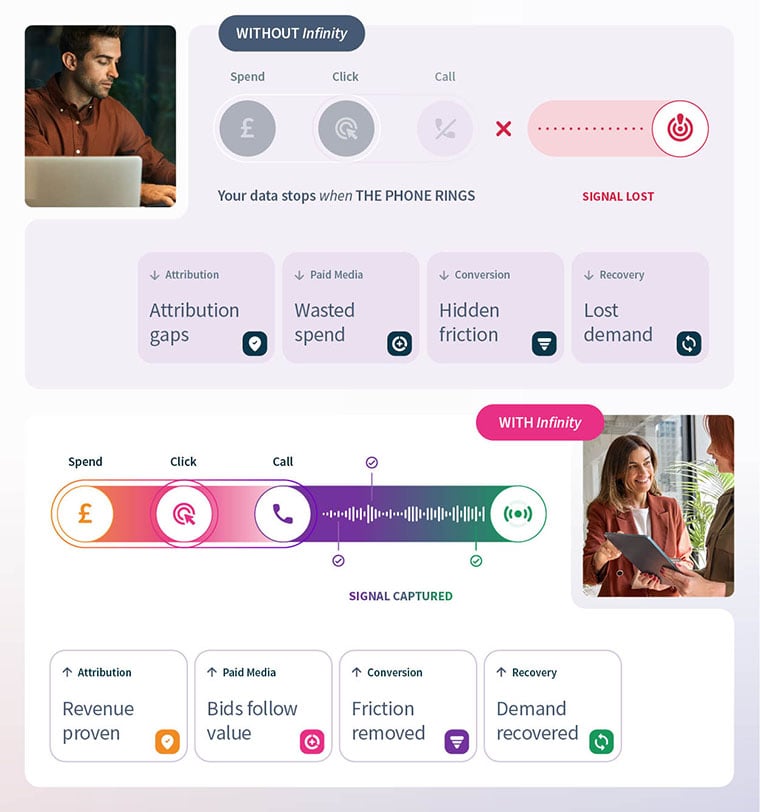
One phone call, three missing chapters
Infinity's core product still performs that original trick, now called visitor-level call tracking. Dynamic number insertion places a unique tracking number on a site, then associates the call with campaigns, channels, adverts, keywords and previous visits. This is more precise than assigning one fixed number to every billboard, search campaign or social account. It gives the business a journey, not merely a source label.
The company has since stretched the story in both directions. Before the call, it shows what marketing created the demand. During the call, Conversation Analytics can transcribe and examine what people ask, how agents respond and why promising enquiries stall. After the call, Smart Match connects the conversation to a sale and its revenue. The progression matters because a ringing phone is an ambiguous event. A request for opening hours, a complaint and a £20,000 purchase enquiry all increment the same crude call counter.
The clever bit happens after listening
Smart Outcomes, launched in January 2025, is Infinity's clearest move from measurement into automation. A customer configures the intents and outcomes that count in its business - a test-drive request, an appointment, a holiday booking, a qualified quote. The software classifies calls and passes those higher-quality conversions into bidding systems. Infinity says categorisation starts immediately and useful campaign results can appear within about 30 days.
This corrects a quiet but costly mistake in automated advertising. If Google Ads is told that every call is equally good, it will seek more calls, including the useless ones. Give it qualified outcomes or revenue and it can bid toward commercial value. Smart Outcomes supplies the quality label; Smart Match or a CRM connection supplies the money; integrations move those signals into Google, Microsoft, Meta, Salesforce, HubSpot and other tools. Infinity lists more than 45 ready-made integrations.
Those are customer case-study results, not a promise that installing a script will triple anybody's sales. Stoneacre connected call conversion data to Performance Max and reported 300 percent more PPC sales calls, a 79 percent increase in its click-to-call ratio and a 21.1 percent rise in average order value. Fred. Olsen Cruise Lines identified booking intent, fed it into Google Ads and reported a 16 percent increase in return on ad spend alongside 37 percent year-on-year revenue growth. The portable idea is narrower and more useful: optimize on the outcome the business wants, not the event that is easiest to count.
Who needs the telephone in 2026?
A surprising number of expensive decisions still escape the browser. A driver wants to ask about a particular car. A patient needs reassurance before arranging treatment. A homeowner wants a mortgage explained; a traveler wants the cabin and cancellation policy settled. Infinity sells to the marketing, sales, customer-experience and contact-centre teams behind those conversations. Its named customers span Aviva, Specsavers, Motorpoint, NFU Mutual, British Gas, Vodafone, Stoneacre and cruise operators. The company says its platform handles calls across more than 75 countries.
This also explains the competitive field. CallRail, Invoca, WhatConverts and CallTrackingMetrics can all make credible claims around attribution or conversation intelligence; Google's own forwarding numbers cover a simpler paid-search use case. Infinity's pitch is the breadth of the chain: visitor-level cross-channel history, analysis inside the conversation, revenue matching and a return path into the advertising algorithm. Enterprise security is part of that sale. The company advertises ISO 27001 and PCI DSS certification, necessary reassurance when recordings may contain health, financial or payment information.
The bill has a dial tone
Infinity is subscription software with a telecom meter attached. Its public US page lists an Essentials plan at $249 a month plus $0.20 per call and Pro at $349 plus $0.15 per call. Enterprise is priced by quotation. The company says UK call tracking can begin at £199. Carrier minutes, additional integrations and longer data storage may add charges; invoices can include a licence, a fee for calls lasting at least one second and carrier time billed per second.
That model is sensible for a car group with thousands of valuable calls and much less obvious for a shop that receives three calls about parking. The spend must be measured against lead value, media waste and the operational cost of listening manually. Infinity's old fair-use rules even charged dormant fixed numbers when they received fewer than ten monthly calls - a small detail that captures the product's economics. Numbers are working inventory.
The acquisition changed the ambition
Infinity grew without outside money for its first two years, opened a Reigate office, added US support in 2014 and raised £10 million from Smedvig Capital in 2016. By 2018 it employed 115 people across five locations. The 2021 acquisition of Manchester rival ResponseTap created a combined team of 135 and brought Smart Match plus phone-call personalisation technology into a broader suite. CEO Warren Newbert described the aim as drawing more insight and stronger conclusions from every call.
The company's centre of gravity continued to move from tracking toward interpretation. A 2024 LivePerson partnership extended attribution toward digital conversations. Smart Outcomes arrived the following January. That same month CIBC Innovation Banking provided a £5 million corporate debt facility, earmarked for product development and customer experience. In September 2025, Mark Adams replaced Newbert after Newbert's nine years at the helm. Adams arrived with more than 25 years in B2B SaaS and an explicit brief to push an AI-first product vision.
“This is a company with incredible momentum, a talented team, and a clear purpose: helping businesses turn call data into better business outcomes.”Mark Adams, CEO
There is a human counterpoint to all that automation. Infinity advertises a four-and-a-half-day workweek, flexible patterns, private healthcare, learning support and employee sessions called “We listen and act.” The culture language is refreshingly measurement-minded: grow and evolve, measure what matters, deliver impact, win and learn together. It is difficult to miss the product philosophy hiding in the employee handbook.
The conditions that make the loop useful
- Calls must be frequent or valuable enough to justify subscription and usage costs.
- Tracking numbers, consent, retention and redaction need careful configuration.
- The business needs a real definition of quality - not simply “somebody called.”
- Ad platforms and CRM records must receive clean outcomes, and teams must act on them.
Without those conditions, conversation intelligence becomes expensive upholstery: handsome dashboards fitted to a process nobody changes. It can also fail quietly. Incomplete number coverage breaks attribution; weak consent practices create risk; too few examples make automated categorisation brittle; a sales team that never records outcomes starves the revenue match. Infinity reduces manual listening, but it cannot invent a useful operating question.
A playbook worth stealing
Start where Infinity started - with the point at which evidence disappears. Give each journey a durable identity. Define the commercial outcome in plain language. Send that outcome back to the system buying the next click. Then inspect the calls with good intent and bad results. Infinity's newer Conversion Barriers product formalizes that last step by finding objections, missing information and process friction. Smart Voice aims to recover missed opportunities automatically.
The company now describes this as a loop: capture, signal, prioritise, activate. It is a neat piece of product packaging, but also a decent management instruction. Measurement is unfinished until it changes the next decision. Sixteen years after a magazine subscriber picked up the telephone and vanished from an analytics report, Infinity is still chasing that missing chapter - only now the reader is an algorithm with a media budget.