The first version of CallRail was not born in a strategy off-site. It was built because Andy Powell had a small-business problem that bordered on awkward. His online directory of BMW repair shops attracted visitors, and the shops were willing to pay for listings, but Powell could not show that those listings produced customers. The click vanished the moment somebody reached for a telephone. Asking a mechanic to trust the dashboard was not much of a sales pitch.
Powell and fellow Georgia Tech graduate Kevin Mann made a tracking tool that assigned calls to the listing that generated them. It gave the directory a receipt. More importantly, it revealed a much larger market: plumbers, lawyers, dentists, property managers and their marketing agencies had the same hole in their reporting. In 2011, the pair turned the internal fix into CallRail.
The proof was the product
CallRail's basic trick remains easy to explain. Give each marketing source a tracking number, or use a pool of numbers that changes dynamically for each website visitor. Calls still land at the business's ordinary line. Behind the scenes, CallRail connects the conversation to the ad, search keyword, landing page or campaign that came before it. A phone call stops being a fuzzy offline event and becomes a row in a marketing report.
That is what the company does, but it is not the whole reason customers pay. The practical product is a decision: keep funding the Google campaign, cut the billboard, call the promising lead back, coach the intake rep, or show an agency client that last month's spend produced actual jobs. Attribution is valuable only when it changes what happens next.
The dashboard learned to listen
Call tracking came first. Form Tracking added web submissions to the same customer journey. Conversation Intelligence, launched in 2016, turned recordings into transcripts and searchable data. Its premium version now summarizes calls, labels sentiment, detects topics and marks likely conversions. Convert Assist, released in 2024 from the company's experimental Labs program, reads recorded conversations and suggests next steps, drafts follow-ups and offers coaching.
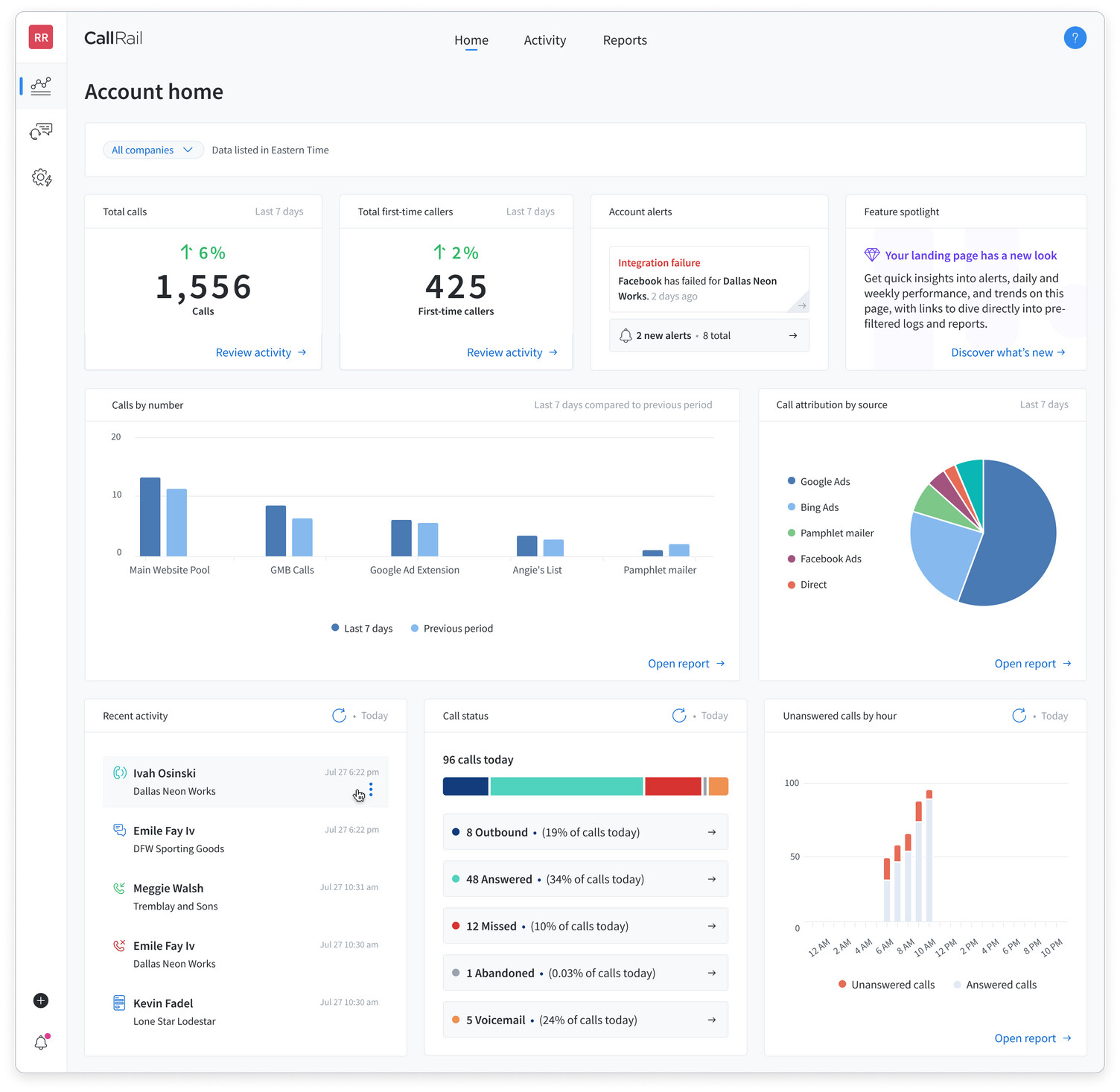
Voice Assist moved CallRail from observer to participant. Introduced in 2025, the AI agent can answer after-hours and overflow calls, collect details, screen out poor fits and book appointments. By August 2026 it could qualify a lead during the conversation, infer intent, route the caller and brief a human before the transfer. CallRail says it analyzes roughly 300 million leads a year. That archive of real, messy business conversations is more strategically interesting than the generic fact that the product uses a large language model.
“We weren't caught on our heels. We've been using AI for years.”Ryan Johnson, chief product officer
Who buys it - and what it costs
The sweet spot is a business where a phone call is both common and valuable. A roofer might close a five-figure job. A law firm may acquire a case. A clinic books a patient. An agency needs to prove it produced either one. CallRail says more than 225,000 businesses use the platform, including more than 7,000 agencies. Home services, legal, healthcare, automotive and real estate appear repeatedly because the gap between online discovery and offline sale is especially wide there.
The model is subscription software with metered edges. Published monthly pricing in August 2026 starts at $50 for Lead Tracking. A $95 tier adds form attribution. Lead Conversion costs $150 with premium conversation analysis; the complete bundle is $195. Voice Assist starts at $95 a month, and CallRail's published terms attach a lead-tracking requirement and overage charges. Numbers, minutes and calls beyond the included allowance cost extra. Annual billing can reduce the base price, while agency, enterprise and healthcare arrangements get more specific.
Base subscription only. Usage, premium integrations and Voice Assist can add to the bill.
The calculation is deliberately concrete. If one recovered appointment is worth more than the software, the product can pay for itself. If nobody reviews the reports, tags outcomes or adjusts spending, it becomes a colorful tax on the marketing budget.
The first thing that failed
The original failure came before CallRail: Powell's directory could not defend its own value. That frustration changed his mind about what the real product was. The directory sold attention; the tracking tool sold proof. Proof was easier to repeat across industries.
CallRail later learned a more expensive version of the lesson. In 2020 it launched Lead Center, a communications hub with an inbox, softphone, texts and an interaction timeline. In October 2025 the company announced that it would sunset the product, with the phaseout beginning in January 2026. Customers could use CallRail's outbound dialer and messaging or migrate phone-system functions to RingCentral.
The retreat says something useful about product boundaries. Running attribution and analyzing conversations are adjacent to operating an entire business phone system, but adjacent is not identical. RingCentral already owns queues, transfers and active routing. CallRail's better position is the intelligence layer that tells a phone system where the lead came from and whether it mattered. A partnership can be a cleaner product decision than another year of pretending every feature belongs under one roof.

The agency flywheel
CallRail's distribution advantage is not a viral button. It is an anxious agency account review. Marketing firms must show that ads produced business, not merely impressions. Put every client in a multi-account CallRail setup and the agency gets a defensible report; CallRail gets carried into dozens or hundreds of SMBs. The partner program adds training, support, co-marketing and referral economics. Nearly 4,000 businesses had installed the HubSpot integration by the end of 2024, while the broader ecosystem spans Google Ads, Salesforce, Mailchimp, ServiceTitan, Clio, Jobber and more.
The integrations also sharpen the difference from a cheap tracking number. CallRail sends qualified offline conversions back to ad platforms, puts summaries and sentiment inside a CRM, and joins appointment or job outcomes to the campaign that started the journey. Competitors such as CallTrackingMetrics and WhatConverts pursue much of the same SMB and agency market. Invoca and Marchex lean further into enterprise conversation intelligence. Twilio can supply the building blocks for a custom system. CallRail's bet is that most small businesses would rather buy the finished workflow.
What a founder can steal
The sequence matters. CallRail did not begin with an AI receptionist and search for a reason it should exist. It owned the source data, then the transcript, then the outcome. Each expansion used context collected by the layer before it. That is a much harder pattern to copy than adding a chat box to a dashboard.
When the playbook breaks
- The sale happens almost entirely online and calls are rare or low-value.
- Marketing spend is too small to reallocate based on source-level evidence.
- The team cannot keep conversion statuses, routing rules or CRM records clean.
- Call recording and transcription cannot be handled lawfully, transparently or with appropriate consent.
- Customers strongly prefer a human and the business has no tolerance for an AI intake mistake.
There are technical traps, too. Dynamic number insertion needs correct website setup. Tracking can conflict with native ad-platform call measurement. Minutes are rounded and overages accumulate. AI summaries can miss the meaning of a rambling appointment call. A dashboard cannot rescue a business that ignores the phone or a marketing team that optimizes to any call instead of a qualified one.
Still, the market CallRail chose has durable physics. Local services are discovered on screens and sold in conversations. Advertising platforms keep automating, which makes reliable offline outcomes more valuable as training signals. Meanwhile, small teams cannot answer every call. CallRail sits in the hinge: it tells software what produced the conversation, tells the business what happened inside it and increasingly handles the first minute itself.
The BMW directory is long gone from the center of the story. Its embarrassing question remains. Did the marketing make the phone ring - and did anyone turn that ring into revenue? CallRail built a large company by refusing to treat either half as somebody else's problem.