The rice-vinegar brand had a problem that no amount of beautiful advertising could wish away. Revenue was behind plan. Its trade budget was locked. Shoppers were changing their habits. Somewhere inside that combination there might be a better way to spend the remaining money. The difficulty was finding it before the year was over.
- Keen turns marketing data into spending scenarios tied to revenue and profit.
- Brands and agencies use it to compare channels, budgets and timing.
- The useful habit: forecast, act, check the result, then plan again.
The unnamed company worked with Helix and Keen Decision Systems to model more than 20 tactics, from retail media to influencers. They compared two objectives: make the existing budget work harder, or pursue a revenue target. The resulting projections put profit ROI between 1.5 and 1.8 times while holding trade spending flat. Those were forecasts, and the distinction matters. Their immediate value was giving marketing and finance a common set of choices.
A budget that would not budge
That modest domestic product makes a useful introduction to Keen. This is software for the moment when someone asks what advertising money should accomplish, and someone else opens a spreadsheet. Its territory is marketing mix modeling: estimating how marketing, prices, distribution and outside conditions contribute to business results.
Keen takes that analysis into planning. A team can compare alternative spending levels, move investment between channels, and examine the likely consequences for revenue and profit. In the vinegar example, the old approach failed at the recovery question. A static budget could describe the constraint; it could not readily show a route through it. Scenario modeling gave leadership something specific to debate.
with trade budgets held flat
A range of modeled outcomes. These figures describe a plan, rather than a verified return.
The report arrived. The decision remained.
Greg Dolan had encountered the underlying frustration from the other side of the desk. Before Keen, he worked in brand marketing at Kraft and Campbell’s. He carried responsibility for financial performance, yet traditional marketing analysis offered limited help with the next investment decision. John Busbice brought the decision-science expertise behind Keen’s algorithms. Alan Hart was also a founder and formerly led marketing.
Founded in 2010, Keen moved to a software-as-a-service model in 2015. The shift made its approach available as a repeatable product. A decision that returns every week is a plausible foundation for a subscription business: new sales arrive, media costs change, and last month’s sensible allocation needs another look.

“We create tangible long-term value through marketing.”
Keen’s stated mission
There is something revealing about that mission’s vocabulary. It says nothing about clicks. The customer Keen addresses has to explain a budget to people who think in margins, cash and growth. The company’s job is partly mathematical and partly translation.
Give the next dollar a job
Consider a channel with an excellent historical return. Buying more of it seems obvious, until the audience is saturated and each extra dollar produces less. A different channel with a less impressive average might offer the better next purchase. Keen’s models use response curves to estimate that changing relationship between investment and results.
Its Bayesian approach starts with informed assumptions and updates them using a brand’s own data. Keen AI Cortex supplies the underlying modeling engine. The company describes mechanisms for advertising’s lingering effects, interactions between channels, and external influences such as weather or distribution. These details matter because an advertisement can help produce a sale somewhere other than the platform that carried it.
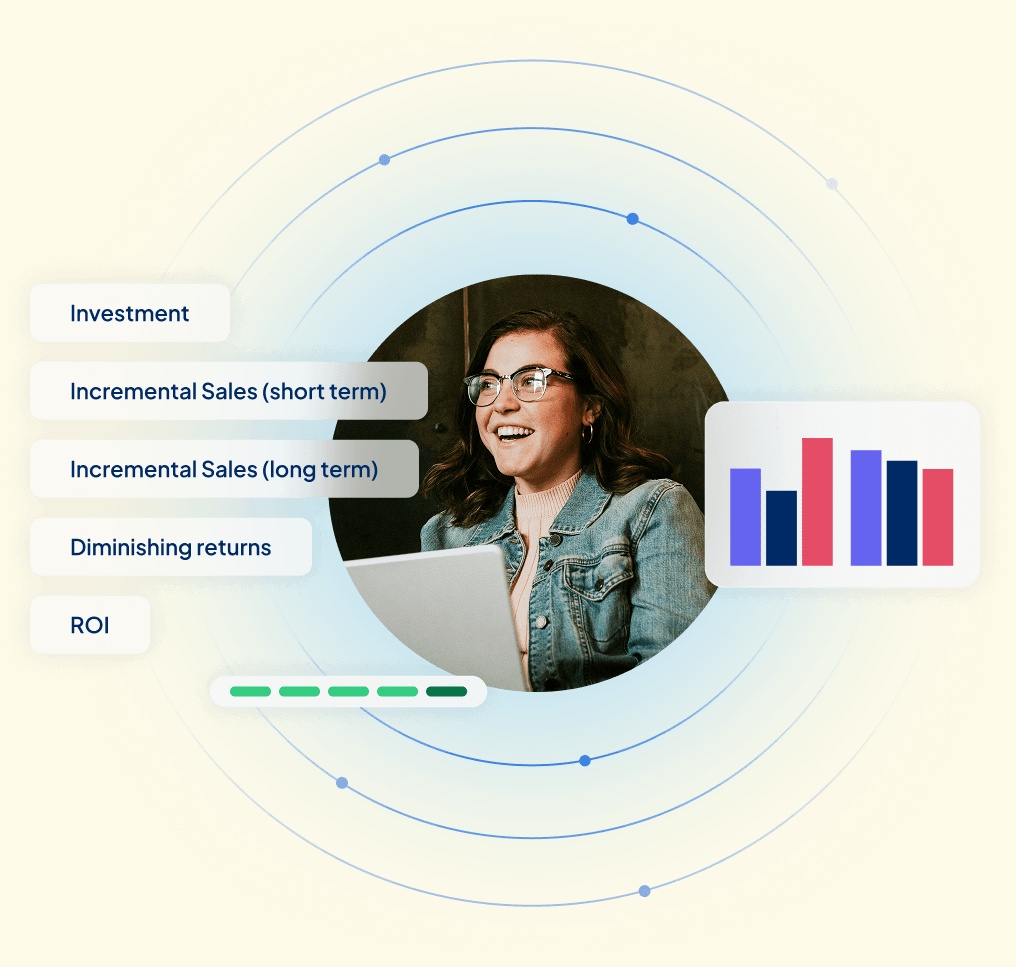
The current product family divides the work into understandable jobs. Keen Measure estimates marketing contribution. Keen Plan develops investment scenarios. Keen OS connects measurement, planning, forecasting and reconciliation. A team sets an objective and constraints, examines the proposed schedule, then compares actual performance with the forecast as fresh data arrives.
Retail media makes that loop particularly useful. Keen’s Walmart Connect integration brings sponsored-search signals into a model that examines effects across retailers. The question is whether an investment helped create additional sales, including outside Walmart. A platform’s own sales attribution and a brand’s total financial result can tell different stories; a broader model gives teams a way to investigate the difference.
A bigger budget can be a rational answer
Optimization does not always mean spending less. Keen describes an unnamed functional-soda brand that began working with it in 2023. The team modeled the upside of larger investments and concentrated activity around significant seasonal and cultural moments. Marketing spending rose from approximately 6.8% to 10.8% of revenue; Keen reports a 75% improvement in profit ROI over 2023-2025.
That is an argument for asking about the cost of opportunity as well as the cost of advertising. It is also a vendor’s account of one customer. The brand’s subsequent acquisition does not establish that software caused the deal. The practical lesson is narrower: put a financial forecast beside the request for more money.
Keen’s own expansion required capital. It announced an $11 million Series B led by Ballast Point Ventures in July 2022, earmarked for product development, awareness and new industry verticals. Its market now includes brands and agencies; named customer examples include Twinings, Perfetti Van Melle and Bob’s Discount Furniture.
The model still needs a human
Keen sells subscription software, with managed services for teams that want someone else to run the process. API access lets customers bring its intelligence into their own systems. In January 2026, Iridio by RRD announced an alliance incorporating Keen’s modeling engine into its measurement offering. Agency expertise remains part of turning recommendations into purchases.
The alternative may be a consultant’s model, an internal analytics team, attribution software or a channel dashboard. Keen’s distinguishing emphasis is the repeated connection between measurement and allocation. Buyers should judge that connection by the decisions it improves, including how well forecasts survive comparison with actual sales.
Inside the company, the calendar has a constraint of its own. Keen advertises a fully remote, four-day workweek and calls its employees “Keenans.” Its careers page pairs that flexibility with explicit expectations around candor, teamwork and accountability. For a business selling better allocation of scarce resources, time is a fitting place to have an opinion.
The operating conditions matter. Teams need usable spend and outcome data, realistic constraints, and authority to change the plan. A model cannot move a contractually fixed budget or replenish an empty shelf. The habit a reader can copy is wonderfully ordinary: write down the expected business result before spending, and schedule the meeting that checks it.