The search ad was doing beautifully. In the accounting of an unnamed North American telecom provider, it appeared to acquire a customer for $26. There is something irresistible about a number like that: small enough to admire, precise enough to stop an argument. Then Marketing Evolution examined the same business across the full funnel. Its model put search’s cost per acquisition at $719. The dashboard had been handing out medals at the finish line.
- Search can capture demand that brand advertising helped create.
- Marketing Evolution combines measurement with marketing data infrastructure.
- Substrate builds the foundation; Darwin lets teams question it.
- The useful habit to borrow: test the explanation before changing the budget.
01 / A cheaper click, a dearer customer
In Marketing Evolution’s published telecom case, the first failure was the assignment of credit. Last-touch attribution rewarded search for arriving just before the purchase. Television and radio, meanwhile, were producing demand without receiving much recognition. Working with agency Mekanism, the team used Marketing Evolution to examine incremental impact. Familiarity campaigns accounted for 44% of media-driven conversions in its analysis.
That finding changed the spending decision. In early 2025, the client halved its Conversion budgets, increased Familiarity investment by 40%, and moved social and display creative toward brand messaging. The company reports 81% more checkouts, 48% more site visits, and 102% more engaged sessions. Those are vendor-reported case results, not a promise about the reader’s next campaign. But the sequence is worth examining: change the explanation of success, then change the purchase of advertising.
The case is also a useful antidote to numerical obedience. Its CPA comparison includes a multiplier that does not agree with the printed dollar figures. The defensible lesson rests on the reported amounts and the spending change. A good measurement story should survive a calculator as well as a sales presentation.
02 / The problem beneath the answer
Marketing Evolution was founded by Rex Briggs, who dates its beginning to 2000 in a published interview. His earlier work had investigated online advertising’s effects beyond clicks, including brand awareness and purchase intent. That interest explains the company better than a list of fashionable technologies. A click is observable. The change in someone’s willingness to buy requires more patient detective work.
The business grew around marketing measurement and optimization. Historical customer references include IBM, MillerCoors, and NBCUniversal. Forrester placed Marketing Evolution among the Leaders in its Q1 2020 evaluation of marketing measurement and optimization solutions. Its constituency is enterprise marketers and their agency and analytics teams: people allocating money across channels that do not conveniently report success in the same language.
In August 2026, CEO Stephen Williams described what that work had forced the company to build. Touchpoints needed connecting. Definitions needed reconciling. Unseen exposure needed estimating. A model could not produce a useful answer merely because someone had assembled a very impressive spreadsheet.
“Every measurement problem exposed a data problem beneath it.”Stephen Williams / August 2026
The company says its Enriched Data technology first entered deployment in 2020, reconstructing missing journeys without cookies or personally identifiable information. The platform later ran in custom enterprise deployments from 2024. By August 2026, that foundation had a public product name: Substrate. The word comes from the layer on which something grows. Marketing software has occasionally indulged in worse metaphors.

03 / Substrate below, Darwin above
Substrate connects paid, owned, earned, CRM, offline, retail, creative, and business data. It standardizes channel names, metrics, and business definitions. This is the portion of the job that rarely gets applause. Yet two systems can both say “conversion” while counting different things, and an AI assistant can repeat the confusion with impeccable manners.
Substrate also reconstructs journeys and generates exposure data where observation is incomplete. It supplies governance, lineage, and validation so teams can inspect how information became an output. The company positions the resulting context as available to warehouses, business intelligence tools, customer data platforms, enterprise applications, and AI agents. Its own interface is one consumer of that foundation.
Darwin is the conversational intelligence application above it. Users can ask about performance, explore investment scenarios, monitor anomalies, and review recommendations. A planner can investigate whether shifting money between channels changes return, audience reach, or the timing of outcomes. That is more interesting than another chart of yesterday’s spend, provided the assumptions beneath the answer remain visible.
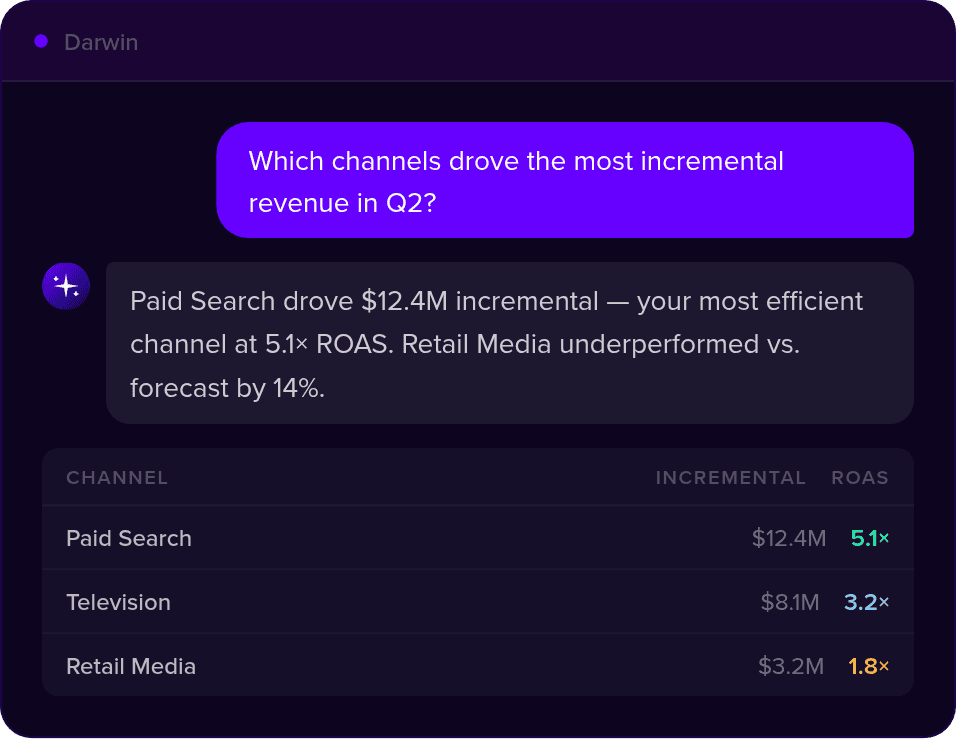
Older pages and marketplace listings call the platform Mevo, separating a Data Platform from a Decision Engine. The current site foregrounds Substrate and Darwin. Reading the two eras together reveals a widening ambition: make the intelligence underneath measurement usable by other applications, rather than reserve it for one screen.
04 / The sale that might never have happened
The methodology describes a discrete-choice framework that combines aggregate signals with optional individual-level data. It models how marketing and external factors affect consumer choices. For attribution, it simulates removing a channel from a journey and estimates the change in purchase probability. In plain language: would this person have bought anyway?
That counterfactual is the basis of the company’s distinction from rule-based credit allocation. It also tries to address the problem of spending more when sales are already rising, which can make advertising appear to cause momentum it merely accompanied. These are model-based estimates. Reconstructed exposure is not a recovered eyewitness account, and calling a method causal does not relieve a buyer of checking its assumptions.
The market has several neighboring answers. Analytic Partners, Ekimetrics, Gain Theory, and Ipsos MMA appeared alongside Marketing Evolution in Forrester’s 2020 evaluation. Connector tools such as Funnel and Supermetrics focus on bringing data together; warehouses such as Snowflake and Databricks supply storage and computing infrastructure. Marketing Evolution’s pitch combines marketing-specific definitions, reconstruction, measurement, and decisions. Buyers should compare the work delivered, rather than award points for the largest pile of overlapping nouns.
05 / What the intelligence costs
This is enterprise SaaS with onboarding and practitioner support. A public AWS Marketplace listing for Mevo Decision Engine specifies a $65,000 base fee for a 12-month contract covering one KPI, plus $15,000 for each additional KPI. Two measured outcomes therefore imply $80,000 under those listed terms. The listing says additional AWS infrastructure costs may apply. It is a price for that offering, not a complete quote for today’s Substrate and Darwin deployment.
One KPI included. Each additional KPI: $15,000.
Investors have funded several versions of the ambition. A $20.6 million Series B in 2018 was led by Insight, with Zetta participating. A $26.1 million growth round followed in 2019. In December 2025, Marketing Evolution announced another Insight-led investment to develop AI-ready data infrastructure. The 2018 round also offered employees an opportunity to sell vested shares: a concrete glimpse of its stated “all in this together” culture, rather than another office-wall adjective.
06 / Borrow the question before the software
The practical starting point is a definition. Decide what business outcome matters, make sure each feed means the same thing by it, and distinguish directly observed activity from modeled activity. Then ask whether a channel created additional demand or merely collected it. These are editorial takeaways from the company’s approach; they are useful even before a procurement meeting.
Next, simulate a constrained change and compare the prediction with what happens after implementation. Keep commercial commitments, audience goals, and brand effects in the discussion. The telecom case supports investigating a different allocation; it does not establish that every advertiser should halve its conversion budget.
Darwin’s product page says it can work with as little as three months of exposure and conversion data and get teams started in six weeks. Those are vendor claims whose suitability depends on the dataset and scope. A business with too little outcome information, unstable definitions, or no ability to act on a recommendation has less to gain. Model-generated journeys also require scrutiny when a market changes sharply. The attractive feature here is the question Marketing Evolution keeps asking: what made the sale possible? Getting that answer right may cost more than counting the final click. Getting it wrong can cost rather more.