Consider a salesperson deciding which product to recommend. The company has a strategy. The customer has a budget. The salesperson has a commission plan. Those three documents may be pointing in three different directions. Before the pitch comes a quieter calculation: what will this deal actually pay? CallidusCloud built software for that calculation, and for the surprisingly complicated organization surrounding it.
- Started with incentive compensation, then expanded into the work around a sale.
- Sold subscriptions to enterprise tools for commissions, quoting, planning, and learning.
- SAP completed its acquisition in April 2018; the core technology continues under SAP names.
The spreadsheet has an opinion
Founded in 1996 by Andrew Swett and Scott Kitayama, Callidus began with enterprise incentive management. That sounds like accounting plumbing. But a commission rule is also an instruction. Pay more for one product, and that product becomes more interesting. Change the quota, and the same sale can acquire a different meaning. The administrative detail is part of the sales strategy.
Its Commissions software handled the design and calculation of incentive payments. Territory and Quota addressed another awkward question: whether a salesperson’s target matched the opportunity in the patch they had been given. These were tools for sales operations and compensation administrators, with consequences for everyone carrying a quota. The ambition was to reduce payout errors and the private calculations salespeople kept to check their employer’s arithmetic.
There is a useful distinction here. A customer relationship management system records the opportunity. Compensation software determines what the opportunity means to the person pursuing it. CallidusCloud’s position was close to that junction, where customer data, management targets, and an employee’s financial interests meet. It made an unglamorous part of selling worth buying software for.
Follow the deal, then follow the money
CallidusCloud called its broader offering “Lead to Money.” The phrase described a sequence: find a prospect, equip the seller, assemble an offer, complete the paperwork, and calculate the reward. Configure, price, quote software, usually shortened to CPQ, helped representatives select valid product combinations and produce priced proposals. Contract lifecycle management extended the process into agreements. Learning and coaching helped prepare the people doing the work.
This was a collection assembled partly through acquisitions. Litmos, acquired in 2011, supplied online learning. In November 2016, CallidusCloud bought Datahug for $13 million in cash, adding predictive forecasting and pipeline analytics. Datahug’s expertise was meant to draw insight from the information already surrounding a deal. The logic was attractive: a company that knew the quote and the incentive might also want to understand whether the opportunity would close.
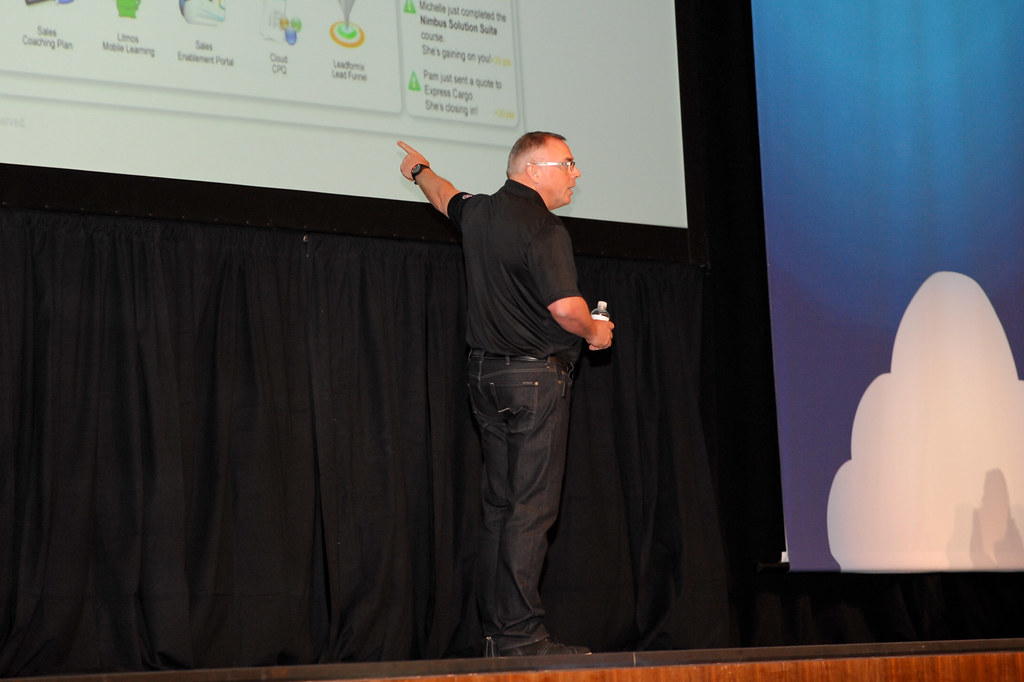
The customers illustrate the range. In 2015, communications provider 8x8 selected Commissions for its direct sales force and channel partners. Vodafone Germany selected the product in 2016. Astute Solutions chose CPQ, contract management, and electronic signature capabilities. These announcements establish purchases, rather than independently measured results. They also reveal the buying problem: selling through several people, products, or channels creates rules that somebody must reconcile.
- 01PlanTerritory + quota
- 02QuoteProducts + price
- 03RewardCredits + commissions
The cloud switch had a bill
Under CEO Leslie Stretch, the business moved toward recurring subscriptions. Customers typically bought annual SaaS contracts, sometimes multiyear agreements, alongside implementation and other services. By 2017, CallidusCloud had stopped selling its on-premise commissions software. That change replaced the old combination of license fees and maintenance with a different revenue rhythm. It also required customers to make a migration decision.
SaaS revenue out of $253.1m total revenue
The transition produced growth and friction together. Full-year 2017 revenue reached $253.1 million, including $198.2 million of SaaS revenue, up 31%. Yet maintenance revenue fell as customers converted, and global data-center investment contributed to pressure on margins. Overall gross margin slipped from 62% to 61%. This was no costless change of vocabulary. Moving delivery into the cloud changed the economics of the supplier as well as the customer’s installation.
There is a practical lesson for anyone copying the strategy. Find a recurring operational problem, then earn permission to handle the adjacent steps. A commission calculation supplies a concrete reason to buy. Quoting, planning, and forecasting offer reasons to expand. But a larger catalogue alone does not prove that customers want everything. Each additional product must justify another implementation, another integration, and another claim on the customer’s attention.
The partner became the buyer
SAP had already worked with CallidusCloud before the acquisition. An OEM agreement announced in January 2017 focused on integrating Commissions, CPQ, and contract management with SAP applications. The companies were testing a commercial proposition before combining ownership: could the sales workflow connect more closely to the enterprise systems behind it?
“SAP is connecting the back office to the front office”
Bill McDermott · SAP CEO · January 2018
That was how SAP CEO Bill McDermott described the acquisition’s purpose. Announced in January 2018 and completed on April 5, the transaction paid shareholders $36 per share. The announced enterprise value was approximately $2.4 billion; the figure including net cash was approximately $2.5 billion. The distinction matters. These were acquisition measures, not a venture funding round or a software subscription price.
CallidusCloud occupied a crowded market. Its historical competitors included Oracle, IBM, Xactly, and customers’ own internally developed systems. Its argument rested on the breadth of the sales workflow and its connections to enterprise data. SAP brought a larger distribution system and a place beside the financial back office. The existing partnership helps explain the deal without requiring a dramatic conversion story.
The name changes. The calculation stays.
Today, SAP describes CallidusCloud’s solutions as part of its SuccessFactors and Sales Cloud portfolios. The inheritance has not remained intact: SAP sold Litmos to Francisco Partners in December 2022. In explaining that decision, Litmos acknowledged overlap with SAP’s existing products. A broad suite can gain distribution through an acquisition and still contain pieces that fit better elsewhere.
For buyers, continuity also has a price beyond the contract. SAP’s guidance says moving legacy Callidus Commissions customers to its HANA-based incentive solution involves reimplementation. Data, rules, and workflows need attention. A small team with simple commissions may struggle to justify that machinery. A complicated organization with agreed rules and reliable transaction data has a clearer reason to consider it. Software can calculate a compensation policy; the organization still has to decide what behavior deserves a reward.