At Chargebee, the first week of the month had acquired a peculiar purpose. The operations team gathered data, worked through spreadsheets and calculated commissions for more than 300 salespeople. Then came the explanations. A paycheck had arrived, but its meaning still required a meeting.
- Everstage calculates commissions and gives sellers a view of earnings and possible future payouts.
- Its customers include Chargebee, Postman, Wiley, Trimble and Notion.
- Planning and quoting joined the product line in 2025, connecting more of the decisions behind a payout.
Chargebee’s commission specialist, Shivaranjani K, described a calendar packed with calls across geographies. There were 50 commission plans, each with at least four components. Reps had fewer than three days to validate their numbers. The arithmetic could be correct and the experience could still be miserable. Imagine receiving a restaurant bill that required an appointment with the chef.
This is the useful way into Everstage. Its subject is sales compensation, an enterprise software category with all the glamour of a filing cabinet. Its underlying problem is personal: a company asks people to chase incentives they cannot readily inspect.
The operator who knew the chore
Siva Rajamani had been head of global revenue operations at Freshworks. He and CTO Vivek Suriyamoorthy founded Everstage in 2020. The founding motivation, as Rajamani describes it, came from frustration with the work itself. Revenue operations teams had responsibilities that stretched across systems, while the tools left too much calculation and explanation in their hands.
By the seed-funded launch in 2021, Postman and Chargebee were already customers. That matters more than an abstract origin story. The early product was being asked to cope with companies whose sales organizations were growing, whose plans were changing, and whose administrators could not simply spend another week maintaining formulas.

What failed was the monthly restart
Postman’s customer story describes a process that seemed to begin again every month. Administrators manually pulled CRM data, generated reports and shared payout information. New hires brought ramp periods and fresh plan assignments. The spreadsheet had become a recurring reconstruction project.
Everstage’s Incentives product gives administrators a no-code environment for commission rules, calculations, statements and approval workflows. At Postman, Salesforce integration removed manual data pulls and let sellers inspect commissions inside their CRM. At Chargebee, a DocuSign integration also brought contract distribution and signature tracking into the process.
The published results are striking, provided they keep their proper labels. Chargebee’s case study reports calculations running 16 times faster and payout queries falling 98%. Postman’s reports 95% less processing time and 99.5% commission accuracy while commissionable headcount grew 300%. These are customer stories published by the vendor, rather than experiments establishing what every buyer will achieve.
Chargebee case study
Postman case study
A forecast with a personal audience
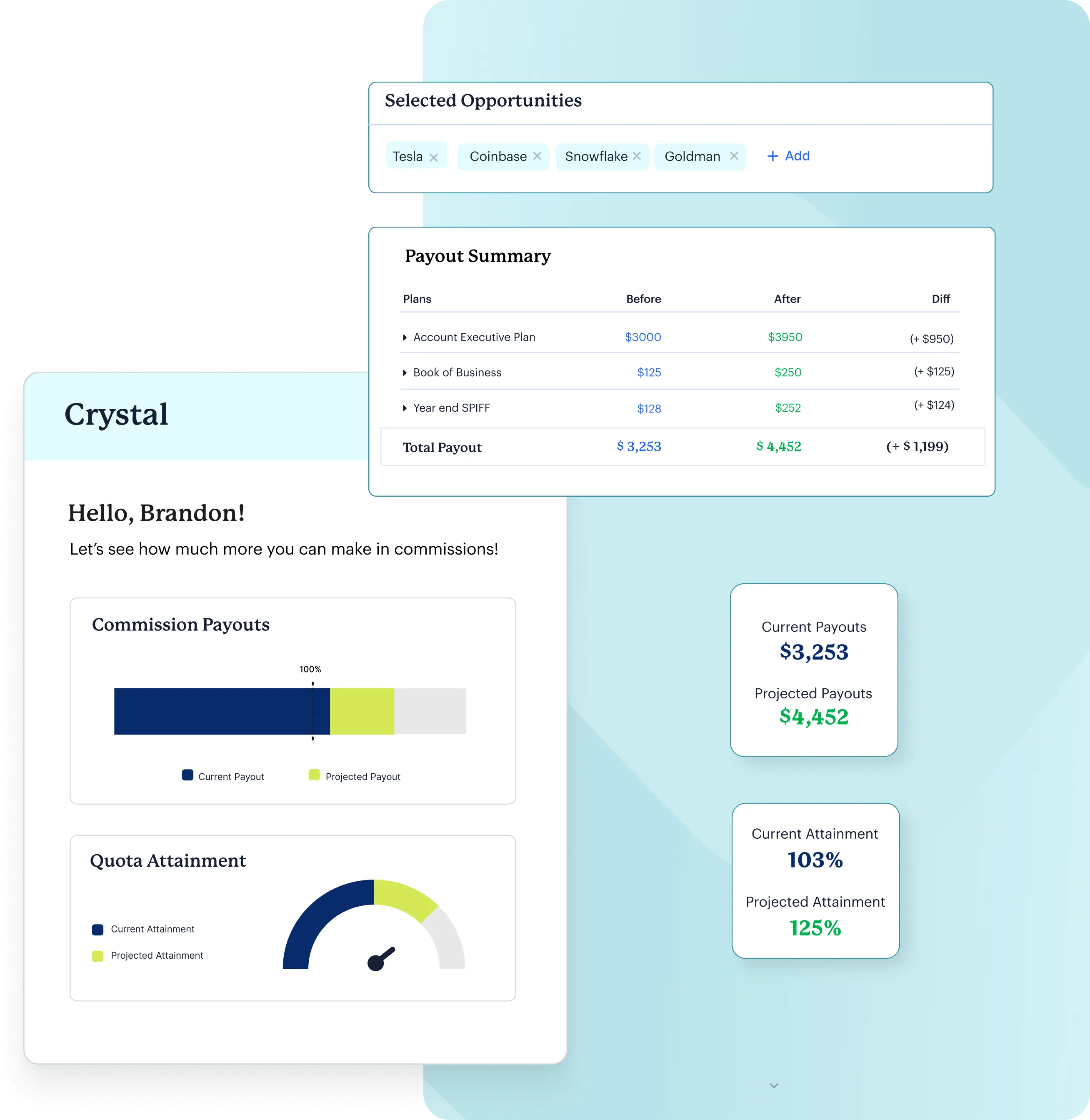
The more distinctive feature is Crystal, Everstage’s commission forecasting module. A seller can explore what a pipeline deal would mean for earnings before it closes. Change the deal structure, examine the effect, and decide what to pursue. The incentive moves closer to the moment when a decision is made.
“Without seeing what you’re getting, it’s hard to sell more.”Kyle Russell, Postman’s Senior Leader of RevOps
Consider the difference between a statement and a forecast. A statement explains yesterday. A forecast can influence tomorrow. At Postman, reps used Crystal to inspect scenarios involving multi-year deals and accelerators. That is a much more concrete proposition than exhorting a team to be motivated.
Following the paycheck backward
In June 2025, Everstage launched Planning, covering territories, quotas and sales capacity. Those choices determine who gets which opportunity and what counts as success. Connecting them to compensation lets teams model financial consequences while making the plan.
Agent Core followed in August. Its initial assistants covered Salesforce data preparation, explanations of commission calculations, payee onboarding and routing administrative queries. The practical question for those assistants is whether they can save an operator another round of preparation or give a rep an explanation that survives scrutiny.
October brought CPQ: configure, price, quote software. Everstage’s version combines pricing rules, margin guardrails and collaborative DealRooms with visibility into commission impact. The company is reaching upstream from the payout to the quote that produces it. A discount is a decision about margin; it may also be a decision about the seller’s earnings.
By October 2025, Everstage reported more than 300 customers across four continents. In July 2026, it announced placement as a Challenger in Gartner’s sales performance management Magic Quadrant. That provides a useful market signal, though a buyer still has to inspect the product against the particular rules that govern their own payroll.
The bill, and the test before it
Everstage sells annual software subscriptions, priced per commission payee. Its dedicated pricing page separates the license, annual enterprise support and a one-time implementation fee; selected capabilities are add-ons. Buyers receive a custom quote. The sensible comparison includes the hours already spent reconciling numbers and answering questions.
The company raised $1.7 million in seed funding, $13 million in Series A funding and a $30 million Series B led by Eight Roads in October 2024. The capital supported product expansion and in-house professional services. The latter is revealing: a calculation engine still needs people who understand the customer’s plans.
Alternatives include Xactly, Varicent, CaptivateIQ and Salesforce Spiff, as well as the spreadsheet already on someone’s desktop. Everstage emphasizes administrator control, plan simulation and seller visibility. Those are useful buying criteria; they deserve a demonstration using actual rules.
The company offers a proof of concept using real plans and data. Bring a split-credit deal, a clawback and an accelerator boundary. Check the result against a known payout. For a small team with a simple plan, extra software may add little. For any team, disputed rules and inaccurate inputs still require human decisions. The lesson worth copying is modest: make the money understandable before asking it to change behavior.