A musician’s wrist is an unlikely starting point for a business that now deals in stablecoins, corporate AI and private-market investments. Yet one of Brinc’s formative bets was Soundbrenner, a startup making a wearable metronome. Its founder, Florian Simmendinger, brought the pitch to life with musicians playing in the audience. Years later, Brinc chief executive Manav Gupta still remembered the performance. The product had a beat. The business needed a route to market.
That second problem has become Brinc’s territory. The Hong Kong company helps founders find capital, expertise and organizations willing to try their products. It also works from the other end of the table, helping corporations and governments find startups suited to particular needs. Between those two groups sits a great deal of screening, introductions and follow-through. Brinc has built its business in that middle space.
Today it calls itself a venture accelerator and private-market innovation platform. Those descriptions can make the work sound more abstract than it is. A hotel group wants less waste. A payments business wants a useful stablecoin application. A founder wants someone with purchasing authority to take a meeting. Brinc’s proposition is to make those interests meet, then give the resulting project some structure.
The factory would not take the order
Founded in 2014 by Gupta, Bashar Aboudaoud and Bay McLaughlin, Brinc began with connected hardware. Its early geography mattered: Hong Kong, Shenzhen and Guangzhou put founders close to design, manufacturing and supply-chain expertise. Gupta had previously built a mobile technology company in Guangzhou and seen the support gaps facing entrepreneurs.
At Brinc’s public launch in 2015, Gupta described startups struggling to find manufacturers willing to entertain small orders. It was an awkward commercial mismatch. A young company needed a first production run; a factory needed an order worth its trouble. An introduction to the right production partner could therefore matter more than another pitch workshop.
Soundbrenner made the problem tangible. The Berlin-born team moved to Hong Kong, where Brinc helped it work through manufacturing preparation, software and its business model. In contemporary reporting, Simmendinger described the difficulty of finding European help to design a device and manufacture 10,000 units. The issue was the distance between a working idea and repeatable production.
That history is useful when judging Brinc’s present offer. Its claim to relevance starts with helping founders navigate practical obstacles outside their own expertise. The tools and sectors have changed. The need for someone who knows which door to knock on has survived.
An accelerator outgrows its label
One early problem was Brinc’s own explanation of itself. In his 2017 review, Gupta wrote that the business had been building communities, developing products and driving sales, but “we had failed to present ourselves correctly.” He described reorganizing its offering so founders could understand the support available at different stages.
He also recorded a change in investment thinking. Enterprise demand was becoming more attractive, and Brinc’s portfolio had moved toward an approximately even split between enterprise and consumer businesses. With hardware becoming easier to build, the software and services running on top of it offered another opening. In drone programs, for example, Brinc could back applications using existing aircraft.
“we had failed to present ourselves correctly”
Manav Gupta, reflecting on Brinc’s positioning in 2017
The lesson is refreshingly mundane: a company can do useful work while explaining it badly. Brinc’s response was to reorganize the offer around the founder’s changing needs. Its acquisition of the Enter China community that year also made peer education and relationships part of the proposition.
The $130 million headline has two compartments
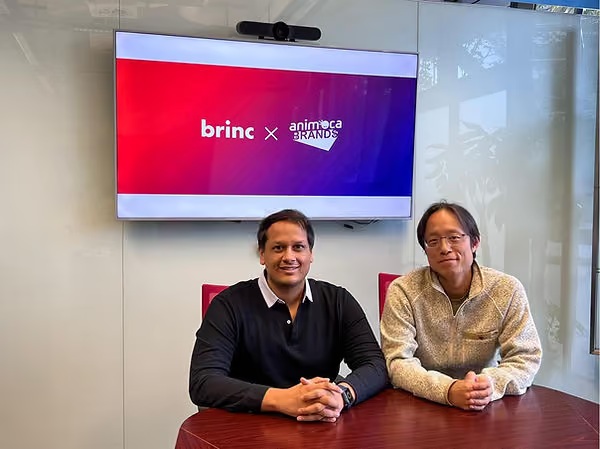
The next conspicuous turn came in December 2021. Animoca Brands led a financing announcement totaling $130 million. Inside that number were a $30 million Series B for Brinc and another $100 million for investments in startups. Calling the whole sum Brinc’s corporate fundraising obscures what the money was intended to do.
Two destinations for capital. One $130 million announcement.
The funding supported international expansion and new blockchain programs, including work in gaming, data and decentralized finance. The relationship had developed over years: Gupta told Tatler that Yat Siu, Animoca’s co-founder, had personally invested in teams emerging from Brinc’s original Internet of Things accelerator. Introductions eventually became a larger institutional relationship.
More recently, Brinc has organized its investor proposition around companies with traction, from pre-seed through Series A, with an emphasis on founders addressing emerging markets. It works with accredited investors and partner firms on co-investment opportunities. Investors are therefore another audience for the company’s ability to find and evaluate young businesses.
That puts Brinc across several markets: startup acceleration, venture investing and corporate innovation services. A founder comparing alternatives might look at Techstars for a structured accelerator or HAX for specialist hard-tech development. The useful comparison is the actual program, its terms and its relevant expertise. An accelerator’s name alone says little about what a particular team will receive.
Read the offer before buying the access
Brinc’s Octopus x IDA Web3 Accelerator Cohort 2 illustrates how specific that decision can become. The published offer is a virtual, 12-week sprint focused on stablecoin use cases and enterprise proofs of concept. Its stated program fee is $40,000. Rebates or subsidies depend on eligibility; the page flags reimbursement of up to 75 percent for eligible Cyberport CASP incubatees.
The economic question is whether the program can advance a commercial objective worth that expense. A team building cross-border payments may value access to payment operators, infrastructure partners and pilot support. A startup whose product has little connection to those partners has less reason to pay for the same room.
A different Brinc program, developed with Ripple for financial applications on the XRP Ledger, offers potential non-dilutive grants. Admission does not guarantee funding: grant applications undergo a separate review, with awards generally tied to milestones. The program combines online work with an in-person Hong Kong Demo Day. Its page listed applications as closed when reviewed for this profile.
These distinctions are the business model in miniature. Brinc provides services, runs partner programs and participates in investment activity. Depending on the program, the relationship may involve fees, investment or advisory interests. Its North American FAIR Data accelerator, announced in Toronto in July 2025, described funding in exchange for equity or token warrants. There is no single Brinc deal to compare against every other accelerator.
A hotel kitchen makes the pitch less abstract
Rosewood Seeds provides a different route in. The 2026 program, powered by Rosewood Foundation and Brinc with support from Rosewood Hotel Group, is free to apply. Applications close September 14. Eight selected startups are scheduled to pitch in late October, with cash prizes of $10,000, $5,000 and $3,000.
The brief extends across hospitality’s food and beverage operations: food waste, packaging, supply chains, agriculture and circular use of resources. The organizers say their earlier review of more than 100 startups exposed a recurring problem: promising solutions were often too locally confined and lacked the industry access to expand. Here the sought-after introduction is to people who understand hotel operations.
Participation does not guarantee a pilot or investment. That qualification helps define the offer honestly. A founder gets an opportunity to test the fit with an industry, while the hotel business gets a closer look at possible solutions. Both sides still have a commercial decision to make.
- 01Name the operational problem
- 02Find a startup that can address it
- 03Agree what a useful test would prove
- 04Decide whether to buy, invest or stop
An editorial reading of the program model: each step needs its own decision.
The meeting is only the beginning
Brinc reports more than 260 portfolio companies and over 75 programs run. Its partner examples include technology scouting for PepsiCo and acceleration with NEOM. Those relationships illustrate the range of buyers for its services, from companies looking for intellectual property to institutions seeking new businesses and local capabilities.
Founder accounts offer a closer view of the intended outcome. In a testimonial published by Brinc, Aitonomi chief executive Torsten Scholl credits the program with helping finalize a NEOM pilot and begin production in Saudi Arabia. Autobia’s Emad Dagheri describes help establishing a presence in the UAE. These are company-selected testimonials, but they identify concrete jobs: arrange a trial, enter a jurisdiction, reach a new market.
The newer Brinc Lab offer takes the implementation theme inside organizations. It proposes connecting business systems, documents and institutional knowledge, then deploying AI into workflows. Data residency, governance and organizational control feature in the offer. That places part of Brinc’s business alongside enterprise implementation providers, serving customers who need systems to work after the workshop ends.
For founders, the repeatable lesson is to specify the missing piece before joining a program. Write down the customer, production milestone or market-entry decision that the next three months must advance. Ask who will own that work, how access becomes a test and what happens after the cohort finishes. A pilot with no internal sponsor or purchasing route can consume time without establishing demand.
Brinc’s evolving founder platform, VentureVerse, adds community, tools and roadshows to that work. The company announced its acquisition of OG Club and launch of the VentureVerse community in September 2025. It is another attempt to keep relationships useful beyond a fixed program calendar. Whether through a factory introduction or a hotel trial, the test remains concrete: what can the founder do next that was previously out of reach?