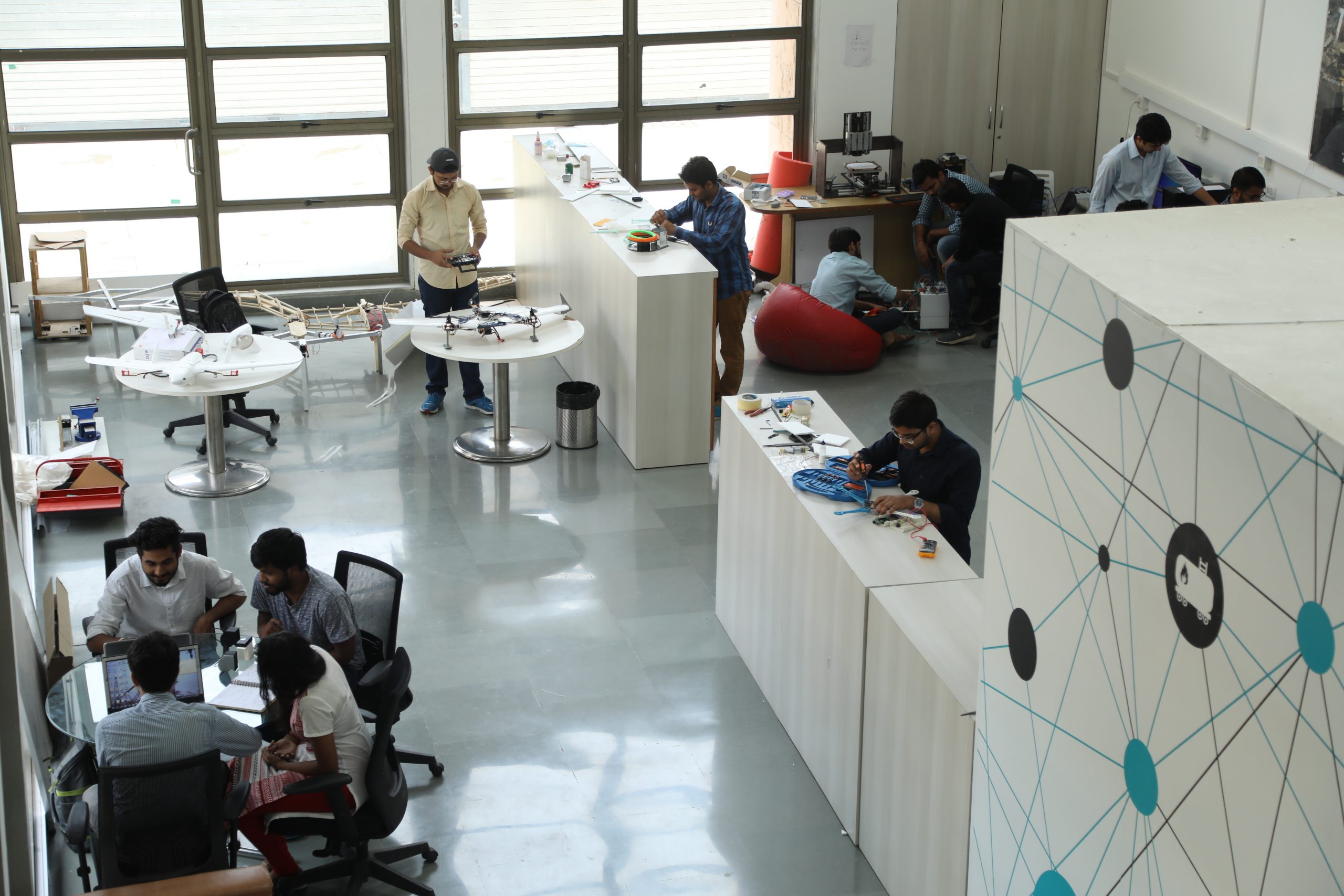
The usual accelerator can feel like a very tasteful airport lounge: fast Wi-Fi, plentiful coffee, ambitious strangers and no obvious machinery. At iCreate, outside Ahmedabad, there is machinery. Founders can walk from a mentoring session into a fabrication lab, turn a model into a part and discover - sometimes rudely - whether physics agrees with the pitch deck.
That physicality explains the institution better than its long name, the International Centre for Entrepreneurship and Technology. iCreate is a nonprofit technology business incubator set up through the Gujarat Foundation for Entrepreneurial Excellence, a 50:50 public-private venture between state-owned Gujarat Mineral Development Corporation and the nonprofit Gujarat Entrepreneurship and Venture Promotion Foundation. The government brought infrastructure and funding. Corporate leaders, technical experts and mentors were meant to bring market discipline.
The result is a home for companies whose products must do awkward things in the real world: manage an electric-vehicle battery, inspect a solar plant, assess fruit with near-infrared light, fly without GPS or survive an industrial buyer's procurement process. iCreate also supports software ventures, but its defining constituency is the deep-tech founder stranded between a university bench and a purchase order.
A campus designed for expensive mistakes
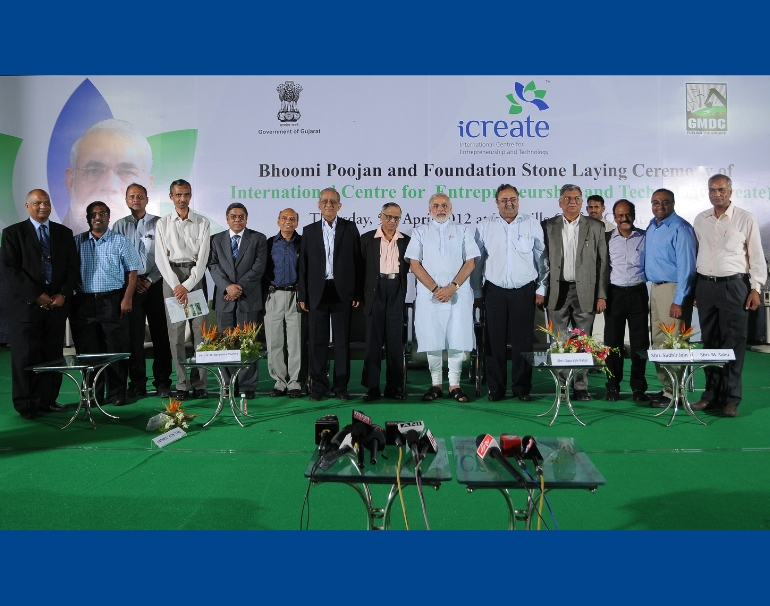
iCreate began as a legal entity in 2011 and started operating in 2012. Its seven-member founding team included academics, technologists and professionals led by figures such as the late N. V. Vasani and Madhu Kumar Mehta. The idea drew political backing from Narendra Modi, then Gujarat's chief minister, and guidance from Infosys co-founder N. R. Narayana Murthy. In 2018, Modi and Israeli Prime Minister Benjamin Netanyahu formally dedicated the Dev Dholera campus.

The campus can accommodate about 100 incubatees and includes offices, project rooms, residential and dining facilities, a 200-seat auditorium, classrooms and seminar halls. Its practical center is iLab, a rapid-prototyping facility designated as a PRAYAS Shala under India's Department of Science and Technology, with support from Gujarat, Cisco and SolidWorks. Nearby sits an IoT-enabled lab established with Cisco.
Why build all this? Because hardware punishes optimism slowly and invoices it promptly. A product can fail at enclosure tolerances, thermal management, certification, component sourcing or maintenance long after a clever demo succeeds. Shared tools and experienced technical review let a young company make those discoveries before ordering a production run. The mistake still hurts. It simply hurts at prototype scale.
“We follow what we call a ‘High-touch, Entrepreneur-first’ approach.”iCreate, describing its incubation model
First, make the assumption confess
The organization's product is not office space. It is a sequence. An idea-stage founder can enter through the iCreate Idea Catalyst and examine the value proposition and innovation potential. A prototype-stage team can use iLab and the Pro-Fund Gateway. A company approaching market can join the four-week Seed Stage Accelerator, where mentors force its projections into contact with customers, suppliers and channel partners. Later programs prepare ventures for grants, investment and scale.
What fails first in this model is supposed to be an assumption, not the company. The accelerator begins by defining the customer and the value delivered, then asks founders to validate their projected numbers in actual conversations. Evidence can trigger a pivot. This is what changes minds: not a mentor's charisma, but a buyer declining to pay, a supplier revising a quote or a test showing that the product does not perform as promised.
It is a useful discipline to copy. Write down the three beliefs that must be true for the business to work. Attach a cheap test and a deadline to each one. Interview the person who controls the budget, not only the person who likes the idea. Price the bill of materials before polishing the brand. And treat an early “no” as information purchased at a discount.
What the runway actually costs
iCreate's published prices and funding paths are unusually concrete in places. Its four-week Seed Stage Accelerator lists a fee of ₹40,000. The student-focused Spark-up Idea Fund can provide up to ₹50,000. Graduates of the accelerator may pitch through the Pro-Fund Gateway for grants up to ₹10 lakh and investments up to ₹40 lakh, subject to selection and the terms of the underlying government or institutional scheme.
Other challenges assemble their own pots. Uber's 2021 Green Mobility Innovation Challenge committed ₹75 lakh across five winners, plus mentoring and incubation. The 2025 iCreate Drone Challenge advertised a ₹2 crore pool and a fully sponsored residential prototype program. More than 500 applicants from 26 states and Union Territories competed; 14 startups entered the 30-day sprint and demonstrated systems ranging from GPS-denied navigation to rare-earth-free propulsion in February 2026.
The customer has two name badges
iCreate serves founders, but it also sells usefulness to large institutions. Corporates bring technical or operational problems; startups bring speed and unfamiliar solutions. Government agencies bring grants, missions and public priorities. Research bodies bring equipment and scientific depth. iCreate plays translator, helping a young company turn its invention into a pilot that an established organization can understand, evaluate and perhaps buy.
That is the logic behind partnerships with Cisco, Uber, the Council of Scientific and Industrial Research, Sona Comstar, Israel's Start-Up Nation Central and Technion. A 2022 agreement with CSIR gave promising startups potential access to national laboratories, scientists and intellectual-property assistance. In electric mobility, iCreate, Sona Comstar and Israel's IRP Systems worked on a motor and controller designed without rare-earth materials.
The visible alumni make the case. Charge+Zone, an EV-charging company incubated by iCreate, secured venture funding and a ₹2,250 crore memorandum with Gujarat to expand charging infrastructure. The portfolio also includes Bioscan Research in medical screening, Photom Technologies in solar-plant maintenance, Drone Nation in agricultural drones and The Solar Labs in solar design software. They do not share a customer. They share the unpleasant requirement that technology work beyond a demo.
The global bridge gets measurable
International partnerships have been part of iCreate's identity since a Technion delegation visited in 2012. The strongest programs try to move beyond ceremonial memoranda. The India Israel Innovation Accelerator was structured around adapting technologies and business models between the two markets. In June 2026, iCreate and the Hauts-de-France Regional Council announced a bilateral deep-tech corridor covering health, climate, agriculture, food, e-mobility, aerospace, defense and physical AI.
The French corridor comes with a useful scoreboard: support more than 12 startups pursuing cross-border expansion, facilitate at least three joint pilots and launch a bilateral cohort over 18 months. Those are modest numbers, which is precisely why they are credible. Internationalization is not an airport selfie; it is a regulatory review, an industrial trial and a local customer willing to answer the phone.
Best fit
A technically capable team with defensible IP, a real industry problem, patience for testing and enough openness to let customer evidence rewrite the plan.
Poor fit
A founder seeking quick capital without validation, a generic service business, or a team unwilling to disclose assumptions, build technical depth or meet a program's residency rules.
This model will not work everywhere. A lightweight consumer app may gain little from a 40-acre campus. A rural founder unable to relocate cannot benefit equally from residential labs, though hybrid programs help. Public funding brings eligibility rules and slower decisions. Corporate challenges can tempt teams toward bespoke consulting instead of a repeatable product. And no incubator can manufacture founder integrity, technical competence or customer demand.
Still, iCreate occupies a valuable part of India's startup market. It sits after inspiration but before industrial scale, where prototypes need equipment, intellectual property needs protection and founders need someone willing to ask impolite questions about unit economics. Compared with university-linked incubators such as IIMA Ventures, national platforms such as T-Hub and specialist deep-tech centers such as Venture Center, iCreate's personality is unusually physical, government-connected and internationally wired.
The institution reports 952 startups supported, more than 140 patents by those startups, 1,611 jobs and 1,559 events. Such cumulative counts cannot tell you which companies will survive. They do show the scale of the experiment. The better measure comes later: a tested component, a signed pilot, a factory order. At iCreate, the founder eventually has to leave the lounge and build the thing.