A potato can survive the harvest and still lose the argument. In storage, rot, moisture and temperature threaten the value a grower has spent months producing. Cellar Insights, a Calgary startup, built remote monitoring to spot trouble early. In January 2026, SVG Ventures | THRIVE announced a $500,000 investment. The revealing detail was what happened before the check.
- THRIVE connects agrifood startups with capital, corporate partners and potential customers.
- Kagome’s Sunrise partnership adds a $50 million fund and places to validate inventions.
- The current Canadian accelerator is free, takes no participation equity and considers investment separately.
SVG first encountered Cellar Insights through its Alberta accelerator. It kept watching as the company validated its technology and expanded deployments. A commercial potato operation in Manitoba became a testing ground. The sequence matters: relationship, observation, evidence, investment. A founder’s promise acquired something more persuasive than another adjective.
“That continued progress is what ultimately led us to invest through the Pioneer Fund.”John Cassidy, Managing Director Canada
A potato pile makes the case
That sequence helps explain this company. SVG Ventures invests; THRIVE is its innovation platform. Together, they work on an awkward problem in food and agriculture: a clever invention needs somewhere to prove itself and someone with a reason to buy it. The distance between those two things can swallow a startup.
Founder and CEO John Hartnett arrived with technology operating experience, including an executive role at Palm. THRIVE’s platform dates to 2014. Its contemporary investment strategy favors capital-efficient, scalable businesses, proprietary technology and B2B or platform models. The territory stretches from farming and nutrition to water, energy and industrial life sciences. This is specialized venture investing with a commercialization apparatus attached.
The introduction business
Consider the audience. Founders need customers, mentors and investors. Corporate innovation teams need to sort promising technologies from a noisy supply of pitches. Economic development agencies want businesses that can grow in their regions. THRIVE serves these overlapping groups through investing, startup development, scouting, research and market access.
SVG says its network includes more than 50 corporate partners. THRIVE’s 2026 announcements describe a community exceeding 15,000 startups across more than 100 countries. That is a network count, not a portfolio count. The useful question is what a connection can become: a demonstration, a pilot, a commercial conversation or a separately negotiated investment.
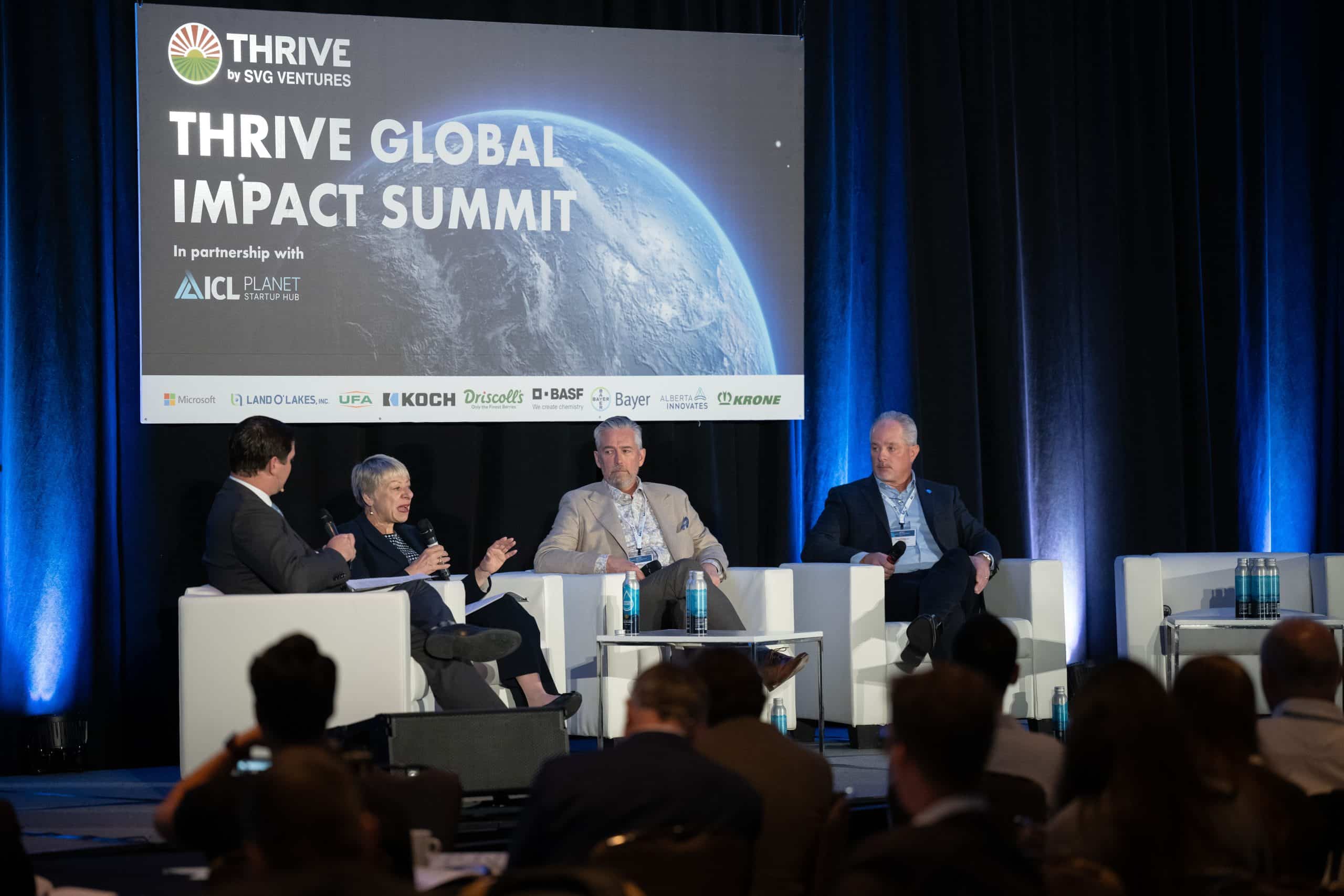
On the corporate side, THRIVE offers innovation assessments, strategic research, startup scouting and industry collaboration. Its partners include names such as Taylor Farms, Driscoll’s and Land O’Lakes. Those relationships give founders a route toward people who understand procurement and production. For a corporate team, the service is a filter and a set of introductions shaped around its priorities.
The business model combines fund management with corporate and institutional services and sponsored programs. Kagome uses SVG as the general partner of its corporate venture fund. Farm Credit Canada supports the Canadian accelerator. Different participants pay for different functions; a founder receiving free program support is not receiving a promise of free investment capital.
A tomato company buys time
The clearest expression of the model appeared in September 2024. Kagome, the Japanese food company associated with tomato products, partnered with SVG to establish the Sunrise Agri Fund: $50 million under management, a ten-year horizon and typical initial investments of $500,000 to $1 million, with follow-on reserves.
Fund capital under management
Kagome’s announcement identified heat, drought and crop disease as pressures on its value chain. Its existing operations, including Ingomar Packing Company and United Genetics Seed Company, would help validate and implement technologies. The attraction is practical: an investor brings capital and startup selection; an industrial partner brings operating knowledge and places where a solution can encounter reality.
In September 2025, Sunrise announced an investment in EF Polymer, an Okinawa company making biodegradable, plant-derived water-retention polymers. The intended work included commercialization and supply-chain access. A fund concerned with agricultural resilience had found a product aimed directly at water scarcity. The investment amount was not part of the announcement.
Keep the pipes. Change the intelligence.
Another investment makes the adoption problem unusually legible. Verdi retrofits automation onto existing irrigation infrastructure. Its pitch acknowledges that a farm already contains equipment, habits and sunk costs. Replacing the whole arrangement can make an otherwise appealing technology difficult to adopt.
SVG led Verdi’s C$6.5 million seed round announced in May 2025. Verdi reported serving more than 5,000 North American acres and saving customers over 100 million liters of water during 2024. Those are company-reported results, not universal forecasts. The broader lesson is easy to copy: understand the customer’s existing system before designing its replacement.
THRIVE has company in this market. AgFunder pairs sector investing with intelligence and community, and its GROW platform supports startups. The Yield Lab operates regional agrifood funds. THRIVE’s recognizable combination is corporate scouting, founder programs, cross-border expansion and fund investment within one organization. A founder should compare the actual buyer access and terms each offers.
What a founder can actually use
THRIVE’s programs track different kinds of readiness. Studio supports researchers and early ideas; Academy addresses pre-seed validation; Accelerator develops commercial connections; Immersion and scaleup programs help with expansion. Choosing the right stage matters more than acquiring another badge for a pitch deck.
- 01 / StudioValidate an idea
- 02 / AcademyPrepare the business
- 03 / AcceleratorMeet customers
- 04 / ImmersionEnter new markets
The current Canada V Accelerator offers a concrete proposition: no participation fee and no equity taken for joining. Farm Credit Canada funds the program. Participants use a scaling assessment, mentorship and THRIVE Connector to pursue relationships. Investment through Pioneer or Sunrise remains a case-by-case decision. Companies should arrive with traction and be ready to demonstrate, rather than test their first MVP.
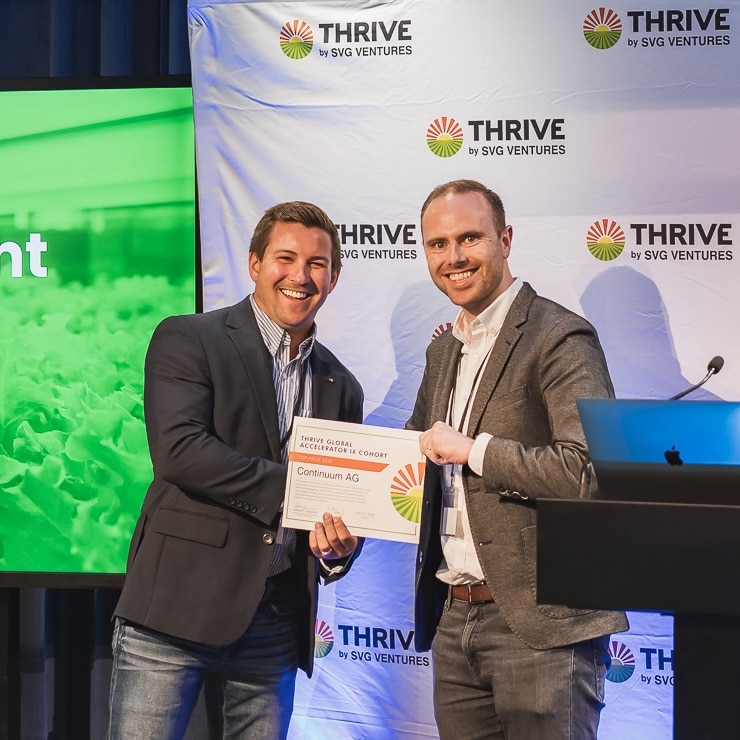
Market access also has a timetable. In June 2026, THRIVE and Innovate UK selected eight companies for nine months of US expansion support and two California visits. September brought a JETRO partnership for Japanese agtech founders. Both address the difficulty of carrying a domestic business into unfamiliar buying networks.
For a founder, the useful preparation is specific: name the buyer, define what a pilot should establish and show how adoption fits the buyer’s operation. THRIVE can help create that conversation. A company unable to demonstrate its product or pursue introductions would have less to gain from a connections-focused program. The potato pile remains a useful standard. What improves when the technology arrives?
Follow the work
Explore THRIVE · Canada program · Pioneer Fund · Sunrise Fund