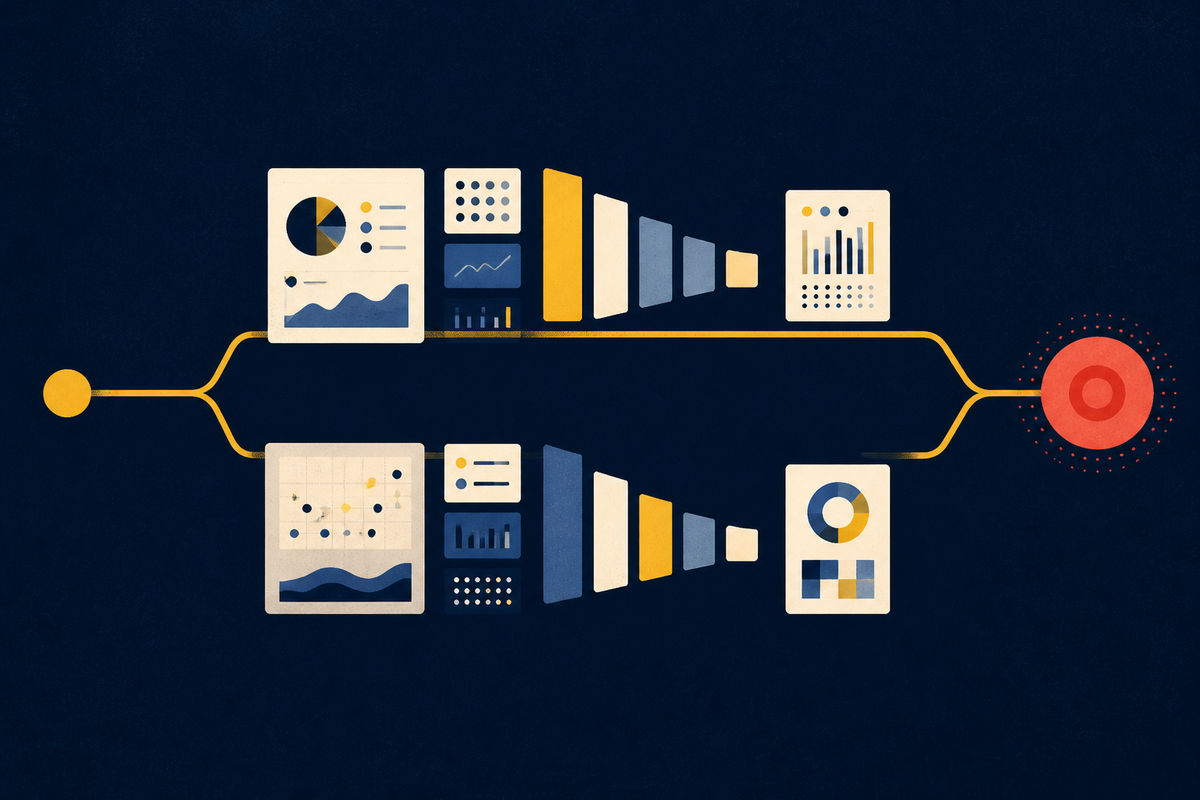
There is a particular kind of silence in a growth meeting when two dashboards show two conversion rates. The lifecycle team opens Braze. The product team opens Amplitude. Both charts look polished. Both analysts can explain their filters. Nobody in the room knows which number goes into the weekly memo.
That silence will become more common as customer-engagement platforms absorb more analytics. Braze now puts campaign and Canvas performance, funnel drop-off, retention impact, conversion lift and variant analysis close to the journey builder. For a marketer deciding whether to change a message, path or wait step, this is sensible product design. The answer sits beside the controls.
Amplitude approaches the same customer from a wider angle. Its funnels can use ordered, exact-order or any-order sequences, with behavioral segments, event properties and cohorts. Its retention work can span product actions that began before a message and continue long after a Canvas ends. Feed Braze events into Amplitude through Currents and the overlap becomes visible: each platform can draw a plausible funnel from the same campaign.
A dashboard should own a decision, not a department.YesPress analysis
The overlap is useful until someone calls it truth
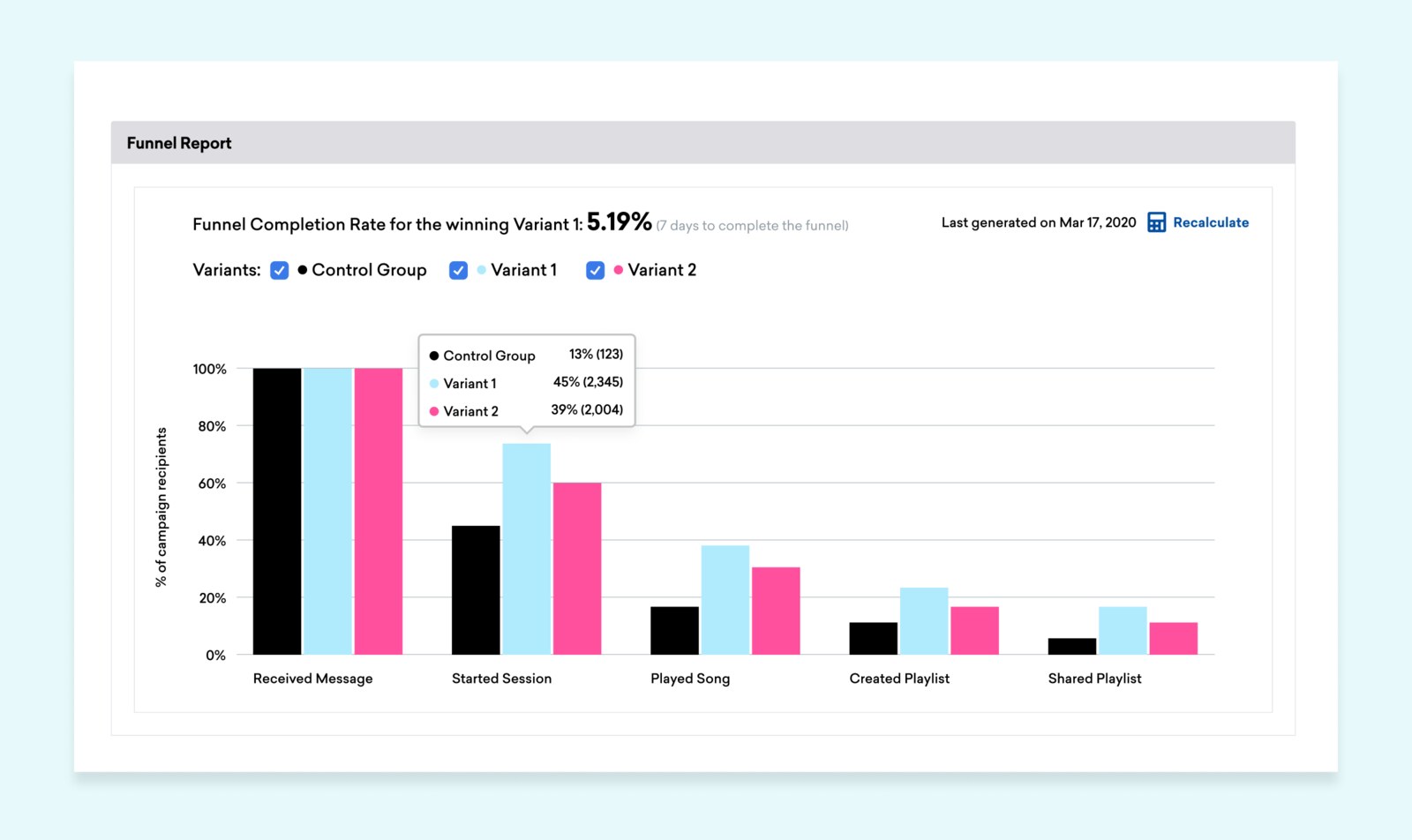
Braze has offered funnel reporting since 2020 and retention reporting since 2022. Its own documentation describes Funnel Reports as a way to see what users do after a campaign or after entering a Canvas. Steps can include receiving a message, starting a session, viewing a product and making a purchase. Retention Reports add rolling and range views of whether people return after a campaign or journey.
Those are meaningful analytical jobs. They are also bounded by a marketer's intervention. The natural population is often people who entered a Canvas or received a message. The natural clock starts around campaign exposure. The practical question is whether the journey produced the behavior it was designed to produce.
Amplitude's natural unit is an event stream across the product. A team can compare exposed and unexposed cohorts, follow behavior across surfaces, change the funnel order, exclude users who performed another event, or inspect retention using starting and returning actions. Its question is usually broader: what behavior predicts activation, conversion or continued value?
A Canvas conversion rate and a product conversion rate may therefore disagree without either calculation being broken. They can have different denominators, entry rules, identity coverage, attribution windows, event arrival times and time zones. Braze may ask what share of eligible Canvas entrants converted within a campaign window. Amplitude may ask what share of all new users completed the same named action within a product window. The labels resemble each other. The populations do not.
Braze owns the journey
Delivery, sends, variants, Canvas steps, immediate conversion and changes a lifecycle marketer can make today.
Amplitude owns the product
Cross-surface funnels, long-lived cohorts, product retention and comparisons that extend beyond one campaign.
The model owns the metric
Executive KPIs, finance-linked outcomes and definitions that must remain stable across tools and quarters.
Give each system a jurisdiction
The clean operating model has three layers. Braze is the operational view for campaign health. Amplitude is the exploratory view for product and growth behavior. A governed semantic layer, often in the warehouse, settles executive metrics that must reconcile with revenue, finance or board reporting.
This division protects speed. A lifecycle marketer should not wait for a data model change to see whether an email variant is failing or a Canvas branch is leaking users. Braze is close to message delivery and journey configuration, so it can answer those questions with less friction. The team can inspect the result and change the intervention in one working session.
The same convenience should not quietly redefine company retention. Product retention may include behavior untouched by the campaign. It may need identity stitching across devices, account-level grouping, historical cohorts or a stable definition used by several teams. Amplitude is designed for that exploration. A warehouse model can then freeze the approved logic when the number becomes financially or organizationally consequential.
The bars illustrate scope, not measured performance. Wider scope adds identity, history and cross-functional governance requirements.
This is also a permissions decision. The person who can edit a Canvas should know which Braze metric authorizes a change. The product analyst should know which Amplitude chart is approved for a launch review. The data owner should know which modeled metric appears in the executive packet. If every dashboard can settle every argument, authority defaults to whoever presents first.
The contract that keeps both dashboards honest
Braze and Amplitude support a bidirectional relationship. Amplitude cohorts can move into Braze for targeting. Braze engagement events can move back into Amplitude through Currents for analysis alongside product behavior. The Tapping Solution has publicly described this loop: build audiences in Amplitude, use them in a Canvas, then send journey data back for visualization.
That loop is only as trustworthy as its identity contract. Amplitude's Braze integration documentation says the Amplitude user ID must match the Braze external ID for identified users. Anonymous users require aligned device IDs. Events also count toward Amplitude volume quotas, and connector problems can create delays or loss. A dashboard disagreement may begin in plumbing long before an analyst chooses a chart.
Teams should write one measurement contract for every important metric. It can fit on a page. Name the eligible population, qualifying event, identity key, clock start, conversion window, time zone, exclusions, late-arrival policy and owner. Then attach the exact Braze and Amplitude implementations. If the implementations differ, document why.
- Population: Canvas entrants, message recipients, new users, active users or accounts?
- Identity: Which external user ID, device ID or account key joins the event stream?
- Event: Does purchase mean an initiated checkout, a completed order or recognized revenue?
- Window: When does the clock start, when does it stop and which time zone applies?
- Owner: Which team can change the definition, and which system settles the decision?
Run a small reconciliation suite after instrumentation changes. Select a fixed cohort, a fixed date range and a handful of durable events. Compare counts at each boundary: Braze generation, Currents export, Amplitude ingestion and final chart. Expect explainable differences. Investigate unexplained ones. This is cheaper than debating a quarterly retention slide after it has reached leadership.
What teams can steal on Monday
Start with a decision inventory, not a dashboard inventory. List the recurring questions in growth, product and executive meetings. Beside each one, name the owner and the system that resolves it. “Which Canvas variant should ship?” belongs to Braze. “Did exposed users form a healthier product habit?” belongs to Amplitude. “Did retained customer revenue improve?” belongs to the governed business model.
Next, change the language in meetings. Ban the naked phrase “conversion rate.” Require a compact label such as “Canvas-entry to purchase, seven-day window” or “new-user signup to first value, fourteen-day window.” The extra words expose differences before the charts do.
Finally, resist forced sameness. Braze can report a strong lift among people reached by a journey while Amplitude shows flat retention across the whole product. That combination can be valuable. Perhaps the campaign works but reaches too few users. Perhaps it moves a short-term action without creating a durable habit. Two scopes can reveal the gap between local optimization and company outcome.
The destination is not one universal dashboard. It is a stack in which every consequential question has one accepted resolver, every difference has an explanation and every operator can act without reopening the constitution of the data. Braze and Amplitude can both be right. They just cannot both have the final word on the same decision.
Frequently asked questions
Should Braze or Amplitude be the source of truth?
Use Braze for Canvas delivery and campaign optimization. Use Amplitude or a governed warehouse model for cross-product behavioral and executive metrics.
Why can their funnel results differ?
Common causes include different populations, identity rules, event definitions, attribution windows, ordering rules, time zones and delayed events.
Can Braze data be analyzed in Amplitude?
Yes. Braze Currents can send engagement events to Amplitude, subject to access, matching IDs, quotas and rate limits.
When is Braze reporting the better choice?
When the decision concerns a specific campaign or Canvas, including delivery, variant results, immediate conversion and journey drop-off.
When is Amplitude the better choice?
When behavior crosses campaigns and product surfaces, or the analysis needs flexible cohorts and longer-lived retention.